Chinese stocks romped into bull market territory on Monday after President Donald Trump said he would delay a rise in US tariffs on Chinese goods, taking gains since the start of the year to more than 20 per cent and making China the world’s best-performing equity market.
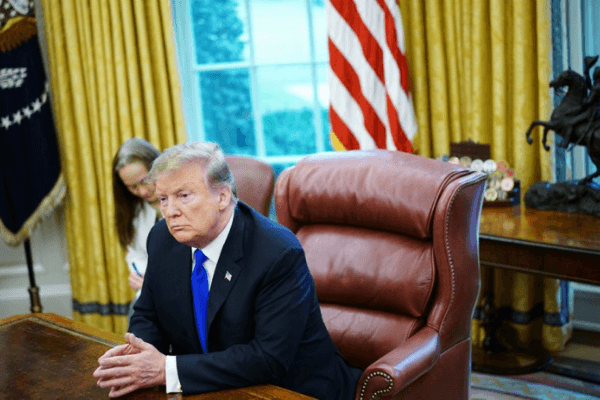
After months of trade tensions between Washington and Beijing, Mr Trump said on Sunday that the White House would postpone the increase in tariffs on $200bn of Chinese imports set to take effect March 1, citing “substantial progress” in trade talks.
The announcement on Twitter sent China’s CSI 300 index of companies listed in Shanghai and Shenzhen up by 5.9 per cent on Monday, its best one-day gain in more than three years.
The CSI 300 has advanced over 25 per cent since early January, moving into a bull market by the definition of a 20 per cent rally from a recent trough. The index has rebounded 16.5 per cent in February alone, putting it on track for its best month since April 2015.

European stock markets rose after the Asia rally, although at a slower pace. Frankfurt’s Xetra Dax 30 gained 0.6 per cent, with the region-wide Stoxx 600 up 0.2 per cent.
In New York, the S&P 500 rose 0.6 per cent in opening trade. The Wall Street benchmark closed at its highest level since November on Friday, while Germany’s Xetra Dax rose 1.4 per cent over the course of last week, on hopes of progress in the negotiations.
This year’s performance for Chinese stocks is a sharp reversal of fortune after they fell into bear market territory last year as the worst-performing equity market globally.
Investors said last year’s slump had left the market looking attractively valued. “Everybody went into 2018 loving China, and then it went down 20 per cent,” said Mark Tinker, head of Asia equities at Axa Investment Managers.
“We’ve come into this year and it’s up over 20 per cent; companies have strong fundamentals, and valuations are looking more attractive,” he said, adding that sentiment also has been brightened by the thawing trade tension.

China’s onshore renminbi hit its strongest point since July on Monday, climbing as much as 0.6 per cent to Rmb6.6718 per US dollar. The currency weakened by nearly 6 per cent in 2018.
Last year, Mr Trump blasted “China, the EU and others [for] manipulating their currencies and interest rates lower”, while the US Treasury secretary warned China not to engage in competitive devaluations of the renminbi against a backdrop of escalating trade tension.
The currency’s recovery and attractive stock prices have sparked strong flows into Chinese equities in 2019.
Overseas investors pumped a record $9bn into Chinese stocks in January, the largest single-month inflow on record. Analysts said the announcement by the US Federal Reserve of a shift away from monetary tightening, damping the short-term prospect of an increase in interest rates, provided broad support for emerging market equities.
“Markets are happy,” said Cliff Tan, East Asian head of global markets research at MUFG. “We’re looking at a scenario where markets are thinking the trade war could be completely over in the first quarter, which gets us back to where we might have been end of 2017. Markets are acting like the conflict is almost solved.”
Hannah Anderson, global market strategist at JPMorgan Asset Management, said: “One of the biggest factors driving sentiment upwards is the government easing measures” and the prospect of increased liquidity.
President Xi Jinping was also said to have emphasised the development of China’s financial sector in comments reported by state media on Saturday. Financials led the charge among CSI 300 stocks on Monday.
The rebound in Chinese equities comes as the market prepares for global index provider MSCI to announce potentially at the end of this week that it will increase the weighting of Chinese stocks in its flagship EM index, which is tracked by about $1.9tn of assets globally.