|
Getting your Trinity Audio player ready...
|
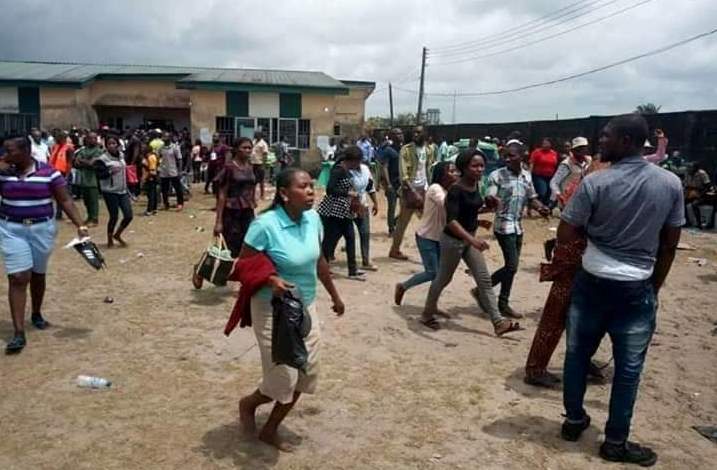
At 2.25pm on Saturday, a group of gun-wielding ballot snatchers stormed a polling station at Ajao Estate, Airport Road, Lagos, shot sporadically in the air and destroyed all the sensitive and non-sensitive materials for Booth 006.
Frightened voters and INEC officials scampered for safety, ending people’s hope of electing their choice of leaders in that area. Several voters were injured in the melee and they vowed not to vote again.
“I will not die because I am trying to vote in people to occupy public offices,” Nkechi Emelonu, one of the voters, told a BusinessDay correspondent who monitored the election in the estate.
“After spending three hours in the sun with my baby on my back, it is hard to swallow that I couldn’t vote and the votes before me would not count,” the 36-year-old mother of two said.
Also, at Ago Palace Way, Okota, Lagos, young men said to belong to Oodua People’s Congress (OPC) stormed polling stations in the area and set sensitive materials ablaze. One Ademola, said to be the leader of the group, was mobbed while another person was murdered in cold blood for political reasons.
The electoral violence in parts of Lagos, Rivers, Ekiti and across the country on February 23 shows that Nigeria is still struggling with democracy while desperate politicians prey on hopeless youths to advance their selfish ends.

Nigeria harbours over 350 million (or 70 percent) of estimated 500 million illicit small arms and light weapons circulating in West Africa, according to reports. Most of these weapons find their way into the hands of non-state actors, posing serious threat to both the existence of the country and lives and property of citizens.
“With the 2019 elections less than a year away, Nigeria’s ability to hold free and fair elections is open to question. Of particular concern are the security threats posed by the Boko Haram insurgency and clashes between farmers and herdsmen in northern Nigeria. There is also a threat posed by the arming of rival political supporters. Finally, there is the lack of election financing regulations which leaves the door open for patronage networks to fund campaigns using public funds,” Olayinka Ajala, associate lecturer and conflict analyst, University of York, said in a June 2018 article.
“The proliferation of arms prior to elections also remains a huge threat. Since the 2003 elections, the arming of supporters has become an election tool,” he said.
Sixteen Nigerians were killed on Saturday across the country, according to the Situation Room, a network of civil society organisations.
Like Nigeria, the Senegalese are casting their votes in a presidential poll at the moment, but no violence, killings or maiming has been reported so far.
Nine people, including a soldier, were killed in Rivers State in an election marred by blood, tears and sorrow. Mowan Etete, a former aide to Governor Nyesom Wike of Rivers State, was murdered, among several supporters of the two main parties.

The Nigeria police said on Saturday that three people were killed in Kogi. One person was killed in Ekiti State, as ballot papers and other sensitive materials, including INEC office, were burnt in Osun State.
“The politicians in Nigeria have over the years become more desperate and daring in taking and retaining power; more reckless and greedy in their use and abuse of power; and more intolerant of opposition, criticism and efforts at replacing them,” Anthony Egobueze and Callistus Ojirika, analysts at Rivers State House of Assembly, Port Harcourt, said.
Democracy is defined as government of the people, by the people and for the people. On Saturday, thugs and party supporters threatened and forced voters to thumbprint for their parties while the security agencies looked away, BusinessDay found in Lagos.
Nigerians are becoming poorer, with 8,000 citizens jumping into the extreme poverty train on a daily basis, according to Brookings Institution.
With 87 million Nigerians living below the $1.90 baseline, almost one out every two national (44 percent) lives in extreme poverty.
Incidentally, India, which is second in the poverty pedestal, has 57 million people that are extremely poor, representing just 4.4 percent of its 1.3 billion population.
The GDP only grew by 1.9 percent in 2018, with misery index sitting at 34.4 percent. General unemployment is 23.1 percent, but youth unemployment is over 60 percent.
“Many youths have no job, so politicians only need to dole out few wads of cash to woo them,” Matthew Ibe, a managing director at MD Services Limited, a general and manufacturing services firm, said.
“Nigeria has to wipe out high poverty rate to make headway,” Akpan Ekpo, professor of Economics and Public Policy and immediate past director general, West African Institute for Financial and Economic Management, said at a breakfast meeting in Lagos.
“Even its GDP needs to grow 10 percent or more and sustain it for 15 years to reduce such poverty,” he added.
Before the election, party supporters went from home to home identifying with the voters and, in some cases, dishing out veiled threats. A senior politician in Lagos told an ethnic group that their votes would be monitored last Saturday.
Nigeria has been an uninterrupted democracy since 1999, but it is replete with violent elections and killings by thugs.
“If we wish to reduce election violence, we must begin to reduce the rate at which we handle physical materials,” Samuel Oyigbo, a lawyer, said.
“INEC needs to improve. Arriving late with sensitive materials, like they did on Saturday, endangers the lives of voters,” he added.
He explained that Brazil, India and many other countries with similar characteristics with Nigeria have adopted electronic voting and Africa’s biggest democracy must not be left out.
“There is no way we can have democracy if we do not have free and fair elections,” Odinaka Okeke, an Awka-based lawyer, told BusinessDay.
“The impression that politicians give their supporters must change. Young people must also stop being gullible,” he added.
ODINAKA ANUDU