|
Getting your Trinity Audio player ready...
|
The US plans to significantly increase its troop numbers in Poland as the Trump administration ratchets up its engagement in central Europe, according to the country’s ambassador to Warsaw.
Alarmed by Russia’s growing assertiveness, Polish officials have been lobbying hard to persuade the US to establish a permanent military base in their country, and last year offered to provide up to $2bn towards funding it.
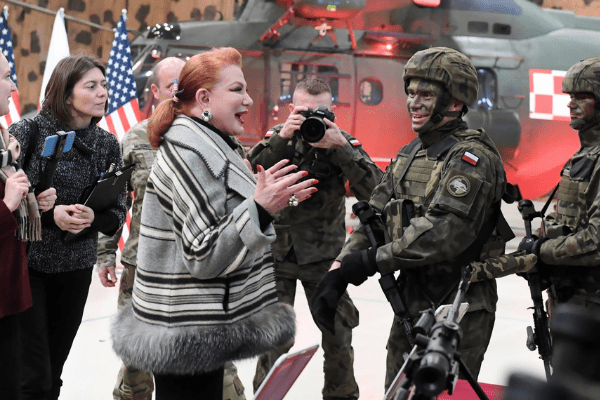
Georgette Mosbacher, who took office as US ambassador to Warsaw last year, said America’s 4,000-strong troop presence in Poland would increase but stopped short of saying a permanent base would be established.
“The Department of Defense sees [the forces of the 21st century] as . . . more agile, more rotating, rather than where you have physical hospitals and homes and you bring your families,” she said in an interview with the Financial Times.

“But in terms of a presence that is undeniable and a large number of American troops here, that’s a given. And I think [the Poles are] going to get most of what they want.”
Asked whether the increase would run into the hundreds or thousands, Ms Mosbacher said: “It will be significant. It passes the hundred mark, the hundreds mark.”
Ms Mosbacher’s comments come as Washington launches a diplomatic push in central Europe, where US officials are concerned that Russia and China have established a foothold in recent years.
On Monday Ms Mosbacher — a friend of US president Donald Trump and former chief executive of cosmetics group Borghese — hosted colleagues from US embassies in 12 EU capitals to discuss how the US could support the Three Seas Initiative, a forum dreamt up by Poland and Croatia to promote central European economic integration.
Meanwhile, Mike Pompeo, US secretary of state, launched a tour of the region with a visit to Budapest in which he pledged to try to prevent central European states from falling into the orbit of Moscow or Beijing.

In recent weeks, the US has expressed concern about the influence of Chinese telecoms company Huawei in the region, seeing it as a potential conduit for Chinese intelligence services to snoop on host countries. Huawei strongly denies it is vulnerable to such interference.
Gordon Sondland, US ambassador to the EU, who was in Warsaw for the Three Seas talks, said it would be hard for the US to co-operate with countries using Huawei’s technology. He urged those that already did so to rethink if they wanted to continue working closely with the US.
“5G [mobile] is the game changer . . . and given that it’s the game-changer . . . even if a country has a significant investment today in Huawei 4G or below, it would probably behove them to look at starting with a clean sheet of paper with western technology,” Mr Sondland said.
Mr Pompeo visited Slovakia on Tuesday and will attend this week’s Middle East conference in Warsaw co-hosted by Poland and the US.
In the latest sign of the growing links between Washington and Warsaw, Poland will on Wednesday sign a $414m contract with the US for mobile rocket launchers.
Ms Mosbacher said Poland’s willingness to play its part in bolstering Europe’s defences was central to the strength of US-Polish relations.
“The Poles are an important ally. They are investing their 2 per cent [of GDP in defence] without even coaxing. They’re well into a $40bn modernisation of their military. We respect that,” she said, contrasting Poland with those states that did not meet Nato’s spending target.
“We’ve asked [other states] to step up and do some burden-sharing to 2 per cent of their GDP and they’re whining about it. But the Poles aren’t. And that doesn’t go unnoticed. So when it comes to an enduring presence here, I think they will be rewarded.”