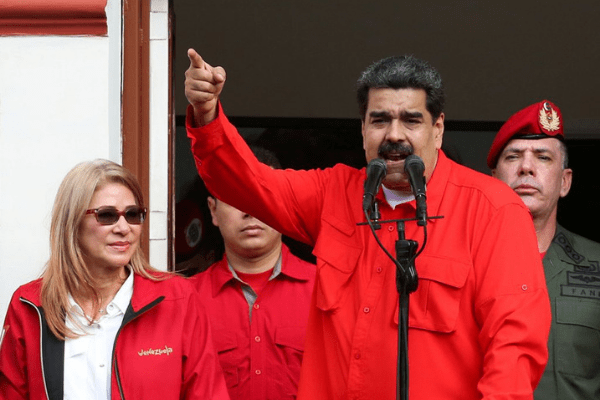
The Venezuelan opposition and its international allies are preparing convoys of humanitarian aid for delivery into the crisis-wracked country as early as this week, potentially sparking a border confrontation with forces loyal to President Nicolás Maduro.
Canada pledged $40m of aid on Monday, Germany has earmarked €5m while the US has already promised $20m. Over the weekend, Mark Green, head of USAID, posted on social media photographs of boxes of food being readied for delivery, each labelled with a US flag.
Mr Maduro has dismissed offers of international aid as a pretext for military intervention. The opposition’s allies counter they are responding to calls from opposition leader Juan Guaidó, recognised by most of the hemisphere and Europe as Venezuela’s legitimate, interim president.
“The time for democratic transition in Venezuela is now,” Justin Trudeau, the Canadian prime minister, said.

In Caracas, Mr Guaidó implored the military to let the aid through, when it is finally shipped.
“You would be on the right side of the constitution, and humanity, and you would also help your family,” he said on Monday. “Will you reject that? If you have doubts, just ask your family. We continue to hope for your support. Your moment is now.”
The opposition’s aim is to expose divisions in the military, which has continued to support Mr Maduro even as rank-and-file soldiers go hungry in a country wracked by shortages and hyperinflation.
“It’s a very unusual situation. Maduro does not want the aid. Guaidó and his allies want to deliver it. What we don’t know is who will deliver it,” said Diego Arria, an opposition leader and former UN diplomat. “My feeling is if they [the military] let the aid in, that will be the end. I think the military will let it through.”
The need for aid is dire given what David Lipton, deputy head of the International Monetary Fund, has called Venezuela’s “unprecedented perfect storm” of food and nutrition crises, protracted hyperinflation, loss of capital and complex debt problems.

More than 3m migrants have left the country since 2014 and many have arrived in neighbouring countries emaciated. In Venezuela, as many as 300,000 people are in mortal danger for lack of basic medicines, according to Mr Guaidó.
Adding to the crunch are punitive financial sanctions the Trump administration launched last week against state-owned oil company PDVSA, effectively the country’s sole industry.
Oil production could halve to 600,000 barrels a day, from 1.2m bpd in December, if sanctions remain throughout 2019, said Francisco Monaldi, a Venezuelan oil expert at Rice University.
The timing and mechanics of aid delivery are unclear. Most aid is expected from the Colombian border town of Cúcuta, with more distributed from across the Brazilian border and from the Caribbean, perhaps the islands of Aruba or Puerto Rico.
Guillermo Botero, Colombia’s defence minister, said that aid could be ready to ship by the end of this week, with Colombian police in charge of co-ordinating deliveries, when Mr Guaidó authorises them. Colombia, Brazil and the US are understood to be leading the effort.
“Military & police leaders in Venezuela must now decide to either help food & medicine reach people, or help Maduro instead,” Marco Rubio, the Republican senator for Florida, tweeted.
The aid is part of a strategy by the opposition and the US aimed at getting the military to switch sides, leading to free elections and a peaceful transition. Mr Guaidó has already sought to win over the military by offering amnesty to those who supported Mr Maduro.
In one sign the approach may be working, mass opposition protests passed on Saturday without any reported repression, arrests or deaths by security forces.
Nonetheless, delivering aid across the border is high risk. Any border incident could escalate internationally given that Mr Maduro is supported by Russia, China, Turkey and Cuba.
“The army will stand by to defend the sovereignty of Venezuela,” said Freddy Bernal, a senior government official, in a social media video posted on Sunday night from a guard post on border town of San Antonio.
Videos posted on social media also showed what appeared to be convoys of armoured cars rumbling through San Antonio’s streets.
Complicating the picture and adding to the possible sources of violence is the ELN, a Colombian guerrilla group that operates on the 2,200km border, and armed gangs of Venezuela government-supported thugs, called colectivos, that Mr Maduro has deployed in the past to quell dissent.
“The best way to organise the delivery of aid should be based on a “Gandhian” way of politics, in which people are empowered to help bring solutions to the people themselves,” Luis Almagro, the head of the Organization of American States told the Financial Times. It is “the people [who will] make it impossible for the army or the Bolivarian guards to resist”.