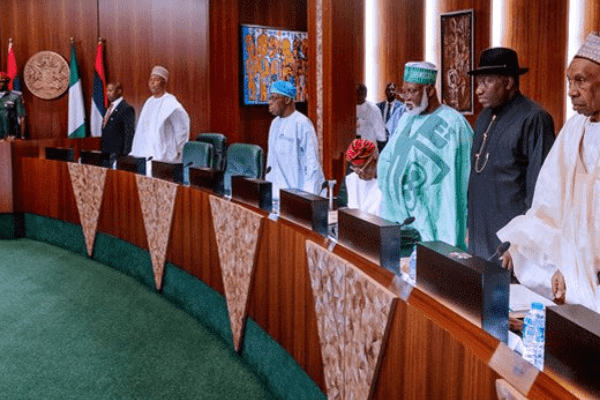
The Federal Government is set to finally transmit the National Minimum Wage Bill to the National Assembly today for consideration and legislative approval after the National Council of State in Abuja approved N27,000 as the new minimum wage for the country.
Organised labour has, however, rejected the N27,000 recommendation, insisting that the Council of State lacked jurisdiction to determine another amount after the minimum wage tripartite committee set up by the Federal Government had submitted its report. The tripartite committee sat for almost a year before recommending N30,000.
Council of State, which met on Tuesday, agreed to N27,000, representing an increase of about 50 percent from the existing N18,000. The N18,000 minimum wage was signed into effect in 2011 by former President Goodluck Jonathan, raising the wage from the previous N7,500.
Chris Ngige, minister of labour and employment, who briefed State House correspondents on the outcome of the Council’s meeting at the Presidential Villa, said in consonance with the fact that the issues of national minimum wage prescription are in the exclusive list, second schedule, item 34, it is not a job that can be done by the executive alone.
“The president has to transmit the bill to the National Assembly and the National Assembly will take legislative action and return the bill that has been so treated to the president for his assent.
“So, a bill will now be transmitted to the National Assembly that will amend the 1981 Act and 2011 Act. The highlight is what you want to know. The figure of N27,000 monthly has been approved for transmission to the National Assembly. The frequency of the review of the bill is five years, to get it in consonance with pension law of the federation as enshrined in the constitution.
According to Ngige, the council took into consideration the recommendations of the tripartite committee but reminded the President of Federal Government’s proposal of N24,000 and the governors’ proposal of N22,700 before arriving at the decision.
The minister however explained that organisations employing less than 25 workers were exempted from the current minimum wage.
“Exemptions to this bill will be establishments that are not employing people up to the number of 25. The various times prescribed have also been altered in the bill and will be sent to the National Assembly before the close of work tomorrow (Wednesday).”
When reminded on labour’s insistence on N30,000 as the minimum wage, Ngige, noted that the N27,000 approved for onward transmission to the National Assembly was the lowest adding that organisations and states with resources can pay more
“Labour should understand that this is the minimum below which no one can go. So, organisations and states with the resources can pay more.”
The minister also revealed that “Federal government has resolved to pay its workers N30,000.”
Ngige noted further that the decision to peg the minimum wage at N27,000 came out of consideration of current economic realities, adding that “we are aware that not every state can afford to pay N30,000 as minimum wage.”
Rotimi Akeredolu, governor of Ondo State, who spoke with newsmen, said the Council also endorsed the election plans as put forward by the Independent National Electoral Commission (INEC) following briefing received by its chairman, Mahmoud Yakubu.
“Council was briefed by the INEC chairman and the briefing as accepted by everybody was lucid and clear. It was all encompassing. The INEC chairman took the council through all the processes that are going to be followed at the national and state elections.”
He disclosed that INEC briefed Council on its preparedness for the election, adding that everybody in the council was convinced that INEC was ready for this election.
“That convinced all of us that this forthcoming election would be free and fair and then the way we see it. They have improved card readers, the details of what have been done to improve it was made known.
“I think that all of us in the hall have heard that look, whatever it is, we have now listened t the chairman of INEC and we are convinced that they are prepared for the election. I am not sure any other person will come out to talk about INEC any longer. The point has been made; all of us now have our hands on deck to ensure success because without our participation, without our cooperation, INEC itself cannot be successful.”
Yakubu had informed the Council that all the necessary ballot boxes and everything to be used were ready, including changes made to the ballot boxes.
“He also informed us that rather using collapsible ballot boxes, they are going to use framed ballot boxes, transparent ones because we have lost so many and a lot have been purchased.
Peter Ozo-Eson, the General Secretary of the Nigeria Labour Congress (NLC) said the government was only projecting the shutdown of the economy by its latest action and workers should not be held responsible for action after its National Executive Council (NEC) meeting on Friday.
The NLC’s position has been backed by a statement from the Trade Union Congress of Nigeria (TUC) jointly signed by Bobboi Kaigama and Musa Lawal, president and general secretary, respectively.
The TUC in the statement said: “The Council of State decision though advisory in nature is weighty and may give semblance of authority to the decision. This decision must not be allowed to stand because it will set a wrong precedence for the future: i.e, after statutory bodies have done their jobs, Council of State will now sit to review it. Let it be known that N30,000 minimum wage is a product of negotiation, not legislation, not advice and not a decree.”