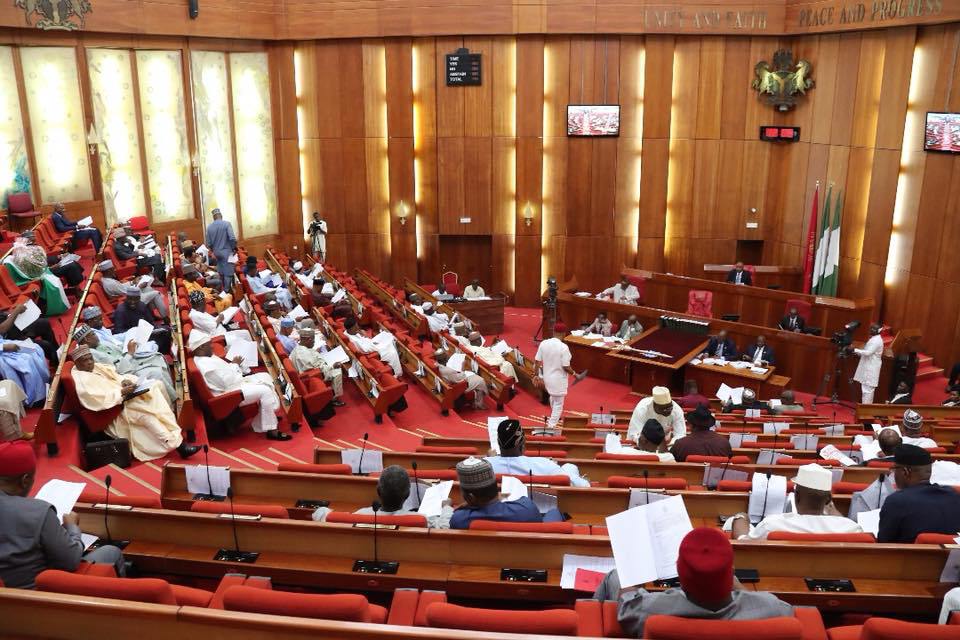
Despite launching an image-laundering campaign in the outgoing year, the Nigerian Senate dominated the news mostly for bad reasons. In this piece, National Assembly correspondent, OWEDE AGBAJILEKE, looks at 12 unusual events in the Senate in 2018.
Since the inauguration of the Eighth Senate on June 9, 2015, the nation’s upper legislative chamber has been embroiled in one controversy or another.
Although the leadership of the National Assembly attributed this to the fact that the Legislature is the most misunderstood arm of government, efforts to change the growing negative public perception by organising an Open Week during the third anniversary of the Eighth National Assembly in June 2018 yielded little or no results.

A review of the activities of the Senate under the leadership of Senate President Bukola Saraki showed that there are 12 uncommon events in 2018.
Senators will resume plenary on January 16, 2019 and there are strong indications that the N8.83 trillion 2019 budget presented by President Muhammadu Buhari will not be passed until after the general election billed for February 16 and March 2, 2019. And the outcome may also determine whether the budget proposal would die a natural death or take a longer time in passing.
Invasion of Senate chamber and snatching of mace
In what appeared like a blockbuster, armed political thugs disrupted Senate plenary on April 18, 2018 in broad daylight and snatched the mace – the symbol of authority. The incident which was aired on live television, happened few seconds after a suspended lawmaker, Ovie Omo-Agege entered the chamber.
Although the Police recovered and returned the mace the following day, they were unable to prosecute the hoodlums, raising concerns of an insider job.

The testimony by the then Divisional Police Officer in the National Assembly, Sulu-Gambari Abdul before the National Assembly Ad-hoc Investigative Committee that some security officials colluded with lawmakers and National Assembly staff to carry out the attack, landed him in trouble, as he was immediately transferred by the Inspector-General of Police, Ibrahim Idris.
Invasion of National Assembly by operatives of the DSS and sack of Daura
Four months after the April 18 incident, the National Assembly yet again witnessed another invasion; this time by masked operatives of the Department of State Services (DSS). The secret police who said they were acting on orders from above, also barricaded the gates to the National Assembly complex and denied lawmakers, National Assembly workers, legislative aides, journalists and visitors access to the Complex.
While PDP lawmakers accused their APC counterparts of plotting to re-open the premises and remove Saraki and his deputy, Ike Ekweremadu from office, APC legislators accused their PDP colleagues of crying wolf.
But in a show of defiance, a member of the House of Representatives from Rivers State, Boma Goodhead, dared the operatives to shoot her, as she forced her way to the complex before other male lawmakers joined her.
The biggest casualty from the incident was the DSS Director General, Lawal Musa Daura who was dismissed by the then Acting President Yemi Osinbajo.
Conviction of Dariye
The Economic and Financial Crimes Commission (EFCC) recorded the highest number of convictions in 2018 since its creation, having secured 312 convictions in the year under review.
In June, the anti-graft agency secured a high-profile conviction when a High Court of the Federal Capital Territory convicted a serving senator, Joshua Dariye, on corruption charges.
Although the Court of Appeal in Abuja reduced the jail term handed the APC chieftain and former Plateau State Governor from 14 to 10 years, there are other Politically Exposed Persons (PEPs) in the Senate facing trial whose cases will be carried over to 2019. They include Deputy Senate President Ike Ekweremadu (PDP, Enugu); controversial senator, Dino Melaye (PDP, Kogi); Peter Nwaboshi (PDP, Delta); Buruji Kashamu (PDP, Ogun); David Mark (PDP, Benue); Stella Oduah (PDP, Anambra); Abdulaziz Nyako (ADC, Adamawa); Danjuma Goje (APC, Gombe); Abdullahi Adamu (APC, Nasarawa) and Jonah Jang (PDP, Plateau).
Dariye is currently serving his jail term at Kuje Prison, but he still draws his salaries from the National Assembly.
Gale of defections
As the cliché goes, ‘there are no permanent friends or permanent enemies in politics but permanent interests’. On July 24, 2018, gale of defections hit upper legislative chamber when 13 members of the APC announced their defection from the ruling party. This was despite their earlier meeting with President Muhammadu Buhari where they pledged allegiance to the party.
However, one of the senators later rescinded his decision, bringing the total number of defectors to 12. Lawmakers who dumped the ruling APC include: Rabi’u Kwankwaso (Kano-Central), Dino Melaye (Kogi-West), Monsurat Sunmonu (Oyo-Central), Rafiu Ibrahim (Kwara-South), Suleiman Hunkuyi (Kaduna-North) and Lanre Tejuoso (Ogun-Central).
Others are Usman Nafada (Gombe-North), Ibrahim Dambaba (Sokoko-South), Ubale Shittu (Jigawa North-East) ,Isa Misau (Bauchi-Central), Suleiman Nazif (Bauchi-North), Shaaba Lafiagi (Kwara-North) and Barnabas Gemade (Benue North-East).
On the other hand, PDP also lost one of its Principal Officers when the immediate past Senate Leader, Godswill Akpabio, dumped the PDP and pitched his tent with APC.
Saraki’s defection and APC’s failed attempt to remove him as Senate president
Despite discharging him of false asset declaration by the Supreme Court, Saraki faced more political battles in the year under review when the Nigeria Police linked him to a Offa Bank robbery in his home state of Kwara which claimed over 30 lives.
Also, his return to the People’s Democratic Party (PDP) caused an upset in the ruling All Progressives Congress (APC), as it was the first time in the nation’s history that two Presiding Officers in the upper legislative chamber would be members of an opposition party.
Attempts by the APC leadership to ask its members to remove him, proved abortive, as they failed to garner the required two-third majority to effect leadership change.
Melaye’s face-off with police
The controversial Kogi West senator was mostly in the news for the wrong reasons. Call him the tormentor-in-chief of the Presidency and the ruling APC and you won’t be wrong.
The lawmaker-cum-singer who released his hit single ‘Aje Kun Iya’ in 2017 to mock the suspension of Babachir Lawal as Secretary to the Government of the Federation (SGF), also released more singles in 2018 declaring his love for PDP as well as his tracks for Kogi State Governor, Yahaya Bello and immediate past Senate Majority Leader, Goodwill Akpabio.
The lawmaker, who survived an attempt to recall him from the Senate, faced many legal battles with the police in the year under review. Specifically, he is still undergoing three trials in Lokoja and Abuja and these court cases will spill over to 2019. Some of the charges bother on alleged gun running, attempted suicide and damaging government property and providing false information.
About 40 senators lost return ticket
At least, 40 senators will not be part of the 9th Senate (2019 to 2023) having lost their return tickets to contest the February 16, 2019 National Assembly election during the primaries of their various political parties in 2018.
While some senators proceeded to contest the governorship seats in their states, others withdrew their ambitions due to rotational arrangements in their senatorial districts, even as others lost out for their parties inability to meet up with the deadline for submission of candidates, as stipulated in the 2010 Electoral Act (as amended).
Some of the senators that will not be part of the 9th Senate are: Ben Murray Bruce, Abu Ibrahim, Abdulaziz Nyako, Ahmed Abubakar, Foster Ogola, Emmanuel Paulker, David Mark, John Enoh, Sonny Ogbuoji and Gilbert Nnaji.
Others are: Fatima Raji Rasaki, Usman Nafada, Joshua Lidani, Sam Anyanwu, Abubakar Kyari, Umar Kurfi, Rafiu Ibrahim, Shaaba Lafiagi, Gbenga Ashafa, Phillip Gyunka, Sabi Aliyu Abdullahi, David Umaru, Buruji Kashamu, Lanre Tejuoso, Gbolahan Dada, Olusola Adeyeye, Babajide Omoworare, Ademola Adeleke and Rilwan Akanbi.
Also, other big losers include: Joshua Dariye, Jeremiah Oseni, Hope Uzodinma, Magnus Abe, Osinachukwu Ideozu, Andrew Uchendu, Kabiru Marafa, Ahmed Sani Yarima, Bukar Abba Ibrahim and Baba Kaka Garbai.
Shehu Sani’s revelation on senators’ jumbo pay
Since return to the Fourth Republic in 1999, federal lawmakers have concealed the actual salaries and allowances of National Assembly members for fear of backlash from the general public.
But in March, human rights activist and Chairman, Senate Committee on Local and Foreign Debts, Shehu Sani blew the lid on senators jumbo pay.
In an interview with TheNEWS magazine, the outspoken senator disclosed that senators are handed N13.5 million monthly as running cost, in addition to N750,000 monthly salary.
Carryover of budget
Attempts to return the budget cycle to run from January to December met a brick wall, as it took about seven months before the record-breaking N9.120 trillion 2018 budget was passed and signed into law.
Consequently, the 2018 budget suffered the longest delay since 1999, having spent 223 days before it was eventually passed and signed into law. BDSUNDAY reports that the 2016 and 2017 budgets spent 136 and 180 days, respectively.
Our correspondent also gathered that the N8.83 trillion 2019 budget submitted by President Buhari to the National Assembly on December 19, 2018 would be passed after the 2019 general elections.
Buhari rejects amended Electoral Act, PIGB, others
For the fourth consecutive time, President Buhari declined assent to the amended Electoral Act as well as the eagerly-anticipated Petroleum Industry Governance Bill (PIGB). The two bills seek to reform the nation’s electoral process and the oil and gas sector.
The development brings the number of bills rejected by President Buhari in the out gone year to 23. Some of the bills include: the Stamp Duties (Amendment) Bill, Industrial Development (Income Tax Relief) (Amendment) Bill, National Research and Innovation Council (Est.) Bill, National Institute of Hospitality and Tourism (Est.) Bill, National Agricultural Seeds Council Bill, National Transport Commission Bill and the Federal Road Authority (Establishment) Bill.
Others are Chattered Institute of Entrepreneurship (Est.) Bill, Advance Fee Fraud and Other Related Offences (Amendment) Bill, Subsidiary Legislation (Legislative Scrutiny) Bill, Nigerian Maritime Administration and Safety Agency (Amendment) Bill, National Broadcasting Commission (Amendment) Bill, five constitution amendment bills among others.
Strike by NASS workers over poor condition of service
For four days, National Assembly staff embarked on strike over poor condition of service.
The workers under the aegis of Parliamentary Staff Association of Nigeria (PASAN), earlier made a peaceful protest at the National Assembly Lobby and prevented lawmakers from sitting. It took the intervention of the National Assembly Management to order security agencies to ensure adequate security within the Complex before President Buhari could present the 2018 budget to both legislative chambers.
Lawmakers cheer, jeer at Buhari during 2019 budget presentation
The year 2018 would not be complete without the controversy that greeted President Buhari’s presentation of the 2019 budget to a joint session of the National Assembly on December 19.
There was chaos, disorder, pandemonium and utmost confusion during the budget presentation, as lawmakers were divided along party lines, cheering or jeering at the President as he spoke.
Trouble started when APC lawmakers chanted ‘Sai Baba’, as President Buhari entered the chamber, even as they cheered him intermittently during his presentation.
But things got out of hand when PDP legislators booed the President, with some shouting ‘It’s a lie’, ‘Propaganda’ when he made certain claims.
The incident elicited divergent reactions from Nigerians. While some viewed the lawmakers’ behaviour as uncalled for, others felt it showed the beauty of democratic system.