|
Getting your Trinity Audio player ready...
|
Nigeria is lagging a number of countries in non-oil export earnings, meaning that whoever becomes president in 2019 must be ready to fix the economy and enable many sectors contribute to revenue.
South Africa, Africa’s second largest economy, earned 164.9 billion rand (about $13 billion) from exporting automobiles alone in 2017, according to the 2018 Automotive Export Manual.
Bangladesh, often regarded as one of the poorest countries in the world, rakes in $28 billion just from textile export annually.
In 2016/17, Brazil, with almost Nigeria’s demographic size (209 million), exported 28.15 million metric tonnes (MT), earning over $38 billion just from sugar.

Sugarcane alone contributed $43.8 billion to Brazil’s gross domestic product (GDP) – equivalent to almost two percent of the entire Brazilian economy. Even India, which was projected to grow as fast as Nigeria by the Goldman Sachs in 2012, is set to produce 35 million tonnes of sugar next year.
For Nigeria, data from the National Bureau of Statistics (NBS) show that the country earned N577 billion from total export in the first quarter of 2018 and N218.98 billion in the second quarter (if you factor out what the body calls ‘other oil exports’). This is about $2.20 billion for the half-year of 2018.
BudgIT carried out a simple research in 2016 using data from Indexmundi, the United States Department of Agriculture (USDA) and Vetiva Research. It was found that Nigeria had a 45 per cent share of world’s palm oil market in 1960. The numbers showed that if Nigeria maintained its 45 percent share in 2016, it would be earning $17.5 billion annually from just one product—palm oil— assuming that it exported all of its output. As of October 2018, one ton of palm oil was around $499.15, using Malaysian prices. Total palm oil output was 58.84 million metric tonnes. Assuming that Nigeria was still controlling 45 per cent of the global palm oil market last month, the country should be producing 26.48 million metric tonnes. Local demand is about 2.1 million metric tonnes, meaning that Nigeria would be able to satisfy local demand and still export 24.38 million tonnes, earning $12.17 billion.
Nigeria heavily relies on crude oil for its export and revenue earnings and any hit on oil hurts the economy badly. Manufacturers and importers rely on dollars for the importation of raw materials and finished goods.
The federal government assumed the crude oil price of $60 per barrel in its 2019 budget but oil Brent Crude was $50.79 per barrel on Tuesday. This portends danger for a monoproduct economy going into a crucial election.

Experts believe that the biggest clog in the wheel of progress in the non-oil export sector is poor infrastructure. Today, energy makes up 40 percent of exporters’ expenditure as firms seek alternative sources of powering their generators.
Manufacturers have spent N212.85 billion on alternative energy sources between the second half of 2016 and the first half of 2018, according to data from the Manufacturers Association of Nigeria (MAN). This is over 100 percent higher than what was incurred in the previous four halves. Manufacturers told BusinessDay that logistics costs have risen by 50 to 100 percent in the last two years, owing to poor state of roads and lack of a good transport system.
Analysts believe Nigeria must spend three to five percent of its GDP on infrastructure annually to become competitive. A 2018 Financial Derivatives Company analysis shows that the country needs to spend $15 billion annually for 15 years to develop its infrastructure.
Nigeria’s infrastructure budget has fallen below 20 percent over the years, though 2018 budget committed about 28 percent to it, despite government’s claim of 30 percent.
Exporters are faced with poor road network and decrepit seaports. Ports in Warri and Port Harcourt are not used because they need to be fixed and dredged. Onitsha seaport is not yet ready for use today. Export firms bringing in raw materials into the overused Apapa and Tin Can ports and those exporting commodities abroad have seen their costs swell on rising dwell time, which results in high demurrage charges.
Only 10 percent of cargoes are cleared within the set timeline of 48 hours now while the majority of cargoes take between five and 14 days to clear, according to a maritime report conducted by the Lagos Chamber of Commerce and Industry (LCCI).The report notes that some cargoes take as many as 20 days to be cleared at the ports.
At a recent book launch in Lagos last month, Muda Yusuf, director-general of the Lagos Chamber of Commerce and Industry (LCCI) said: “The key issue is competitiveness. Unless we have an environment that positions the economy for competitiveness, we cannot make any headway in non-oil export”.
“Diesel is N260 per litre. So, how will those in the manufacturing sector survive? Export is not just about cocoa, shea butter and other primary products, which make up 90percent of our export portfolio today. Export is about industrialisation, value-addition and manufactured products.”
He explained that Nigerian manufacturing and export sectors cannot make headway without strong infrastructure, citing the case of Apapa ports roads as one key reason why exporters are struggling today.
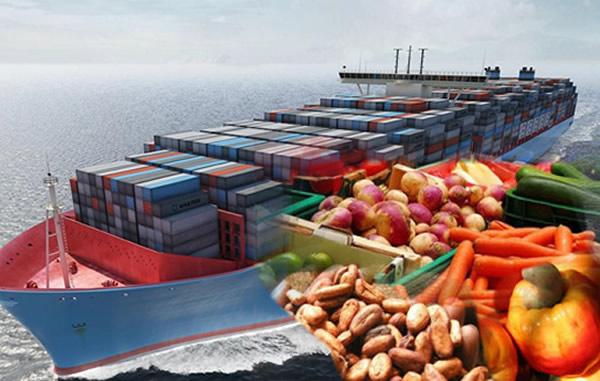
Nigeria heavily exports raw materials such as cocoa, shea butter, hibiscus flower and other agro products, which are converted into finished goods in foreign factories.
The current government is pumping billions into agriculture through the Anchor Borrowers Scheme. As of last month, 850,000 smallholder farmers had benefited from the Central Bank of Nigeria (CBN)’s N160 billion under its Anchor Borrowers’ Programme (APB) in the last three years, Godwin Emefele, CBN governor, said.
“In the past five years, the CBN has achieved a lot in agriculture, not restricted to rice production but spread over targeted 15 different commodities.
“For instance, since the launch of ABP in November 2015, over 850,000 small holder farmers have benefited from N160 billion disbursed under the programme,” Emefele said at a town hall meeting on Agriculture in Dutse, Jigawa.
A lot of activities are also taking place in the solid minerals sector. Quarrying and other minerals sector grew by 3.08 percent in the third quarter of 2018 from 3.31 percent in the second quarter and 27.45 percent in the first quarter.
Symbol Mining, PW Nigeria Limited, Minutor International, African Industries and Mines Geotechniques Nig. Limited, among others, are pumping billions into the mining sector.
However, the majority of work done is at the primary level.
According to MAN, genuine diversification happens when raw materials are processed into finished products.
“So, if I am sending cashew nuts in a raw form, I get $800 per ton, but if it is processed, I get close to $2000 per ton. So the money-making thing here is value addition,” saidAttah Anzaku, CEO of AgroEknor, an international commodity trading firm.
Experts say a true diversification must look at value addition in all sectors.
“The next president needs to look at how to broaden the foreign exchange earnings through other non-oil export products. This is why the next election should be about economy, not politics. We do not need a repeat of the 2016 experience, where oil price fall crashed the whole economy,” said Ike Ibeabuchi of MD services Limited.
ODINAKA ANUDU