|
Getting your Trinity Audio player ready...
|
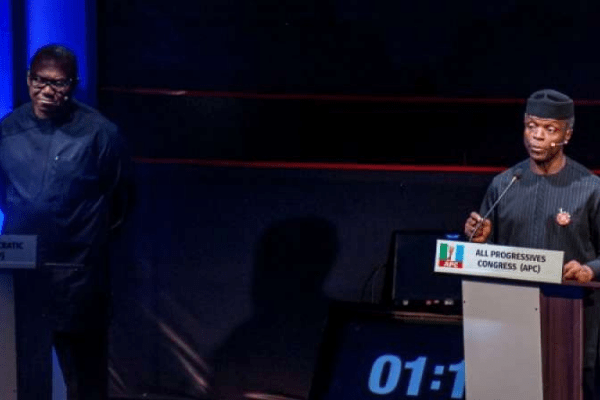
On Friday evening, five vice presidential candidates from the about 79 parties participating in the 2019 national elections lined up to defend their ideas on how they plan to take Nigeria forward from 2019.
Lined up for the debate were the vice presidential candidates of the Allied Congress Party of Nigeria (ACPN); Alliance for New Nigeria (ANN); All Progressives Congress (APC); People’s Democratic Party (PDP), and Young Progressives Party (YPP).
The vice presidential candidates that participated in the debate were Ganiyu Galadima of ACPN, Khadija Abdullahi of the ANN, Umar Getso of the YPP, Peter Obi of the PDP, and incumbent Vice President Yemi Osinbajo of the APC.
In a bid to push their positions, the vice presidential candidates reeled certain facts and figures, some wrong and some true.
Vice President Yemi Osinbajo at the debate said Nigeria was now producing 90 percent of the rice that it consumes and now importing only 2 percent of what we used to import. This is largely untrue. Data from the Bloomberg terminal show that rice production in Nigeria has increased more than 50 percent since 2012 to 3.7 million tons in 2017.
However, domestic demand has also risen 4 percent to 6.7 million tons in the 2017-18 year that ended in May. This means that Nigeria produces only about 55 percent of its rice demand. The balance of demand is filled mainly with smuggled rice from Benin Republic, a country that imports more rice than its population can consume. It is a common knowledge that most of the rice imported into Benin Republic is destined for the Nigerian market.
“You can’t have a thriving economy if you allow the kind of grand corruption that took place in the past 16 years. The government of President Muhammadu Buhari has spent N2.7 trillion on infrastructure, the highest in the history of Nigeria,” Osinbajo said. This is also largely untrue. The vice president refers to capital releases in the last two years.
Actual capital expenditure, according to CBN figures, in the last two years stands at N1.61 trillion. The highest actual capital expenditure since 2004 happened in 2009 when the Federal Government spent N1.15 trillion.
It is also untrue when Osinbajo said the Federal Government was getting 60 percent less in revenues than previous administration. CBN figures show that FG’s retained revenue at N4.62 trillion in 2017 was the highest since 2004. While oil prices have fallen since 2015, the almost 50 percent devaluation in the naira means that the Federal Government is getting more revenue in naira terms than previous administration.
Osinbajo also said at the debate that Nigeria had a social investment policy, possibly the largest ever in the history of our country. This is largely true. This is the first time the Federal Government is going all out to dish cash handouts to Nigerians. However, there are questions about the long-term sustainability of this social investment scheme.

On the other hand, Peter Obi of the PDP said in 2015 Nigeria generated $41 billion in Foreign Direct Investment, but now, we attracted only $12 billion last year. This is largely untrue. Data from the National Bureau of Statistics (NBS) show that total FDI in 2015 stood at $1.45 billion. As of 2017, this has dropped to $982 million. So, while it is true that FDI has dropped within the period, Obi exaggerated the magnitude of the decline.
“Even our stock market has lost over N2 trillion in one year. You can’t shut down your shop and be chasing criminal,” Obi said. This is true about the stock market but depends on how you calculate the drop in the stock market.
Stock market capitalisation fell from N12.23 trillion in September 2017 to N11.97 trillion in September 2018, a drop of N260 billion. In dollar terms, the decline is steeper, declining from $39.99 billion to N32.9 billion, representing a decline of $7.09 billion or N2.55 trillion, using the market exchange rate of N360, which is line with the figures given by Peter Obi.