What could have become Nigeria’s biggest attempt to support micro businesses which dominate the country’s informal trade sector, help them scale and bring them gradually into the formal sector is turning out to become the biggest credit disaster, thanks to vice president Yemi Osinbajo.
On paper, Trader Moni is a good scheme. You give traders initial loans of N10,000 without collateral. Their incentive for repayment is that if they repay on time, they will get a bigger loan, rising up to N50,000, a significant amount for a petty trader.
Mohammed Yunus, the founder of Grameen Bank in Bangladesh is known to have perfected the art of micro credit or lending money to the poor. As of 2017, Grameen Bank reportedly had 2,600 branches in Bangladesh, about nine million borrowers and a repayment rate of 99.6 percent. Most significantly, 97 percent of the borrowers were women. But it must be noted that Grameen bank is a purely private sector initiative. Grameen Bank gets a good chunk of its funding from donor agencies which use the bank as a platform to support the poor, based on the concept that loans are better than grants.
READ ALSO: Logistics Haven, Mama Moni collaborate to distribute food items to poor Nigerians

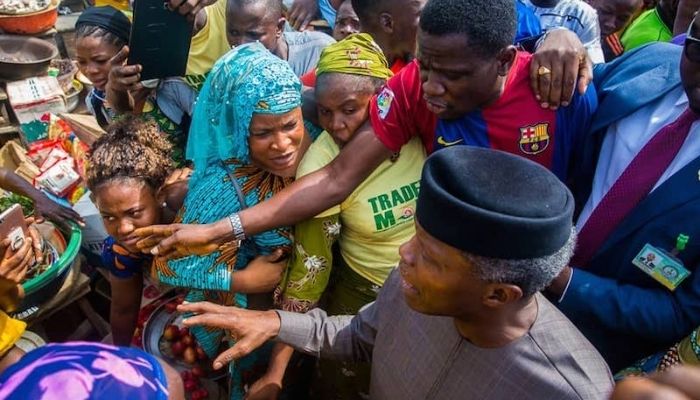
Herein lies the challenge with the government’s Trader Moni Scheme. It is a Federal Government led scheme implemented by the wholly government owned Bank of Industry (BOI). The Trader Moni Scheme is run in partnership with the National Social Investment Office (NSIO) which is attached to the Office of the Vice President. This is the main reason why Vice President Osinbajo has become the face of Trader Moni across the country. And this is also why he has become the biggest problem with the Trader Moni scheme.
With Osinbajo’s direct involvement in the Trader Moni scheme, political considerations have overshadowed what should be a purely credit decision. The beneficiaries of the Trader Moni scheme are no longer seeing the initial N10,000 as a step up into the credit ladder but as their share of the proverbial ‘national cake.’ Feelers from the street clearly show that many of the petty traders getting the initial N10,000 credit do not think that they need to pay back and do not have plans to pay back. This means that a good chunk of the loans being giving out on the Trader Moni scheme will eventually go bad.
And this will create a new challenge for the very poor that Trader Moni is trying to help. Once they are unable to repay these loans, they create for themselves a bad credit history, destroying their capacity to borrow money in future. Most of the petty traders collecting Trader Moni are not even aware that their inability to repay these loans could destroy their chances of taking new loans in future. They are unknowingly being led into a debt trap by a scheme claiming to help them improve their wellbeing.
Nigeria has gone this way before when former military president, Ibrahim Babangida established the Peoples Bank of Nigeria (PBN) in 1989. The bank, despite its noble objective of giving loans to the poor, eventually failed amidst allegations of massive fraud and corruption. Trader Moni has the tendency to go a similar way because it is taking a path that has been taken before and failed.
It is not impossible to lend to the poor. Grameen Bank succeeded in Bangladesh and even in Nigeria there are many existing highly successful stories of Micro-Finance banks’ lending successfully to the poor. These purely private led institutions are not only lending to poor, but the poor are paying back and the Micro-Finance banks are making enough money to stay in business and keep lending.

They are largely successful because they are not seen as government owned institutions. Trader Moni could have been structured as special social intervention scheme for petty traders through selected micro-finance banks, taking advantage of their already tested systems to make the scheme sustainable and more economically impactful.
Trader Moni could have been successful without Osinbajo. His association with the scheme has shown that gaining political mileage from Trader Moni has been prioritised over the economic impact and its long term sustainability. And that is why it will fail like other schemes before it and it will be mainly because Osinbajo has politicised a scheme that did not need politics to be successful.
Anthony Osae-Brown