This year, two Nigerian banks have seen their market capitalization on the Nigeria Stock Exchange fall below the minimum capital base of N25 billion required to own a national banking license in Nigeria. The banks are Unity Bank (₦8.06 billion) and Wema Bank (₦21.2 billion) with a combined market capitalization of just ₦29.26 billion, less than 10 percent of the market capitalization of Tier 2 lender Stanbic IBTC which closed the day with a market capitalization of ₦505 billion on Thursday.
The drop in the market capitalization has no effect on the banking operations or the securities of their license.
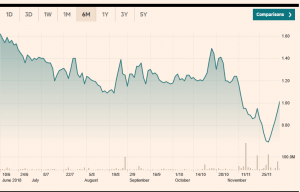
In 2016, Wema Bank profit after tax fell from ₦2.56 billion to ₦2.25 billion in 2017 despite the economic recovery that occurred in 2017. However, analysts told BusinessDay that the bank seems to be on track to post profit after tax in the region of N3 billion after declaring H1 2018 profit after tax at N1.56 billion. The stock has taken a severe beating this year like many other bank stocks, collapsing from a year high of N1.54 in February to N0.55 Friday, signifying a drop of around 66.2 percent from its year high.
After a prolonged delay in the release of financial results, Unity Bank finally released its 2017 annual report along with quarterly financial results in 2018 in the third quarter this year. Third quarter results showed that Unity Bank’s profit after tax declined by 76.1 percent from ₦2.44 billion in Q3 2017 to ₦585 million in Q3 2018. Low profitability and poor asset quality continue to be a drag on the tier 3 lenders as it currents carries a negative book value of -₦242.3 billion. Unity Bank is the only bank on NSE with a negative book value.

Source: FT Markets
Earlier in March, private equity firm, Milost Global Inc disclosed their interest in acquiring Unity Bank in a $1 billion offer withdrew their interest in the bank in very controversial circumstances. After the deal failed, Unity Bank sold about ₦400 billion worth of its bad debt to Frontier Capital Alternative Asset, a unit of Lagos-based advisory and investment firm, Frontier Capital Group.
In an interview with Bloomberg, Chief Financial Officer of Unity Bank, Ebenezer Kolawole said “the disposal to Frontier Capital Alternative Asset Limited of the toxic assets cut the ratio of non-performing loans to near zero from almost 50 per cent and helped to shore up Unity Bank’s liquidity.”
The bank’s stock which rallied to ₦1.92 kobo in February during talks of capital injection by Milost has now dropped to 69 kobo as at Friday.