Now that the Nigerian National Petroleum Corporation (NNPC) is the sole importer of petroleum, it means that downstream oil and gas firms will have to cut costs to bolster future profit.
In the light of the above, we have decided to drill down the books of firms to ascertain the profitability ratios or how they have turned each Naira invested in sales into higher profit.
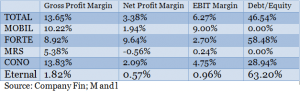
Of the six largest quoted downstream oil and gas that have released third quarter results- Total, Mobil, Forte, Conoil, Eterna Oil, and MRS Oil- only Total and Forte Oil had net profit margin exceed industry average.

For instance, Total’s and Forte Oil’s 3.38 percent and 9.64 percent are above the industry average of 2.84 percent, according to data gathered by Markets and Intelligence.
On the flip side, Conoil, Mobil, MRS, and Eterna Oil have fallen off the cliff as their net margins of 2.09 percent, 1.94 percent, -0.56 percent, and 0.57 percent is below the industry average.
Net margins give investors deeper insight into how a company is converting its bottom line revenue into profit for shareholders. The higher the ratio, the more efficient a firm, but a lower ratio means a firm will have to intensify bolster efficiency levels.
Forte Oil’s third quarter net income surged by 1701 percent to N9.13 billion as at September 2018, albeit a 61.78 percent increase in gains from discontinued operations added impetus to profit.
Total Oil recorded the fasted profit growth among peers. Net income increased by 28.69 percent to N7.66 billion in the period under review.

But an assessment of margins based on earnings before interest and tax means the tide has changed.
Total, Mobil, and Conoil’s EBIT margin of 6.28 percent, 9 percent and 4.75 percent outperformed industry average of 3.96 percent, based on data gathered by Markets and Intelligence.
While the proportion of debt to equity in the books of downstream oil and gas firms are below 100 percent, the gearing ratio is increasing.
Conoil’s debt to equity ratio increased to 51.64 percent in the period under review from 28.94 percent the previous year.
Eternal Oil’s debt to equity ratio moved to 72.80 percent in the period under review from 63.20 percent the previous year.
Total Oil’s surged to 118.82 percent in the period under review from 46.53 percent as at September 2017.
However, Mobil and MRS have zero debt to equity ratio. Mobil rarely engage in long term debt.