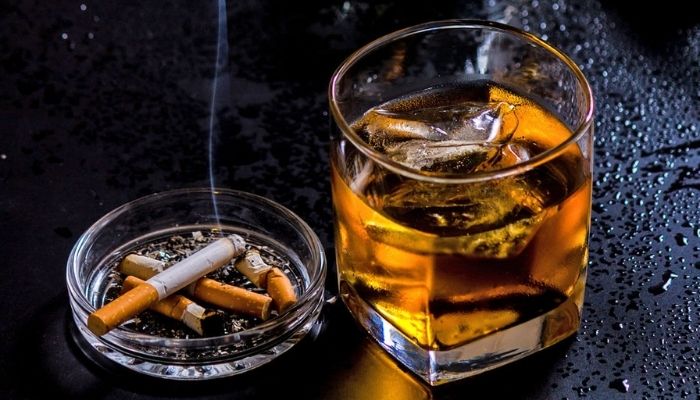
The Senate on Tuesday asked the Federal Government to immediately suspend the implementation of Excise Tariff increment on alcoholic beverages and tobacco until all relevant stakeholders were adequately consulted.
This, it believes, will give an avenue for consensus rates and implementation approach among stakeholders in the beverage and tobacco industries.
It also asked the Federal Government to sensitise producers and consumers of alcoholic and tobacco products to understand the need for the increase and its advantage in adding to the economic fortune of the country as well as providing the government with more resources to invest in health services of the nation.
This followed the adoption of the report of the Senate Committee on Finance on the Urgent Need to Review the Excise Tariff Increment in order to save Local Distillers of Beverages from Looming Extinction.
READ ALSO: The tobacco challenge
It would be recalled that in May 2018, sequel to a motion on the floor the Senate, it mandated its Committee on Finance to organise unfettered discourse between the Federal Government and relevant stakeholders on the matter.
In June this year, the Federal Government had raised excise duty on alcoholic beverages and tobacco. Although President Muhammadu Buhari had approved the amendment to the excise duty rates in March, implementation of the upward review, however, took effect from June 4, 2018.

The immediate past minister of finance, Kemi Adeosun, had stated that the new excise duty rates were spread over a three-year period from 2018 to 2020 in order to moderate the impact on prices of the affected products.
Under the rates for tobacco, in addition to the 20 percent ad-valorem rate, each stick of cigarette now attract a N1 (N20 per pack of 20 sticks) in 2018, N2 specific rate per stick (N40 per pack of 20 sticks) in 2019 and N2.90k specific rate per stick (N58 per pack of 20 sticks) in 2020.
Similarly, the new specific excise duty rates for alcoholic beverages cut across Beer and Stout, Wines and Spirits from 2018 to 2020. Also, Beer and Stout attract N0.30k per centilitre (Cl) in 2018 and N0.35k per Cl each in 2019 and 2020.
In the same token, Wines attract N1.25k per Cl in 2018 and N1.50k per Cl each in 2019 and 2020, while N1.50k per Cl was approved for Spirits in 2018, N1.75k per Cl in 2019 and N2.00k per Cl in 2020.
The former minister had disclosed that the new excise duty regimes followed all-inclusive stakeholder engagements by the Tariff Technical Committee of the Federal Ministry of Finance with key industry stakeholders.
But in a report presented by the Vice Chairman of the committee, Umaru Kurfi (APC, Katsina State), the panel observed that most industry players in the beverage and tobacco industries were not properly engaged during the consultative process that led to the adTariff of the new excise tariff rate.
The committee recommended an upward review of not more than 50 percent Excise Tarrif increment on alcoholic beverages and tobacco.
Specifically, the panel recommended that: “An increment of not more than 50% at maximum should be adopted, as it becomes necessary for the Federal Government to increase the tariff rate in order to boost revenue generation as the rate will provide more leniency to the affected manufactures and give more hope for the survival of the indigenous companies.
“There is the need to increase the import duties of foreign alcoholic beverages and tobacco products in order to give local indigenous companies more competitive edge as this will provide for a less price differentiation.”