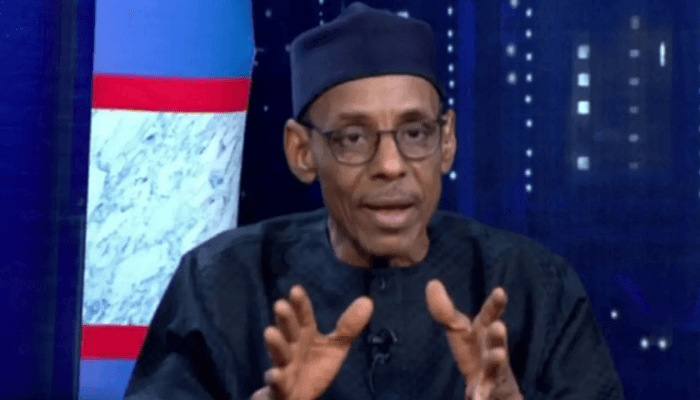
Presidential candidate of the Abundant Nigeria Renewal Party (ANRP) in the 2019 elections, Tope Fasua, expresses optimism that he has the potentials to rescue Nigeria from the vice grip of what he called poor leaders if he is elected President of the Federal Republic of Nigeria. In this Interview with Innocent Odoh, the trained economist reels out his economic blueprint anchored on revitalization of moribund industries, revival of infrastructure and poverty reduction through youth empowerment, which he says will grow the economy at 20% per annum. Excerpts:
Fasua
What motivates you to run for the office of the President of the Federal Republic of Nigeria?

It is actually because of the urgency of now and the fact that Nigeria has been on the downward spiral and for too long we had trusted people tolift of the country but it seems it was never going to happen and in life one should learn that often times, when you expected some people to do something and it does not get done, you may need to do it yourself.
So for me it a call to service because I am very much aware that many of the ideas that I have put forward have been very inspired. We have been putting on these ideas in newspapers, on radios, in interviews on TVs and it seems to be ignored. So I have a feeling that Nigeria is under some sort of vice grip of criminal entities and the only way to rescue Nigeria is to mainstream the idea that I have been pushing that have been ignored. That is the reason I am stepping forward. And again, perhaps by extension, the problem with Nigeria is not at the state level, local government level, it is not even at the National Assembly level, it is right there at the top.
We need the vision to say what kind of people should we be, what kind of people do we want to be? This is because repositioning a country is not just a matter for economics it is also a matter of the social philosophy that the country should be running and all of these need to be affected in positive manner.
As a trained economist, do you think that the problem of Nigeria is a question of the structure and system of the political economy that drives the country?
The thing about economics is that anyone who purports to be an economist should be very versatile because we don’t study economics in ignorance of other fields. Economics according to Bernard King, deals in the arts and sciences at the same time, very comfortable with mathematics and also poetry and prose. You have to immerse yourself in sociology and social psychology and of course politics. Politics according to David Eaten is the authoritative allocation of values in a society, meaning who gets what, which is also the concern of economics, in fact, more concern of economics especially at the macro level and at the level of development economics.

It is very critical question as to how we allocate our resources as a people given the population that we have and the mouth that we have to feed. So these are the core issues and I believe that a lot of our social issues are intertwined with our economic issues and to a large extent if we are able to fix the economic issues, the social issues will unravel. The big problem with Nigeria is allocation of scarce resources.
Oxfam came out with a report recently that says that Nigeria is the global capital of inequality. In the Commitment to Reduce Inequality of the Oxfam, Nigeria came 157 out of 157 countries surveyed meaning that this is the global headquarters of inequality meaning that inequality is increasing in Nigeria more than anywhere else in the world. It is a very pathetic situation meaning also that politics have not been played right. Our politics is ensuring that just a few people get the majority of the resources by hook or crook. Those who are in politics they know themselves, those who are in the top echelon of government they know themselves and their private sector cohorts with whom they gang together and consistently raped the country.
But we can actually fix the economy and ensure that out of about 90 million people in extreme poverty in Nigeria now we can actually take 60 million of them out of poverty. Yes, it can be done; the point is that we have hardly ever prioritized that fact. If we prioritize that fact then we can actually begin to work towards that.
So, the first thing is to target those in poverty and see how to take them out of poverty. India is doing it presently, China has perfected it because, by next year, they intend to zero poverty in China can you imagine that 1.4 billion people, no poverty. Part of what they are doing is targeting poverty in a précised manner. Chinese President is visiting those poor areas and documenting them. In China they have a file on every family even in the rural areas, where they will understand the real issues with the families and the communities. They just don’t spend money anyhow.
What the Nigerian government is doing is a sham, they take the $322 million Abacha loot and give people without documentation. We don’t know those you are giving the money, you said you are giving people money inside the market we don’t know who you are giving the money. You don’t have a right to spend money in that manner without documentation. We have not started yet; in fact I just pity Nigerians because Nigerians want more of this and what we are doing unwittingly is to conform to those racists in the world that the Blackman cannot do well for himself, the Blackman cannot lead himself, the Blackman is primitive and wants to live in filth, want and hunger and we have the leaders to perpetuate that kind of mindset.
Nigeria is never short of people with great ideas, the problem, however, is the right structure to put the right people like you in place. You are contesting under the ANRP, a relatively known party. Do you have the clout to battle with the bigger parties such as APC, PDP?
The truth is that we will actually not be playing their game with them, we will be changing the game, that is the only hope we have. When you talk about battling with them, the way they battle is with money. How did they get the money? By stealing from the people and this is what they have been doing for a long time now. The people in APC and PDP are discredited people. So we cannot fight them with money, however, what we do is that the places that we visit we will give them something. Nigerians are indeed poor such that N1000, N500 is a lot of money to most Nigerians. It is unbelievable. The problem is that Nigerian leaders have sinned against humanity and we are only trying to come and correct it. And we understand that the masses may not understand it but whether they understand it or not we have to keep moving on because we have to save the masses in spite of themselves.
The campaigns will kick off on November 18, and there are indications that some political parties may coalesce to produce a consensus candidate under the Coalition of United Political Parties (CUPP). Is your party considering being part of that arrangement?
I am not a spokesman for my party and cannot speak for them alone being the chairman of the party. But what I know is that the last time we discussed, we are still open to such arrangement. However, we have to be extremely careful if we want to go into such coalition. We did not join the CUPP because we were very careful. As a presidential candidate, my vision is different from another person, the things I say on each sector of the economy, you will not hear them say it because many of them have not talked about it. And the reason most of them have not talked about it is that they allow their personality to interfere with their vision for the country. I am not thinking about myself. In this quest we have scenarios where people have started contacting foreign powers can you believe that? By the time you allow that you cannot see Nigeria from an objective point of view. I am detached from that so that I will be able to proffer unique solutions.
If we take the economy, industrial development and fight against corruption, how will you address these issues if you become President of the country in 2019?
In the area of the economy, which is my forte, I have this idea. I believe that we should be targeting GDP growth of between 15 and 20 % per annum. The previous leaders, the current ones and those who want to come back don’t have this kind of vision for this country. I believe that we are in the negative growth territory of 1.5% right now, inflation is about 11.2 % and the population is growing at 3%. A country like India is growing at 8% and is projecting to grow at 8.5% up to 2022.
So, on the economy, we should prioritize taking people out of poverty not by giving them cash but by providing them jobs. So if you are talking about security, the best security is mass employment for the youth and the jobs are there even in the public sector. I am one of those that will tell that it is a fraud for us to say that our public sector is so large. No, our public sector is too small and it is too concentrated in state capitals, it is useless, it is ineffective and ineffectual in terms of delivering service to the people and it is too top headed and toxic and needs to be repositioned. We need to get people who are busy carrying files in Abuja and state capitals and take them back to the rural areas and give them remit, a schedule to deliver on daily basis.
The people in local areas don’t see anything good in government, no light, no water, no hospitals, no school, no teachers, no good roads. If you look at every sector there are different kinds of jobs that can be provided from those places. For example, the environmental sector is massive and can employ 2 million people and sustained them. The total number of staff in the federal government’s core services is less than 100,000 even if you add all of the parastatals including the states, the total number employed by government is just about 2 million people and the working population is more than 100 million. It means that if we are indeed 190 million and only 2% are in the public service, then there is a problem.
I find out that the countries where you have a very low percentage of the workforce in the public service are failed countries. Go to Madagascar, Iraq, Yemen all of those countries have 3%. In the real countries of the world even if you go to the capitalist countries, United States is 17%. 15 to 17% of every worker is employed by the US, in the UK it is 20-21%, in the OECD countries, in general, it is 21%. In places like Norway, the Scandinavian countries, 30-35% of workers are employed by government and what this does is that it takes government goods to the people.
And as a country, the first thing you will have is to establish a minimum living standard for your people to say that any Nigerian no matter where they may be must never fall below this level and you set out apparatus of government to provide those things for them. In the northern parts of the country, there is desertification and trees need to be planted and tended. When the Korean War ended in the 50s, they planted more than 50 million trees and today those things are still there. In the South East of the country, there is a huge problem with erosion; some of these are going to take a lot of physical work to fix. In everywhere in Nigeria we have a problem with disposal of waste management and so on. We have a problem with the maintenance of lawns and gardens and you have to put your people there and the youth of this country are actually waiting to solve the problem of this country including infrastructure problem.
If you want to solve the energy problem go back to the Nigerian universities. Challenge them in the department of Electrical Engineering and send them to the villages by groups for projects. We can train 20 people from the University of Uyo and said let’s go to the villages and light up these villages. Now people talk about wind energy, biomass, sola and many of these things were put together by young people in other countries of the world and our youth can begin to catch up now rather than trailing behind by several hundred years. And we are always buying the products of other people’s innovation at very expensive rates. So if you want to solve energy and infrastructure problem go back to our youth. The products of agriculture research should be taken straight back to our farms. In China what they did as part of poverty eradication was to partner with a private sector company. We can do that in Nigeria.
We can get our Architecture and Engineering students to start greenhouses for agriculture and what we will do is to procure material for them and then they use their own ideas and ingenuity to perfect it. And equally with the road’s construction, give them the coal and give them whatever materials they need. This will also put some money in their pockets. Let’s change the educational system away from theory into practice. So those are the kind of ideas I am talking about which you won’t hear from anywhere else. In my campaign, I am going to concentrate on those who understand these big issues.
The President Muhammadu Buhari administration said it is fighting corruption but his style has come under intense criticism. What is your opinion on that?
While Buhari is not fighting corruption, Buhari probably does not understand what corruption is about and you can’t fight what you don’t understand. He is deliberately refusing to understand it because his style is to dodge behind and watch some of his people perpetrate corruption and they end up favouring him one way or the other.
He thinks he is smart but he is not so smart and we are watching and the youth in this country understand exactly what is going on. You cannot say that you are not corrupt and you get to the government only for you put all your family members there. That in itself is corruption and total unprofessionalism and if you are unprofessional there is no way you cannot be corrupt because it goes hand in hand.
Nigeria has not defined corruption in holistic terms but more fixated on monetary corruption or what is called “Grand Corruption.”
Buhari has not addressed his mind to corruption. The truth is that Buhari does not care about corruption because if he does he would have articulated some of these things. Some of us live here in Abuja; we interact with the civil servants and know what is going on.