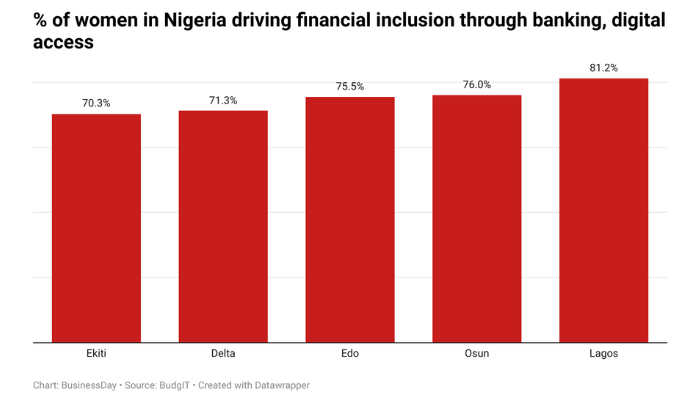
At a time when Nigeria’s economic growth is at a fragile state, financial inclusion could not be more important. Financial inclusion means individuals and businesses, irrespective of their income level, have access to affordable and useful financial services and products which are beneficial to them and the economy at large.
Nigeria recorded 1.92 percent Gross Domestic Product (GDP) growth year-on-year in the fourth quarter of 2017, representing the third consecutive expansion in the positive trajectory after exiting its worst recession in second quarter of last year.
Although the growth remains fragile and not inclusive. Analyst are however of the opinion that financial inclusion can be a catalyst to achieving inclusive growth in Africa’s largest economy.
Given that low-income earners constitute a significant portion of the population and have a huge chunk of the economy’s idle funds, increased access promotes capital accumulation, credit creation, increased economic activity, and increased investment.

The World Bank cited out the fact that a bank account is a step to broader financial inclusion. Therefore an establishment of an account relationship can pave way for the customers to avail the benefits of a variety of financial products, which are not only standardized, but are also provided by institutions that are regulated and supervised by credible regulators that ensures safety of investment.
Bank accounts can also be used for multiple purposes, such as, making small value remittances at low cost and purchases on credit. As such bank account provides the account holder not only a safer means of keeping his/her fund but also provides access to use of other low cost and convenient means of transaction.
For the regulator, transparency in the flow of transactions makes monitoring and compliance easier, while for the economy, increased financial makes capital accumulation easier and more transparent.
And this in a long run will lead to economic growth and development, as the government will also be able to generate revenue from transactions that it monitor. Analysts that gave their view on the issue were however of the opinion that the larger money in the economy are in the informal sector and it can impact positively on the economy of Nigeria if only they can be included.
The World Bank however, stated that 59 percent of the 2 billion adults worldwide who do not have access to a basic account cited lack of funds as the barrier to opening one.

An expert who spoke to BusinessDay was of the opinion that the high cost of running the affairs of the bank are the reasons why access to financial services in the country are expensive, although he said the banks are doing their best to ensure they bring down the costs of operating and having a bank account.
Consequence of financial inclusion on the other hand is to minimize the scale of economic activities that can be financed and hence, limiting the potentials for higher economic growth.
The Nigeria government in its quest to ensure a larger number of its citizens are financially included has introduced different policies and strategies that can help achieve this aim and they include; the adoption of the rural banking programme in the late 1970. This was introduced by the Central Bank of Nigeria (CBN) in 1977 with the aim of achieving one branch bank in each of Nigeria’s local government areas.
One of the critical initiatives in this same direction was the incorporation of Financial System Strategy (FSS2020). The initiative represents a holistic and strategic road map and framework for developing the Nigerian financial sector into a growth catalysts that will enable Nigeria be one of the 20 largest economies by 2020, as compiled from the CBN website.
Nigeria currently have 58.4 percent financial inclusion rate but it wish to achieve 80 percent and 20 percent exclusion rate by 2020.
“The target is attainable, considering the current level of technology in the banking sector, as it makes possible to reach people who were initially unreachable and the insurance companies too are taking leverage of technology,” Ayo Akinwumi, Head of Research FSDH merchant bank told BusinessDay by phone.
Endurance Okafor