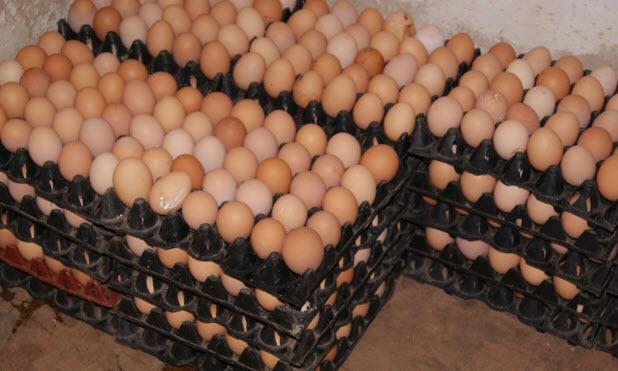
The Federal Government recently disclosed plans to launch yet another fund for the agric sector, this time, a N10 billion fund for egg production which joins many others before it. The fund for the National Egg Production Scheme (NEPRO) in the country is to be disbursed with the support of the Central Bank of Nigeria (CBN), which has taken on similar roles in recent times.
The target of the scheme is to achieve a daily production of 50million eggs over the next five years for the purpose of local consumption, export and processing into egg powder for use in confectioneries and pharmaceuticals.
This is one of the key aspects of the new scheme which requires deliberate planning and strategy is done, to ensure that eggs do not end up getting produced in abundance, only to result in a glut.
Olatunde Badmus, chairman, Tuns Farms Limited, which is the Anchor for the scheme, said in an interview with a local newspaper, that “the Eggs we are producing now makes up about 10% of our national requirements, and under this MOU we will not have a glut again in this county, every time we produce eggs in excess, we are going to process into egg powder as we are going to have six egg powered machines in each zone of the country. That will consume about 100,000 eggs every hour that will turn them into powder and instead of importing egg powder from India or anywhere, we are going to be producing egg powder for children’s meals.”

READ ALSO: Experts see wealth creation as missing link to tackling unbanked population in Nigeria
While the egg production scheme is to take off, there is no evidence that the required processing facilities have been put in place for the conversion of eggs into powder form. This will on one hand reduce the need to keep importing egg powder, while also offering guarantee that the increase in production will not result in a glut.
Badmus, had however said during the flag-off for the scheme, that “the secondary aspect of the production is processing that is capable of crushing 200,000 eggs per hour. The factory is expected to take off in June this year, because it is expected that the eggs would start coming out from that period.”
Some stakeholders also express reservations on the structure of this scheme, which they think unduly gives the anchor an undue advantage, while also putting some smaller players in the industry at a disadvantage.
“it is a good development, no doubt about it, but this idea of having one company as the Anchor, I don’t really think that is good at all,”said Tunji Falade, chairman, Agric & Agro-allied Group at the Lagos Chamber of Commerce and Industry. “I think initiatives like this should have a multisectoral approach in it and not just one person.”

Still, the scheme is generally considered to be a plausible one which can give many poultry businesses the much needed lifeline to expand their operations.
Audu Ogbeh, the Minister of Agriculture and Rural Development, during a press conference announcing the launch of the programme, disclosed that the programme would provide one million jobs nationwide through egg production, processing and marketing.
Ogbeh disclosed that the loan to be provided by the CBN will be disbursed by the Bank of Agriculture (BoA), at a single digit interest rate of nine percent, and would be piloted in six states of Abia, Cross River, Ondo, Kebbi, Kogi and Ondo.
He explained that if the loan is approved by the CBN each farmer would get N4.2million with repayment spread over 30 months, each farmer would be self reliant with physical assets worth over N2.8million and cash assets of N1.68million.