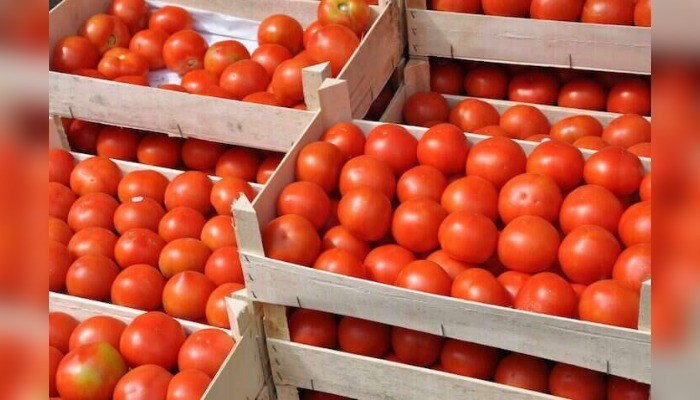
Private sector initiatives in redefining the agriculture value chain in Nigeria through innovation recorded another feat on Sunday with the deployment of a reefer truck for the transportation of tomatoes from the North to South.
The first experience of Cold Chain Tomatoes delivery from Kaduna State to Lagos State was facilitated by Naija Pride in partnership with APMT and collaborating with Technoserve, GEMS 4, Pyxera, and Nigeria Yieldwise Project.
The successful delivery forms a crucial part of evolving models for addressing post-harvest losses and profitability, particularly for the tomato crop which suffers a 40 per cent loss, valued at N72 billion annually, between farm and market.
READ ALSO: Climate change, low farm yields spark fears of food insecurity
BusinessDay gathered exclusively, that the consignment was transported by an APMT Reefer which left Dutsen Wai in Kaduna state, in the early hours of Friday, December 1, and arrived in Lagos on Sunday, December 3, with 933 crates of tomatoes each weighing 20 kg, a cumulative of 18,660 kg or 18.6 metric tonnes. Nigeria is the 13th largest producer of tomatoes in the world and the second after Egypt in Africa, yet the country is unable to meet local demand because about 40 per cent of tomato produce is wasted due to poor packaging, transportation and storage.

Tomato demand in Nigeria is put at 2.2 million metric tons per annum, while the annual actual production is 1.5 million metric tonnes but 700,000 metric tonnes is lost to post-harvest wastage, leaving only 800,000 metric tonnes supplied to the market, data obtained from the agric ministry shows. Tomatoes transported by road from the North to markets in the South of Nigeria in raffia baskets are heaped on each other, resulting in a significant volume being crushed and rotting due to heat and poor ventilation along the way.
Emmanuel Ijewere, vice president, Nigeria Agribusiness Group (NABG), told BusinessDay that; when the shipment left Kaduna, it was preserved at a temperature of 12 degrees Celsius, and on arrival in Lagos, was 14 degrees Celsius. This ensured that the tomatoes were adequately preserved as against the regular form of transportation which exposes investments in freighting the commodity to a lot of spoilage risks. As Ijewere noted, “losses are the biggest problem along the roads; caused by the heat and instability. The tomatoes are also transported in baskets which are themselves destructive and have a lot of microbes. Now, they are in crates, with ventilation going through them, and they are also in a chilled, controlled environment. So it arrives in the market cool.
READ ALSO: In six charts, how prices of staple food items in Nigeria have fared in four years
“When there is a breakdown along the road, you have more peace of mind because the reefer remains refrigerated. But, if it was the normal trucks, the heat will just cook the tomato. The longer it stays on the road (particularly in hot condition), the lower the quality and the lower the sellable price,” Ijewere said. On his part, Henry Akintoye, president, Horticultural Society of Nigeria, described the initiative as a positive development which will transform the value chain, not only for tomatoes but all other perishable crops in the country. This, he says will ensure more wealth is retained in agriculture and not lost due to avoidable wastages.
Akintoye however expressed the view that establishment of “park houses” should be given adequate consideration, where such facilities (with provision for cooling) will be located in different areas nearby for farmers to get their perishable crops aggregated. From these places, they can then be transported either to urban centres where they will be consumed or to the airports for export. This point resonates Nigeria’s laxity in the provision of refrigerated space with a meagre 15,000 cubic metres of refrigerated space. In Africa, Egypt has the highest refrigerated space with 3 million cubic metres, while India has the world’s largest refrigerated space at 131 million cubic metres, the USA has 117 million cubic metres, and China has a little over 90 million Cubic metres.

It has however been advocated that, without conscious efforts and investment to preserve the food produced in Nigeria, the country will continue producing food which is insufficient as it will also mostly get wasted. BusinessDay also learnt that the cost of transportation through these refrigerated trucks is twice the normal transportation. However, this is compensated for through the elimination of risks in spoilage. Furthermore, there are plans to consolidate on the model by adopting solar panels which will be mounted on the refrigeration units, thereby bringing the cost even below that of the present mode of transportation.
CALEB OJEWALE