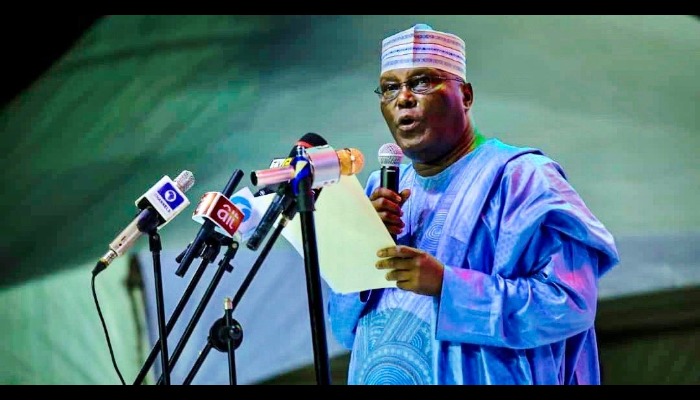
On Friday, November 24, one of the biggest political heavyweights in Northern Nigeria left the All Progressives Congress (APC) to seek a greener pasture elsewhere.
Atiku Abubakar, former vice president of Nigeria, in his characteristic manner, dumped the APC, predicting his exit on the party’s inability to deliver even the mundane things and for snubbing the youths. He alleged that the same fractionalisation for which he left the PDP on August 31, 2013, has made a home in the APC, with no remedy in sight.
“While other parties have purged themselves of the arbitrariness and unconstitutionality that led to their fractionalisation, the All Progressives Congress has adopted those same practices and even gone beyond them to institute a regime of a draconian clampdown on all forms of democracy within the party and the government it produced,” he said.
READ ALSO: Why Atiku remains best man to lead Nigeria- support group

Being an astute politician, the Turakin Adamawa, as he is known, used the words of his political enemy, Governor Nasir El-Rufai of Kaduna State, against President Muhammadu Buhari.
“Only last year, a governor produced by the party wrote a secret memorandum to the president which ended up being leaked. In that memo, he admitted that the All Progressives Congress had ‘not only failed to manage expectations of a populace that expected overnight change but has failed to deliver even mundane matters of governance’,” Atiku said.
“Of the party itself, that same governor said, ‘Mr. President, the Sir, Your relationship with the national leadership of the party, both the formal (NWC) and informal (Asiwaju Bola Tinubu, Atiku Abubakar, Rabiu Musa Kwankwaso), and former Governors of ANPP, PDP (that joined us) and ACN, is perceived by most observers to be at best frosty. Many of them are aggrieved due to what they consider total absence of consultations with them on your part and those you have assigned such duties,” he said.
Atiku concluded that since that memorandum was written up until the date he announced his resignation from APC, nothing had been done to reverse the treatment meted out to those invited to join the party on the strength of a promise that has proven to be false.
The “party we put in place has failed and continues to fail our people, especially our young people”, he said.
In a previous letter of resignation Atiku sent to his ward chairman at Jada 1 Ward, Jada Local Government Area of Adamawa State, which came to the fore after APC claimed it had not received his letter, the former vice president said he was unable to reconcile himself with the dismal performance of the party in government, especially about the continued polarization of Nigerians along ethnic and religious lines, which is threatening the country’s unity more than at any other time in the recent past. He also cited the unbeatable hardship hitting Nigerians as another reason for his exit.
READ ALSO: South-East Development Commission Bill: Remembering a neglected region?

Atiku’s next move
While Atiku’s next move remains a subject of speculation, and while the former vice president has said he was taking his time to “ponder” his future, without even looking into the crystal ball, many political pundits say Atiku may have concluded arrangements to return to his former party, the People’s Democratic Party (PDP), with the hope of picking the party’s presidential ticket for 2019. They say the signs are evident from Atiku’s body language, adding that considering the option of floating a new party may not be in the picture.
“From what we have heard so far from various sources, I think Atiku is on his way back to the PDP,” said Eddie Ekpeyong, a data analyst with a Lagos-based tech firm. “Some people say he was going back to his vomit, but I say no. This is politics; when you are not wanted in a party, you move ahead and try your luck elsewhere. You have to be restless to achieve some of your dreams. For me, I think it would be more beneficial to him if he swallows his pride and goes back to the PDP than floating a new party,” he said.
Neither the former vice president nor his media office has either denied or confirmed this speculation. Just recently, Atiku displayed a picture on his Twitter page, where he was shaking hands with former President Goodluck Jonathan whom he had jettisoned in the build-up to the 2015 elections. Atiku’s newfound romance with Jonathan is perceived as an attempt to woo major PDP stalwarts.
The PDP question
With speculations rife that Atiku is jostling to return to PDP and also considering a brand new alliance that will incorporate the PDP and unhappy APC members in case his chances seem cloudy in the main opposition party, political watchers say his chances of returning and clinching the PDP presidential ticket depend on who emerges chairman of the party at the December 9 national convention.
“He may try to support some candidates during the convention. It is not out of place in politics,” said Festus Ugwa, a PDP member in Anambra State.
At the moment, many interests are scrambling to control PDP. Ahmed Makarfi, PDP caretaker chairman, is seen as a man with presidential ambition. Ibrahim Aliu, campaign manager of Bode George who is aspiring to be PDP chairman, has already alleged that the 2019 presidential ambition of Makarfi will affect his ability to conduct free, fair and transparent convention.
READ ALSO: Stakeholders urge FG to sign National Quality Policy into law
Goodluck Jonathan, the former president, is also interested in holding the opposition party’s grip, while Nyesom Nwike is fighting for the emergence Uche Secondus, a former acting chairman of the PDP National Working Committee and a former chairman of the party in Rivers State.
Meanwhile, more than a week before Atiku officially announced his resignation from APC amid speculations that he was returning to the PDP, Walid Jibrin, chairman, PDP Board of Trustees, had said that the former vice president had not informed anybody of any intention to return to the PDP after dumping the party for APC ahead of the 2015 election.
Jibrin, however, said his party was ready to accept Atiku if he made a come-back journey, but maintained that there would be no automatic ticket for the former vice president and now presidential aspirant in the coming 2019 general elections.
“We are ready to accept him to our party but he should be ready to work for a waiver. The North met in Abuja to say that any candidate from the North can contest. Let us get them. I think they are getting set now. For now, we have a former governor of Kano State, Ibrahim Shekarau; former Jigawa State governor, Sule Lamido; a former governor of Sokoto State, Attahiru Bafarawa, and so on, preparing to vie for the PDP presidential ticket,” Jibrin said.
“If the PDP grants Atiku a waiver, he should then join the cream of presidential aspirants in the party to fight for the ticket in 2019. If the PDP considers Atiku for the automatic presidential ticket, what about those in the party who are showing interest? Should we throw them away? If he is coming, he should come as an equal partner. We are ready to accept him, but he must follow the rules of the game. First, he must undergo primaries like any other person, and he must fight for the presidential ticket,” he said.
Atiku’s chances
Atiku is generally seen as a liberal-minded, detribalised politician, a bridge-builder who has friends and wide contacts in all parts of the country, including the South-East and South-South, and can reach out – unlike Buhari who is yet to substantially convince the two regions that he has their interests at heart.
Francis Apoti, a youth member of the PDP, told BD SUNDAY that Atiku seemed to be the best option for Nigeria at the moment.
“I think the situation we have found ourselves in now needs a person of Atiku Abubakar’s stature. He seems to be a detribalized Nigerian; he is visionary and I also think that he is acceptable across the ethnic and religious divides that make up Nigeria. I believe he can pull this nation back from the brink of destruction,” Apoti said.
“I have listened to the debates on restructuring and I am happy about what he has continued to say. He has continued to canvass the need to alter the status quo for Nigeria to achieve sustainable peace, unity and progress, whereas most of our politicians are committed to the sustenance of the failed status quo,” he further said.
Recall that Atiku has consistently spoken in favour of restructuring Nigeria. Riding on the mood of the moment, Atiku has used every opportunity he has to harp on the need to restructure the country, contending that it was Nigeria’s only option. This has continued to endear him to many proponents of restructuring, even though political analysts say he may only be playing politics with those utterances.
READ ALSO: 2019: Finally, Atiku signs Peace Accord
Prospects of an Atiku presidency
It may be too early in the day to say what the campaign promises of Candidate Atiku Abubakar would be, assuming he clinches the highly coveted PDP ticket. However, a look at his antecedents may provide a guide.
In a paper he presented on the eve of Nigeria’s 50th Independence anniversary in Enugu, Atiku had given a glimpse into areas he would likely concentrate if elected president of Nigeria.
In the lecture presented at the 50th-anniversary celebration of the Enugu Sports Club on September 3, 2010, Atiku said while there seems to be a wide consensus in Nigeria around issues like the country’s place as a market economy driven essentially by the private sector; the rule of law and enforcement of contracts; federalism as the organizing framework for the Nigerian nation; need for multiparty democracy and a free, fair and transparent electoral system; and the need for fairness and equity in the distribution of the nation’s resources and in the treatment of various states and ethnic nationalities that make up the Nigerian nation, the challenge has been to consolidate on these pillars and to deepen transparent and visionary leadership and governance at all levels of society.
“In my two and a half decades of active participation in Nigeria’s politics, I have devoted myself to the promotion of these ideals. As I have always stated, I envision a Nigeria that is prosperous, peaceful, democratic, secure, caring and confident. I dream of a Nigeria that will be among the world’s best.
“Realising that vision would require a government that creates conducive conditions, and puts in place incentives, for productive investment in our country. That would lead to the creation of massive numbers of jobs, which will keep our youths gainfully employed and help to reduce the high level of insecurity in our country.
“To significantly increase our productivity, we must invest massively in education, research and modern technology, and infrastructure. These would lead to increased prosperity which will enable us to provide sustainable and enabling social services. We will thus become a more caring society as we give more support to those who need it.
“When we grow our economy and become more prosperous and secure, we would be better able to confidently take on the world, a world that would be more respectful of Nigeria and Nigerians. We will be confident to visit any part of the country without the fear of attack by armed robbers and kidnappers. And Nigerians will, once more, be proud of our green passport as it will no longer be an excuse for being singled out for further scrutiny at international entry ports,”,” Atiku said in the lecture themed ‘A Tale of Two Entities: The Enugu Sports Club and Nigeria’.
The former vice president said one issue that was central to him was the question of youth empowerment, adding that with more than half of the population being below 18 years, the future of Nigeria depended on what “we do today for our youths”. He said the future was doomed if the youths continued to be neglected, stressing that “youth unemployment is a national crisis”.
“I have committed to creating millions of jobs as president. But we cannot achieve these without creating a Nigeria where every citizen will feel a sense of belonging, with a significant stake in its greatness, and thus working hard for the Nigerian nation to endure and prosper. There are cries of marginalization and neglect all around the country. We cannot ignore these and hope that the polity will be sustainable. Without political stability, no sustainable development of the nation can take place,” he said.
READ ALSO: Atiku is giving hostages to fortune in a quest for power
Wooing the South-East/South-South
Political watchers say that Atiku is particularly banking on Jonathan’s support not only to clinch the PDP ticket but also to convince the South-East and South-South to give him block vote.
“This is just a simple logic. Atiku thinks Jonathan can influence things at the party. Secondly, Jonathan had 12 million voters in 2015, most of whom will still vote for him again and again if he contests. Atiku knows that Jonathan can convince these people, who are mainly from the South-East and South-South, to support him. This is the reason behind his new-found love with Jonathan,” a PDP stalwart in Rivers State told BD SUNDAY.
Atiku himself appear to know where the shoe pinches the South-Easterners and has also used every available opportunity to appeal to their sentiments.
In his September 3, 2010 lecture at Enugu, Atiku had argued that while every zone of the country had its own list to demonstrate some sense of neglect or marginalization, the signs were glaring in the case of the South-East.
“Many Nigerians would not dispute that the South-East has some of the most deplorable federal roads in Nigeria. Why is kidnapping becoming synonymous with the South-East? Why would the South-East not have the same number of states as other zones? Why is the Onitsha seaport commissioned by President Shehu Shagari in 1982 not being used? Why has it taken more than 11 years to build the Onitsha-Owerri road, a distance of about 100km? Why has the second Niger Bridge remained on the drawing board for several years? Why has there been no functional international airport in the South-East despite the huge demand? Why are the Igbo whom we appointed into high Federal Government positions being displaced? When will an Igbo man become president of Nigeria?” he had questioned.
Atiku also lamented the death of industries and cities in the South-East, citing the Emene Industrial Layout in Enugu and the Onitsha-Nnewi-Aba industrial complex which, he said, had become ghosts of their old selves.
“Furthermore, at 50, and 40 years after the civil war, Nigeria should be able to reassure the South-East that indeed the war has ended by ending the neglect and marginalization of the zone. Nigeria should effectively resolve and put the question of abandoned properties behind us. Some 40 years after the civil war, it is about time that someone who is Igbo, one of Nigeria’s three largest ethnic groups, becomes president of Nigeria. This will be the boldest way to put the civil war behind us,” Atiku said.
Atiku vs Buhari
One erroneous permutation by APC is that the South-East and the South-South, especially the South-East, will vote massively for Buhari in 2019. The assumption is predicated on the recently concluded Anambra governorship election where the APC candidate, Tony Nwoye, came second, having 98,752 votes.
Analysts see this thinking as a miscalculation, given that the people themselves say they gave Nwoye some of their votes because he was not an outsider.
Up till now, Buhari has not done much to woo the actual voters in the South-East and this may count in Atiku’s favour.
The South-East particularly will gladly vote for Atiku, whom they see as someone that will not marginalise them like Buhari.
If Atiku gets votes from the two regions, and add more votes from South-West, North-East and North-Central, then Buhari might struggle to win in 2019, analysts say.
READ ALSO: Atiku Abubakar wins a fair contest
Another ground upon which Atiku is hoping to the bank is Buhari’s economic failures. The inflation rate was less than 10 per cent in 2015 but is now above 15 per cent. A litre of fuel, which was between N85 and N90 when Buhari became president, is now N145. A 50kg bag of rice was less than N10,000 during the immediate past administration but is now above N13,000. Prices of foods and commodities have risen, in some cases two-fold, owing to poor management of the economy by Buhari and his team.
Infrastructure is still decrepit and one dollar has jumped to N305 in the official market and N360 in the parallel market, due to perceived mismanagement of the FX market by the Buhari team.
The APC promised to fix power six months after its emergence, but the power supply is now worse two and a half years after.
In terms of human rights and abuse of power, APC and the present administration have done the same or even worse, in some cases, of what PDP did for which the APC criticised it.
Atiku is particularly banking on Buhari’s economic failures to launch his presidential ambition, despite that some of them are completely out of Buhari’s control.
He knows that some of the crowd of people who shouted ‘Sai Buhari’ in the North and South-West in 2015 are disillusioned today.
Again, Atiku’s chances will be brightened in the South based on his position that only restructuring will save Nigeria. Whether he will restructure Nigeria when he becomes president or not is a different ball game.
The odds
Atiku must ready his media team to fight off corruption allegations that will dog his path once he officially joins a new party.
He must be ready to clear himself of corruption allegations by the United States of America’s Senate Committee on Homeland Security and Governmental Affairs, which said he wired millions of dollars to offshore accounts 2000 to 2008 while he superintended the Nigerian Petroleum Development Fund.
One of the biggest challenges that will be thrown at him is to visit the USA. If Atiku can visit the USA and clear some doubts, he will likely win the confidence of many voters.
Again, many voters believe that Atiku is now bereft of ideas and has nothing more to offer.
One Twitter user said that Atiku and Buhari as candidates of two major parties in 2019 will be two bad choices. Many Nigerians are seeking young and technology-minded Nigerians to lead them in 2019.
“Atiku’s chance now is not as bright as it was in 2003 when he traded his opportunity to Obasanjo. He is also no longer young, which will be a factor in 2019,” said Mathew Ibeabuchi, a political analyst and former House of Representatives aspirant.