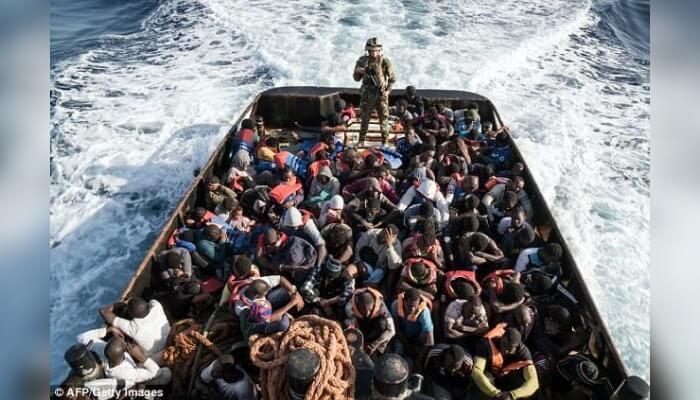
They may be dead, but the circumstances surrounding their death and burial remain fresh in our collective memory. Looking for greener pastures, these 26 young women who were probably part of a larger crowd set out to distant lands, only for their bodies to turn up in a sinking vessel on the Mediterranean about three weeks ago.
Two weeks after their death was announced, Nigerians were perplexed when the young women were given a state burial in Italy with only Italians and some sympathetic Italy-based Nigerians as witnesses, with no representative from the Nigeria High Commission in Rome.
In disbelief, several Nigerians took to social media to ask if Nigeria was represented. To these queries, Trisha Thomas, of the Associated Press, Rome, replied: “In response to those who asked, I did not see any official Nigerian representative at the ceremony today for 26 women.”
READ ALSO: Group advocates inter-agency collaboration to fight human trafficking

The Federal Government would later condemn the “hasty burial” of the 26 migrants by the Italian authorities and the fact that the burial took place nine days ahead of the slated date.
Abike Dabiri-Erewa, senior special assistant to the president on foreign affairs and diaspora, told journalists in Abuja that the Italian Embassy had earlier indicated to the director-general, National Agency for Prohibition of Trafficking in Persons (NAPTIP), that the burial would take place in Salerno, Italy on November 26, 2017.
“Why were they (the bodies) hurriedly buried nine days before the date communicated to the DG, NAPTIP by the Italian Embassy without any information to the Nigerian government? Why the rush to bury the bodies without carrying out a post-mortem to determine the causes of death?” she queried.
She said that from available information, only three of the girls were identified as Nigerians and that the identities of the other victims had yet to be ascertained before they were interred.
But to Dabiri-Erewa’s question above, a respondent on Twitter, reacting via the Twitter handle @Latunji, said, “The Nigerian government and Abike Dabiri are hell-bent on embarrassing this country. Our ambassador was 90 mins away by train, why did we have to depend on the Italian government for information? Did our ambassador even bother to visit?”

READ ALSO: Edo govt receives, reintegrates over 5,000 returnees in 3 years
Many Nigerians were quite vocal about their feelings and what they thought about the government. One could read the anger, disappointment, helplessness and despair in their responses. The decried the fact that “the life of a Nigerian is rather cheap and the victims, mere statistics”; that the happenings in Italy have shown that what Nigeria has as ambassadors abroad are mainly figured heads and political appointees and that the welfare, plight and lives of Nigerian citizens resident in countries where they are ambassadors mean next to nothing to them.
‘slave markets’ for migrants
But while the dust of this disheartening development was yet to settle, CNN drew attention to the inhumanity happening in Libya as it released an exclusive report entitled “People for sale: Where lives are auctioned for $400!”
Describing the auction process for these humans in the introductory part of the report, CNN said, “One of the unidentified men being sold in the grainy cell phone video obtained by CNN is Nigerian. He appears to be in his twenties and is wearing a pale shirt and sweatpants.”
First Lieutenant Naser Hazam of the Libyan government’s Anti-Illegal Immigration Agency in Tripoli told CNN that although he had not witnessed a slave auction, he acknowledged that organized gangs operated smuggling rings in the country.
“They fill a boat with 100 people, those people may or may not make it,” Hazam said. “(The smuggler) does not care as long as he gets the money, and the migrant may get to Europe or die at sea.”
“The situation is dire,” Mohammed Abdiker, the director of operation and emergencies for the International Organization for Migration, said in a statement after returning from Tripoli in April. “Some reports are truly horrifying and the latest reports of ‘slave markets’ for migrants can be added to a long list of outrages.”
READ ALSO: We have recorded substantial gains in the fight against human trafficking in Edo – Obaseki
William Lacy Swing, director-general, UN Migration Agency, aired his opinion on the plight of migrants, saying that the “detainees’ harrowing stories have left an indelible mark on me, both the journeys to Libya and the endless misery of unjust detention”.
“Their ordeal begins before reaching Libya. Tragically ill-equipped, these sub-Saharan Africans travel in open trucks across a thousand or more miles of desert with little food or water. Countless witnesses have testified to seeing friends abandoned after falling off trucks, only to be left to die.
“Once over the border and in the hands of people smugglers, a fresh nightmare begins for the migrants. One man reported systematic beating and rape; others witnessed people being starved to death or shot,” he said.
Swig said the agency he runs focuses on saving migrant lives. “In multiple meetings with various Libyan authorities, I have requested that they do all in their power to stop rounding up migrants and confining them to detention centres where they lose their freedom and dignity.
“I have also called, repeatedly, for the establishment of alternatives to detention and to ensure accountability for abuses perpetrated against migrants in detention.
“Engaging with Libyan authorities seems to be paying off. I’m happy to report that seven of the more than 30 official migrant detention centres in Libya have closed recently,” he said.
“While this is progress, IOM calls for all detention centres — official and nonofficial — to be closed and replaced with open centres, where migrants’ basic human rights are respected. We stand ready to provide the necessary support to the Libyan authorities that would help make this a reality,” he added.
“Indeed, already this year IOM has managed to return over 10,000 stranded migrants to their homes — many of whom had spent months, or even years, in Libya’s worst detention centres. Since 2015, we have flown a total of 13,530 men, women and children home to 30 countries,” he said.
According to the CNN investigation, the auctions take place in a seemingly normal town in Libya filled with people leading regular lives. Children play in the street; people go to work, talk to friends and cook dinners for their families.
But inside the slave auctions, it’s like we’ve stepped back in time. The only thing missing is the shackles around the migrants’ wrists and ankles. According to Swing, many detained migrants want only to go home and right now; often, only IOM can help them.
Meanwhile, CNN said the evidence it filmed has been handed over to the Libyan authorities, who have promised to launch an investigation.
“After the auction, we met two of the men who had been sold. They were so traumatised by what they’d been through that they could not speak, and so scared that they were suspicious of everyone they met,” CNN said.
Unhealthy silence
In her reaction to the report, Dabiri-Erewa described the act of auctioning human beings as “totally unacceptable, despicable, and inhuman and should be condemned by anyone who is human and has blood running through their veins”.
While she appealed to the African Union, European Union, United Nations High Commission for Refugees, International Organisation on Migration and the Economic Community of West African States to intervene in the matter and tackle the issue of slavery happening in Libya, she failed to hold the Nigerian government accountable for its apparent slow response and tardiness in an issue of this nature involving lives of Nigerians.
After the report was published, by 6:45 pm, Jennifer O’Mahony, AFP’s West African correspondent, announced via a post that “Burkina Faso has recalled its ambassador to Libya over black African slavery markets operating there following @CNN report from November 15.”
“UN Secretary-General says Libya slave auctions may be a crime against humanity. African nations who have reacted so far: Guinea, Senegal, Burkina Faso, Niger.
“Outpouring of anger from Nigerians on my feed who want to know why their government is not making bold statements over the Libya black slave market auctions as Burkina Faso has by recalling its ambassador,” O’Mahony.
As at the time of this report on Friday, the Nigerian government was yet to make any concrete official statement or take any action on this issue involving Nigerian citizens.
Mabel Dimma