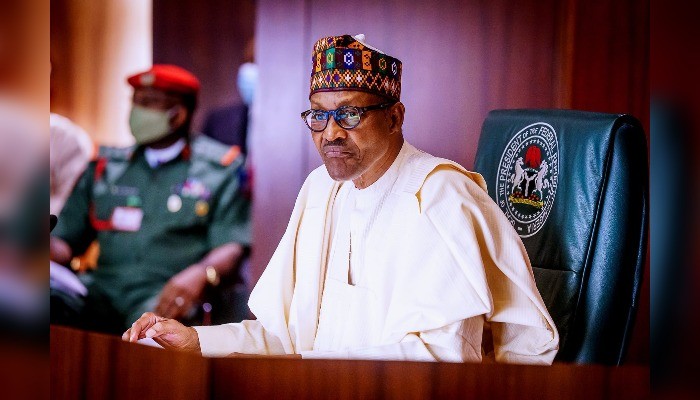
President Muhammadu Buhari has reassured that his administration is working hard to ease the present economic hardship through job creation, as well as the provision of social security for vulnerable Nigerians.
The president stated this Thursday, at the public presentation of his mid-term scorecard at the Presidential Villa, Abuja.
The 360-page book titled “Making Steady Sustainable Progress for Nigeria’s Peace and Prosperity ” was launched by the former Lagos State Governor and chieftain of the All Progressives Congress, Bola Ahmed Tinubu.
The President assured that his commitment to fighting corruption, tackling the nation’s security challenges and restructuring the economy, would continue to occupy a strategic place in his administration.

READ ALSO: Nigerians’ immigration to Canada booms amid economic downturn, hardship
He also promised to address the issues of the farmers- herdsmen clashes, kidnapping and armed robbery to ensure peace, across the country.
“We have gone through difficult times due to the world economic recession, we are coming out of recession and efforts are targeted at easing economic hardship, with more jobs and social security for vulnerable families and unemployed youths and developing infrastructural projects,” he stated.
The president also vowed to work with the international community to recover the remaining Chibok girls still being held by Boko Haram and said the government had so far recovered 103 Chibok girls, most of who are doing well in their academic pursuits.
At the event, many of the speakers applauded Buhari for setting the pace for economic progress, but cautioned against poor policy implementation, adding that economic indices show that Nigeria’s economy remains fragile.

While unveiling the 360-page book, guest speaker and former governor of Lagos State, Bola Ahmed Tinubu, listed three things the Buhari administration must do to keep Nigeria afloat.
Tinubu called on the government to urgently pursue an industrial revolution policy that will partner with the private sector, protect key industries, promote employment and encourage exports.
Such policy, he said, must be implemented with a laser-like focus” adding that “no populous nation has ever attained prosperity without first establishing a robust industrial capacity.”
Citing the experiences of countries like England, the USA, Japan and China, Tinubu said they implemented policies to protect key industries, promote employment and encourage exports.
“If Nigeria is to be a leader in the next phase of global economic history, we must learn from these prior successes,” he said, adding that the common thread among them was the objective of buffering strategic industries in ways that allow for the expansion and growth of the overall economy.”
He also emphasised the need for strong public-private sector collaboration to enhance cooperation, adding that, “As the private sector partners with government on public endeavours, the government must guide and support the private sector into new areas of industry and production.
As part of the agenda for the Buhari administration, the government was asked to focus on research and development of new products the private sector may find risky and uncertain in the initial stage.
Tinubu also called for a policy that must push and incentivise the private sector into the production of goods that will be demanded in the immediate future and for some time to come, a policy that will need unprecedented coordination between the private sector and government.
READ ALSO: Nigeria insurers deliver returns to shareholders amid economic downturn
He said, “Whether we focus on steel, textiles, cars, machinery components, processed agricultural goods, other items, or any combination of the above, we must manufacture things the rest of the world wants to buy and not necessarily the things we think are the easiest to do.
“Second, as a corollary to the push for industrial maturity, we need a national infrastructural plan that accords with both the industrial plan and with extant agricultural activity. The fulcrum of this plan must be continued progress in the achievement of adequate and affordable electric power, especially solar and winds”
He also called for a return to commodity exchange boards era or similar mechanism, to allow farmers to secure their income and hedge against loss. An active and expanded agricultural loan scheme is needed to further promote these goals.
The absence of capital for small and medium scale businesses, he said, requires a new policy that will reduce interest rates and make business and consumer credit available.
“We also must move towards true federalism by the balance of power and responsibility between the Federal Government and the states. In so doing, we attain the correct balance between our collective purpose on one hand and our separate grassroots realities on the other.
“Noise abounds. Voices rise. Critics moan. The angry and the desperate even question whether this nation should exist, whether it is an experience or experiment that has failed.
“Mr President, the noise can be loud, almost deafening at times. Yet ultimately, both noise and clamour shall fade, for progress.
“What shall be left is reality and fact. The core reality, the fact of our political existence, is that Nigeria is an indivisible entity; a nation of many peoples wedded in a common enterprise, with its better days yet before it.”
Minister of Information and Culture, Lai Mohammed, listing the progress made by the administration, said the administration improved power from a transmission capacity of 5,000MW in 2015 to 6,700MW, even as distribution capacity was raised from 4,000MW to 4,600 MW and on the grid power to 6,619MW, from less than 3,000 in 2015.
He berated the Jonathan administration for spending N18 billion on roads, N5 billion on power and N1.8 billion housing in 2015 without results.
In comparative terms, he said the current administration, despite dwindling resources, spent N198.25 billion on roads, N91.2 billion on power and N71.559 billion on housing in 2016, adding that “We constructed or rehabilitated 766 kilometres of roads across the country in 2017.”
He declared that” inflation has fallen for the eighth consecutive months this year. Foreign reserves are up to $34 billion, from $24 billion a year ago”
Nigeria is out of recession and the economy is on the growth trajectory again, after the economy contracted for five consecutive quarters.
“Despite the downturn in oil prices, this administration was able to invest an unprecedented sum of over N1.2 trillion in capital projects through the 2016 Budget, the highest ever in the history of this country.”
“Our Sovereign Wealth Fund, which was established in 2011 with US$1 billion, did not receive additional investment for four years when oil prices were as high as US$120 per barrel. This administration was able to invest an additional US$500 million into the Fund.”
Buhari’s government also declared that “stability has been restored to the foreign exchange market.”
“Recently, we achieved a positive movement in the World Ease of Doing Business Index, moving 24 places to 145th position in 2017. Nigeria is among the top 10 reforming countries in the world.”
Tony Ailemen, Abuja