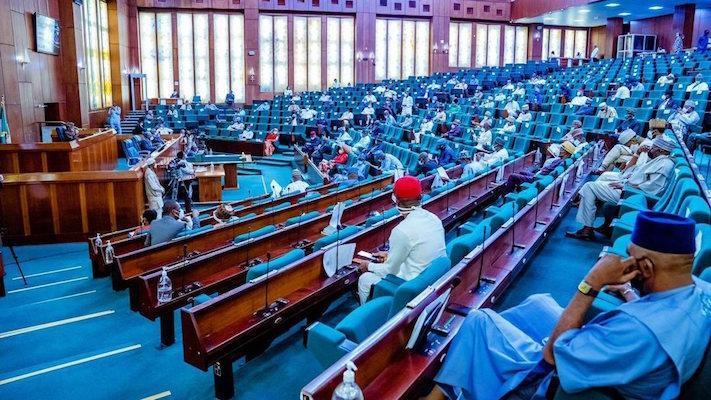
The House of Representatives, on Tuesday, approved the Federal Government to issue $5.5 billion Eurobond from the International Capital Market, for the financing of the capital expenditure projects in the 2017 Appropriation Act.
According to Nigeria’s Economic Team the proposed $2.5 billion Eurobond or a combination of Diaspora bonds or a combination of Eurobond and Diaspora Bonds to finance the N2.356 trillion budget deficit while $3 billion Eurobond or loan syndication by banks for refinancing maturing domestic debt obligations of the Federal Government.
READ ALSO: Reps seek budgetary increase for Army’s capital projects
The delegation assured that Nigeria has attracted investors confidence with five coupons made since 2011 when it raised $500 million at 10 yearyears6.75%;
$500 million in 2013 (5year at 5.125%) and additional $500 million in 10 yearyears6.375%); $1.5 billion in 2017 (15 yearyears7.875% while $300 million Diaspora Bond in June 2017 (5year at 5.625%) rates respectively.

President Muhammadu Buhari had in a letter dated 4th October, 2017 sent to Speaker Yakubu Dogara, solicited for approval of the sum of $3.2 billion external borrowing through the issuance of $2.5 billion Euro binds or a combination of Eurobonds and Diaspora Bond while $700 million is proposed to be raised from multilateral sources.
READ ALSO:Reps call for timely release of funds to MDAs
According to the report considered and adopted by the House at plenary, “the prior approval of the National Assembly shall be sought and obtained as to the parties, structure, cost of syndication and other terms and conditions of a loan syndication intended to be utilized in refinancing maturing domestic debt obligations.
“That the committee on Aids, Loans and Debt Management should monitor the disbursement of the proceeds of the approved $1.5 billion euro binds as specified in the 2017 Appropriation Act.”
Adeyinka Ajayi, chairman and members of the House Committee on Aids, Loans and Debt Management, laid the report which was considered at the Committee of the Whole and passed accordingly.

met with the representatives of the National Economic Team on Monday evening, vowed to adhere strictly to the provisions of the Fiscal Response Act, 2007 and 1999 Constitution (as amended) bypassing the MTEF/FSP before the 2018 budget.
The lawmakers including Jones Onyereri, chairman, House Committee on Banking & Currency; Johnbull Shekarau (PDP-Plateau); worried over the N12 trillion domestic debt and called for an amendment of the constitution of the Monetary Policy Committee as well as ensure synergy between the Monetary and Fiscal authorities in order to have seamless economic policy for the country.
Breakdown of the matured instruments between 30th November, 2017 to 15th February 2018 worth N1,080,705,632,000.
On his part, Ajayi (APC-Osun) who chaired the session, requested for details of the revenue generation and expenditure made so far in the year, and update on the Moody rating and its impact on Nigeria at the international market as well as terms and conditions for the proposed syndication.
He maintained that the Executive is not at liberty to embark on any form of borrowing on the guise that the MTEF/FSP document has been approved by the Parliament adding that MTEF/FSP is mere fiscal strategy paper but the Parliament must approve the policy direction. We passed the deficit but the terms and conditions were not stated nor approved,” Ajayi observed.
In his presentation, Ben Akabueze, Director-GeneralBudget Office who represented Udoma Udo Udoma, Minister of Federal Ministry of Budget & National Planning, urged the National Assembly to promulgate laws that will enhance revenue generation through taxes and compel all the N40 trillion worth of State Owned Public Enterprises to remit N847 billion (representing 2% of their value) to government coffer, through intensified oversight by the Legislature.
According to him, total revenue accrues into governments coffer was N3.3 trillion against N4.9 trillion expenditure leaving a deficit of N1.6 trillion for which the proposed external borrowing will be used to finance.
“What we have is revenue generation challenge not debt problem. Our focus should be on how to drive revenue. We looked at things like the state owned enterprises, for National Assembly to bring its oversight power for these agencies to generate funds.
“If we have aggregate investment of N40 trillion but they can’t generate N400 billion… What we are asking for is N847 billion or 2% is what we are asking for. Overtime they have exploited the window to get their budget approvals from the National Assembly. What they consider law is at variance with what we approve. What they say is that, that’s is what the committee approved, that is why the Committees need to focus on across the service generally,” he urged.
While soliciting for expedite action by the House and indeed the National Assembly, Akabueze, hinted that the 2017 window for the external borrowing will soon be shut if the approval required for the external borrowing is further delayed beyond November ending.
He added that most of the contractors may demobilize from projects sites if the National Assembly further delay in approving the proposed financing plans,
Akabueze also noted that about N211 billion from the total overhead for year 2017 has not been totally released, adding that in addition to the N450 billion released for capital expenditure as at October ending, President is committed to committing additional N500 billion including zonal intervention projects before the end of December 2017, if the borrowing succeeds.
On her part, Patience Oniha, Director General of Debt Management Office (DMO) disclosed that the N1.254 trillion was projected to be raised at the domestic market has been fully achieved leaving the N1.067 trillion to be raised at the international market, out of which only the sum of $300 million Diaspora Bond has been raised in June 2017, so far.
She, however, noted that if the $5.5 billion cannot be fully raised at the international capital market which remains the best option, it would be raised through a syndicate of banks under the Plan B. According to her, the choice of the consortium of banks will be subjected to the extent Nigeria’s Public Procurement Act.
According to the document submitted by DMO to the Committee, the country’s Debt to GDP ratio of N20.373 trillion ($66.634 billion) comprising of Federal, States and FCT stands at 17.85% as at 30th September, 2017.
When approved, the fund which amounted to about N1 trillion will help in the payment of matured debt by reducing the N12.496 trillion domestic debt stock as at September, 2017 financial statement.
Some of the projects to be financed as captured in the 2017 Appropriations Act include: N10.5 billion for construction of 3,050MW Mambilla Hydro Power Project; N7 billion for construction of Bodo-Bonny road with a bridge across the Opobo Channel in River State; N10 billion for construction of Second runway at Nnamdi Azikwe Airport, Abuja and N148.136 billion for Railway projects: Lagos-Kano; Calabar-Lagos; Kano-Kaduna; Ajaokuta-Itakpe-Warri; Kaduna-Idu counterpart funds and other rail projects.
READ ALSO: Reps pledge more support to Airforce in fight against criminal activities
According to Oniha, who explained that at macro benefits include: external borrowing option will help in long term repayment period of between 5 to 20 years; lower interest rate of between 7 to 8% at most against 16-18% at the domestic market; improve liquidity in the system and boost Nigeria’s foreign reserves, enhance provision of critical infrastructure and create employment opportunities for Nigerians.
While allaying the fears of the Parliamentarians on the exercise, she disclosed that the entire process at the international capital market is online and go through transparent process in line with global best practice, adding that the Monetary Policy report released by the CBN shows that Nigeria’s external reserves has hit $40 billion
She added that it will also stop crowding out of private sector and provide opportunities for domestic banks to lend to the real sector of the economy including telecoms as well as reduce the 90 days repayment of domestic debts, adding that about N91 billion that would be saved on servicing local debt serving through the external borrowing, could be used to finance other projects in the country.
The new DMO administrator added that the injection of about N1 trillion will also help in achieving 60-40% domestic/external borrowing policy adopted by the Federal Executive Council (FEC) in 2016, against the current 77% domestic ratio to 23% external borrowing ceiling; achieve the plan to reduce inflation and interest rate to single digit by 2020, as postulated by the Central Bank of Nigeria (CBN), adding that both the Fiscal and Monetary Policy authorities are on the same page on the economic recovery plans.
She lamented that the country resorted to borrowing due to 50% reduction in total oil revenue, adding that “this is the appropriate time to borrow, if the US reserve mop up like we used to do or raise its MPR” the market will no longer be favourable for Nigeria to explore.
In the bid to reducing demand for foreign exchange, she harped on the need to sustain the gains recorded in critical sectors especially in the agricultural sector through rice production; exportation of solid mineral; ease of doing business which will translate to capital and foreign direct investments inflow.