|
Getting your Trinity Audio player ready...
|
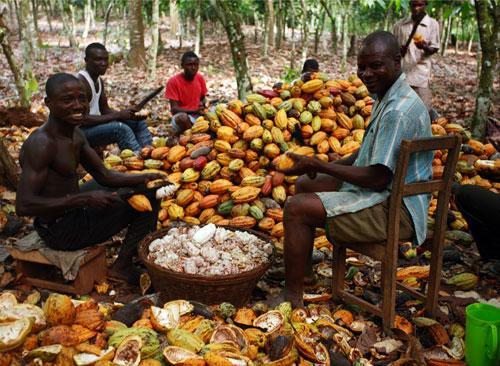
Nigeria cocoa output is seen hitting 203,300MT by December 2017 despite huge numbers of old and worn-out cocoa trees across major producing states in the country, as farmers commence main-crop harvest.
Farmers link the increase in production to favourable weather condition which has helped in boosting the country’s cocoa pod production in recent months.
“We expect that there would be a marginal increase in our cocoa production at the end of the year. Our total cocoa production will increase by 7 percent at the end of the 2016/2017 season,” said Robo Adhuze, chief operating officer, Centre for Cocoa Development Initiative in a telephone response to questions.
“There have been enough rainfall and sun as well to sun-dry but the prices of cocoa beans are a lot more lower than last year prices,” Adhuze said.

Nigeria has lost its position in the comity of cocoa producing nations when its production declined from 240,000MT in 2014/2015 season to 190,000MT in 2015/2016 season, pushing the country to seventh position globally.
Seven percent of 190,000MT is 13,300MT, meaning that Nigeria’s 2016/2017 production will hit 203,000MT (190,000MT plus 13,300).
But the International Cocoa Organisation (ICCO) forecast Nigeria’s 2016/2017 cocoa production to hit 200,000MT.
“Most of the cocoa pods we have seen across main cocoa producing states so far are bigger and better than that of last year main-crop when most of the pods were shrinking,” Zacheaus Egbewusi, chief executive officer, Agri-Commodity Inspection Limited told BusinessDay.
“Our production is going to increase marginally at the end of the season. The issue now is the price of the crop. Currently, a ton of cocoa sells between N580,000 to N600,000 MT unlike last year when farmers made money and were selling a ton between N1 million and N1.2 million,” Egbewusi said.

On year-on-year basis, global average price of cocoa has declined by 31 percent from $2881 per metric ton in September 2016 to $1998 per ton in September 2017, according to data from the International Cocoa Organisation (ICO).
Farmers across the country’s main producing states are very optimistic that Nigeria’s production will increase at the end of the 2016/2017 season but are worried about the prices and the worsening state of the Apapa and Tin Can gridlock, roads leading to the nation’s two busiest sea ports.
“My production this year is much larger than that of last year. But we have not started seeing a lot of buyers unlike last year when buyers where competing to buy from us,” said Hakeem Adebisi, a cocoa farmer in Ajebandele in Ondo state.
“Despite prices dropping by almost half compare to last year we are still not having rush for our cocoa. I called some of the exporters on phone and they are all complaining about the Apapa and Tin Can gridlock,” Adebisi said.
Rima Sayina, national president, Cocoa Association of Nigeria, said “there will be a slight increase in the country’s 2016/2017 cocoa production but the issue at the ports is a big challenge facing the industry currently.”
“Bad roads have been a mockery to the country’s ease of doing business. The Apapa port gridlock is a threat to the progress made on the non-oil sector by the Buhari-led government,” said Sayina.
He noted that the increase in the volume of cocoa production is under threat if the government fails to address the Apapa gridlock, as exporters will be unable to meet up with contractual agreements and farmers would be unable to sell their produce which in turn would affect their livelihood.
Nigeria has two cocoa harvests which includes the smaller midcrop from April to June, and the main crop from October to December. The midcrop normally accounts for about 30 percent of Nigeria’s cocoa output while the main crop accounts for the remaining percentage.