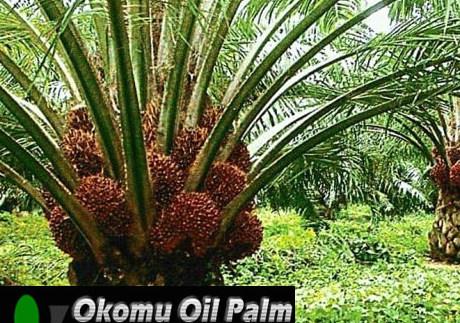
An upsurge in commodity prices has pushed up the earnings of Okomu Oil Palm Company Plc as the firm continues to focus on cost containment with a view to bolstering margins.
For the first six months through June 2017, Okomu Oil Plc’s net income surged by 73.53 percent to N6.23 billion from N3.59 billion earned in the first half of the previous year.
Sales spiked by 65.38 percent to N12.47 billion in June 2017 thanks to higher domestic crude palm oil prices.
Okomu Oil’s operating profit margin increased to 63.59 percent in June 2017 from 53.05 percent the previous year, which means the company, was able to translate increased sales to profit growth.

The firm plans to add 4000 hectares in 2017 to the existing 14,463 hectares-total oil palm area, while additional 1000 hectares would be added in 2018.
The oil palm producer’s N4.46 billion accumulated cash and cash equivalent gives it the leeway to finance the aforementioned expansion plan as it seeks to increase its market share.
Nigeria’s biggest oil palm producers have been experiencing high patronage for their products as ban on importers from accessing foreign exchange for certain products in June 2015 and the devaluation of naira reduced imports and bolstered demand for domestic goods.
Nigeria’s central bank stopped the importation of 41 items, including palm oil and textiles.
The company’s operating expense margins (operating expenses as a proportion of sales) fell to 26.06 percent in the period under review compared to 37.93 percent as at June 2016.

Okomu Oil’s return on equity (ROE) increased to 28.85 percent in the period under review as against 21.01 percent as at June 2016.
The Nigerian oil palm producer is lowly geared. This means the proportion of debt in its capital structure is low. Debt to equity ratio rose to 10.82 percent in June 2017 from 16.27 percent the previous year. Total trade and other receivables increased by 64.56 percent to N4.33 billion.
Experts say oil palm development can help diversify Nigeria’s revenue base to generate foreign exchange revenue as a drop in oil price since mid-2014 tipped the economy to its first recession in 25 years.
Nigeria, which dominated global oil palm market in the sixties, currently imports 552,000 metric tonnes (mt) of palm oil to augment the 970,000 mt being produced by farmers, according to Isaac Gyamfi, regional director, Solidaridad West Africa.
The country consumed 1.41 million tons of oil palm in 2013 while it produced 930,000 tons, according to data from the U.S. Department of Agriculture.
Nigeria is Africa’s largest producer of the product and the world’s fifth, behind Indonesia, Malaysia, Thailand and Colombia, according to data from the USDA.
Okomu Oil’s share price has risen by 79.81 percent since the beginning of this year, outperforming The Nigerian Stock Exchange All Share Index (NSE ASI).
The company’s share price closed at N72.23 at the NSE on Friday, valuing it at N68.90 billion.
BALA AUGIE