Paul Collier, renowned professor of economics, University of Oxford, Thursday, listed the ingredients necessary to actualise the Lagos’s dream of transiting from a mega city to a smart city.
Collier, invited as keynote speaker at the two-day international conference, holding at the Eko Hotel and Suites, Victoria Island, with the theme “Towards a Smart City”, moderated by Ayo Salami of the Lagos Business School (LBS), said to realise the dream, the government cannot shy away from a legislation that clearly defines the status of individuals with regard to property ownership.
“Every time I drive around your state (Lagos) I see the caveat: “This property is not for sale”. What this suggests is that there is absence of security in ownership of property,” said Collier, stressing that there have to be a legislation that truly defines ownership of property, such that an individual does not live in fears over the possibility of his property being taken over because he does not have legal title to it.
The implication, according to the professor, is that the marketability of property in the state is limited thereby denying government taxes that should accrue from property transactions.

“People don’t feel sufficiently secure with their property and therefore cannot put them up for investment,” he said, while also noting that Lagos must avoid a situation where one man sits over a large expanse of land in choice areas, as this also limits the prosperity of a smart city.
Collier, who defines a smart city as a city that works for all, also harped on the need to make deliberate and conscious investment in transportation infrastructure to allow better commuting of people across the state in good time.
He identified Bus Rapid Transit (BRT) as 21st century technology for a city like Lagos, and advised the government to expand its scope. A smart city will be a city where somebody like me does not put a car on the road, but can take a BRT to my office,” said Collier, saying this will reduce the number of vehicles on the road thereby impacting positively on traffic congestion.
He also stressed the importance of security cameras to monitor traffic congestion and punish persons who contribute to worsening it. The professor, who zeroed in on power, said regular electricity was a necessary element for a smart city.
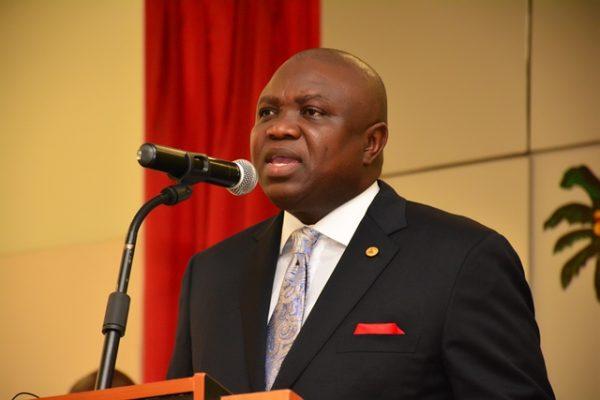
Governor Akinwunmi Ambode, speaking at the conference, said although much had been done, a lot still needed to be done. “This gathering is not about what we have done or what we ought to have done. There is so much yet to be done. Yes, we are always in agreement that the interplay of THINK, PLAN AND ACT is a sure recipe to success; but the practice and process are not fully picked up in textbooks or lectures. Leadership must have passion and commitment for vision before it can be delivered as a product.

“The next fifty years must cut out a path for us to create a framework for leaders that are not only visionary but also inspirational with passion if Lagos must become a Smart City. Our state has made this commitment which has the potential to improve lives of our citizens, expand economic opportunities and access to critical public services. The Smart City initiative is Lagos Urban Development vision to integrate all sectors of governance into one box of growth and development – through efficient service delivery to each citizen.”
Ambode noted that the future prosperity of Lagos was dependent on how well “we can equip our children and youth with technological and educational skills they can use to develop the solutions of the future,” he said.