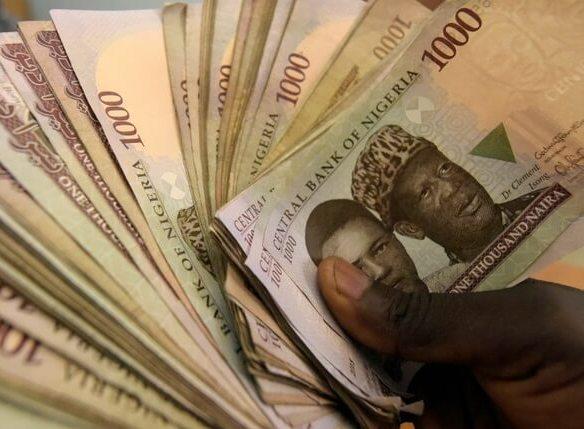
With naira bonds yielding 18 percent and equities cheap, analysts at Renaissance Capital have placed Nigerian assets on a buy position to foreign investors.
This follows the progress seen in the recently introduced investor and exporter (I&E) foreign exchange window, which has recorded over $1.1 billion in volume of trade.
At around NGN400/$, the naira currently offers a 5% discount to the analysts N375/$ estimated fair value, although they believe this discount will likely disappear due to inflation over 2017.
“In February, we argued that when greater foreign exchange flexibility came to Nigeria, investors might only enter the market at an exchange rate of NGN450-500/$. We assumed there would be no Egyptian style float of the currency. We thought investors would need a ‘Nigeria foreign exchange risk premium’ of at least 10-20 percent to compensate for the potential risk that forex flexibility might be short-lived.

“But we were wrong to only look at investing in Nigeria through the forex prism. We should have also considered whether bonds and equities were cheap or expensive,” Charles Robertson, global chief economist at the Renaissance Capital said.
Ayodeji Ebo, managing director, Afrinvest Securities limited said, in dollar terms, Nigerian stocks remain relatively cheap, due to the devaluation/depreciation that the naira has experienced in the last two years. For instance, a stock trading at 50 cents in 2015 may now be trading at 20 cents, hence presenting more upside opportunities.
“In addition, the higher yield environment in the fixed income market has continued to attract foreign investors attention due to near zero level interest rates in the Euro and US region”, said Ebo in an emailed response.
Godwin Emefiele, governor of Central Bank had stressed that one of the objectives of the bank was to achieve a convergence of the rates in the various segments of the market.
Comments last week from Vice-President Yemi Osinbajo, that “the market should determine everything”, imply all Nigeria exchange rates may be seen converging to a market-determined rate.

“But for now, we think investors should cautiously assume the I&E window remains the only accessible window, until the 2019 elections,” Robertson said in a note made available to BusinessDay.
Robertson added that the most obvious threat to the I&E window is a collapse in oil production and/or oil prices; “in that scenario, we cannot be sure the Central Bank of Nigeria (CBN) would continue supplying forex to this window. But potentially, investors would meet their own supply and demand needs, presumably at a much weaker exchange rate.
“Whatever scenario unfolds, the key point is that the foreign exchange barrier to investing in Nigeria has now been removed. As a consequence, investors can now focus on the reform priorities of the government,” Robertson added.
The nation’s currency on Thursday appreciated against the U S dollar across foreign exchange market segment. The naira gained N2.12k at the investors and exporter’s window, to close at the rate of N379.69k per dollar on Thursday, from N381.81k traded the previous day, data from FMDQ show.
At the inter-bank spot foreign exchange market, the local currency was quoted at N305.40 to the dollar, gaining N0.50k from its close of Wednesday according to FMDQ data. However, the naira remained stable at the black market, closing at between N378 and N380 per dollar.
HOPE MOSES-ASHIKE