|
Getting your Trinity Audio player ready...
|
“Were it left to me to decide whether we should have a government without newspapers, or newspapers without a government, I should not hesitate a moment to prefer the latter,” these were the words of former American President Thomas Jefferson.
While the third United States President opted for media without government, thus emphasising the importance of the Press in society, Clerk of the Senate, Nelson Oyewoh, preferred the contrary, as he barred seven television stations from covering plenary at the upper legislative chamber last week.
The development happened 11 days after the Chief Security Officer to President Muhammadu Buhari, Bashir Abubakar, expelled the State House correspondent of Punch Newspaper, Olalekan Adetayo, over a story on the President’s state of health and 24 hours after the World Press Freedom Day.
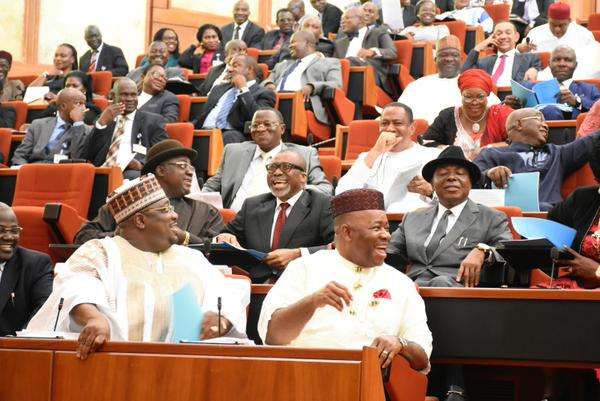
This followed a similar move in January when the number of cameramen and photojournalists covering the Senate were reduced from about 40 to 13. Not done yet, the number was trimmed down to six on Thursday, effectively barring broadcast stations like Murhi International Television (MiTv), Ben Television, Core Television, Peoples Television, DTN, Independent Television and Galaxy Television.
Consequently, the six media houses accredited to cover proceedings but later boycotted in solidarity with those not allowed into the chamber include Africa Independent Television (AIT), Nigerian Television Authority (NTA), Channels Television, Silverbird Television, Television Continental (TVC) and New Age Media.
Officials have attributed the arrangement as part of efforts to ‘decongest’ the Senate and establish an atmosphere of orderliness in the chamber.
If the move is aimed at easing out ‘small’ media organisations, it is dead on arrival because what you call ‘small’ media organisation is like a rejected stone becoming corner stone. The news of former Speaker of the House of Representatives, Salisu Buhari, who was discovered to have forged his university certificate from Toronto University, was first broken by a relatively unknown newspaper.
In all, the move is part of a grand plan to eventually kick out all broadcast stations to pave monopoly for National Assembly Television Station which has gulped into billions of naira, with the sole rights to cover plenary and send feeds to other television stations. This obviously, is with the aim of canvassing for increased budgetary provision for this purpose, thus creating avenue for ‘food for the boys’.
One ironic thing about our leaders is that if they want to carry out unfavourable policies or programmes they are quick to cite what obtains in other countries but the same individuals refuse to copy the monumental projects they see abroad for the benefit of their people back home.
For instance, the Senate bureaucracy said its decision was based on the fact that there is no parliament in the world where cameramen are allowed into the chamber. They forget that such legislative bodies have functional central pool units where professional and experienced broadcast cameramen using latest television technologies such as Ultra High Definition cameras operate to deliver quality feeds. Such equipment are yet to be installed in the Senate, neither are there requisite broadcast professionals to man them. An official attributed it to lack of funds. But why put the cart before the horse when the institution is yet to put its house in order?
Commissioned by former Head of State Abdulsalami Abubakar on May 25, 1999, the hallowed chamber of the upper legislative body and Press Centre are not media-friendly, as they are not equipped with 21st Century gadgets that make the work of a media worker easier. Not even a facility like Wi-Fi is available for journalists to do their job anymore.
The development also occurred 24 hours after Senate President Bukola Saraki, assured Senate correspondents, as part of activities commemorating the World Press Freedom Day, of unfettered access to information to carry out their constitutional duties. His visit to the Press Centre was the third time he met with journalists since his election as Senate President at the June 9, 2015 election. The question then arises: was the Senate President playing to the gallery?
Even cameramen from the six accredited media houses have also complained that in the new order, they were asked to stay in obscure positions in the chamber while covering proceedings. They said the position would only enable them capture the front view of Senate President Bukola Saraki while other lawmakers would be filmed from their back. No human wants to be shown on national television talking with his back and not his face, being shown on air.
I also gathered that the National Assembly bureaucracy is set to extend the order to print journalists, with a view to achieving media censorship and avoiding negative stories. This signals a subtle return to military era where the Press was gagged under draconian decrees.
Feelers from the House of Representatives and Villa also suggest that their Press associations are ready to join the Senate Press Corps in solidarity.
Following media backlash, the Senate leadership through its spokesperson, Aliyu Sabi Abdullahi, reached out to the Senate Press Corps executive last Friday, leading to a scheduled peace meeting with the National Assembly bureaucracy on Monday to resolve the issue ahead of plenary on Tuesday.
But events at the May Day rally in Abuja last week Monday, where Senate President Bukola Saraki, Speaker House of Representatives Yakubu Dogara and Labour Minister Chris Ngige were chased out of Eagles Square, signalled the fate of most politicians as the 2019 general election draws near.
On Tuesday, Senate President referred the screening of 27 nominees as Resident Electoral Commissioners for Independent National Electoral Commission (INEC) to its Committee on INEC.
The panel, which will be chaired by Suleiman Nazif, has two weeks to submit its report.
The nominees include: Godswill Obioma (Abia), Ibrahim Abdullahi (Adamawa), Ahmad Makama (Bauchi), James Apam (Benue), Mike Igini (Delta), Nkwachukwu Orji (Ebonyi), Illoh Joseph Chuks (Enugu), Hussaini Halilu Pai (FCT), Sadiq Abubakar Musa (Kaduna), Jibrin Ibrahim Zarewa (Kano), Asmau Sani Maikudi (Katsina).
Others are: Mahmuda Isah (Kebbi), Samuel Egwu (Kogi), Rufus Akeju (Lagos), Mustapha Zubairu (Niger), Agboke Mutiu Olaleke (Ogun), Sam Olugbadebo Olumekun (Ondo), AbdulGaniyu Olayinka Taju (Oyo), Riskuwa Shehu (Sokoto), Kasim Gana Geidam (Yobe), Ahmad Bello Mahmud (Zamfara), Nentawe Goshwe Yilwatda (Plateau), Umar Ibrahim (Taraba), Francis Chukwuemeka Ezeonu (Anambra), Emeka Ononamadu Joseph (Imo), Obo Effanga (Cross River) and Briyai Frankland (Baylesa).
The Senate had on March 28, 2017, suspended the screening and confirmation of the 27 RECs sent to it by President Muhammadu Buhari as a result of the failure of the President to remove the Acting Chairman of the Economic and Financial Crimes Commission (EFCC), Ibrahim Magu.
However, it rescinded its decision on Tuesday May 2, even as Senate President explained that this was done in the interest of the nation.
With frequent postponements trailing the passage of the 2017 budget, Nigerians are waiting to see if the Senate will keep to its promise of passing the appropriation bill this week.
Owede Agbajileke