Nowhere is Apapa’s rot more pronounced than in its network of shabby roads which has become a metaphor for neglect, writes ISAAC ANYAOGU.
The thought of driving through the roads leading into Apapa, Nigeria’s premier port city, located to the west of Lagos Island, now elicit the same kind of feeling you get contemplating a root canal operation. There is a special kind of temperament required to drive on the roads in Apapa – the kind you need to stand up to a baying mob.
The air in Apapa is foul, thick with plumes of smoke from tankers long past their sell-by dates. There are also billows of smoke from industrial generators louder than angry thunders. Apapa has the ambiance of chaos, rich in rancorous disorder, a city both hostile and confining. Apapa is the elegy that never stops.
Those that say there is no continuity in governance in Nigeria will be put to shame driving around roads and bridges leading to Apapa and within the city of over 200,000 people. The present and past governments have demonstrated an uncommon commitment to continuity in the policy to let the port city rot.

More than others, the current APC-led government has made the most noise about the need to fix Apapa roads. Babatunde Fashola, minister of Power, Works, and Housing, has certainly taken more pictures along broken portions of the roads with contractors and talked more than any other minister but Apapa’s continuous decline into a putrid mess proves eloquently that the capacity to muster outrage does not always translate to an ability to fix things.
“Apapa continues to spill forth revenues to the national government, not only in millions but in hundreds of billions and sometimes trillions. The question simply to ask is what kind of manager makes that kind of money in a place and refused to put something back there,” Fashola said in 2014, while he was governor of Lagos.
Two years later, Fashola was given the job to fix the roads when President Muhammadu Buhari appointed him Works Minister. Yet Apapa still is not on anyone’s priority list. There was no budgetary provision for the roads in 2016 and in 2017; it got the sort of palliative a starving man gets when he is allowed to sniff through a soup kitchen.
In January this year, authorities at the Tin-Can Island Port 2 Customs Command said that it generated N834.6million in the month. According to Godwin Andishu, the public relations officer (PRO) for the command, the figure was N274.9 million higher than the N559.7milion generated December 2016.
The January 2017 figure is also over 100 percent increase from the N349.07 million the port generated in January 2016. Despite a recessed economy and low port activities, the ports in Apapa continue to generate billions of naira income every year for the Federal Government but what remains constant is the negligence with which it is treated.

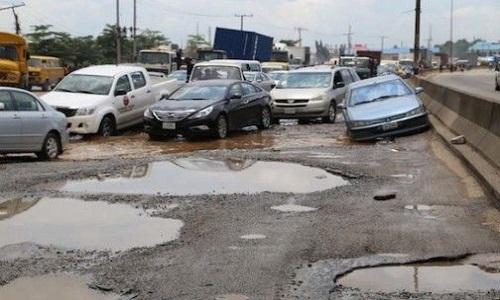
That is why the craters on Apapa roads are now deep enough to bury a Volkswagen Beetle, the links on the bridges are widening and holes on the bridge that were hurriedly patched have begun to show the first signs of a crack. The railings on the large swaths of the bridge are broken and when it rains, enough water is collected in puddles to start a thriving fishing farm.
Apapa’s most effective means of transport is the plethora of commercial motorcycle operators popularly called ‘Okada’ dotting every inch of the landscape. They are not intimidated by traffic logjams, gullies of potholes, the maddening tanker drivers or road signs.
The ‘Okada’ drivers are mostly young men from northern Nigeria many barely starting to shave. They have morphed into terrors on the roads, engaging in fracas with road users at the slightest provocation. In February, they staged violent protests around Point Road destroying the street gates and private properties over a dispute with some naval officials.
BDSUNDAY observes that some days, after a downpour, the ‘Okada’ riders convert the collected waters on the road to a makeshift car wash, sometimes the waters are deep enough to submerge their motorcycles.
Many Nigerians are asking questions about how a government that is keen to diversify its revenue base will allow its most strategic ports to rot away. Ports are the drivers in economies where corruption plays less significant roles. Ports facilitate international trade and port cities are purposely developed to engender trade.
“I was at Apapa on Monday (April 17), the whole place was a refuse dump. I would say the money we’ll have to spend on soil stabilization due to it will be much,” says David Temitope, a civil engineer on his social media post.
“How we can be so insensitive to a road that brings in billions daily for the nation is mind boggling. Some people even offload on the road,” he added.
In March this year, Yakubu Abdullahi, head of Ports Operations at Dangote Group told journalists that the organization spent N1 billion to repair the road leading to Apapa Port.
“The distance from the port gate to the Airways Bus stop caused the organization that much. We would have done more if not for Lagos State government’s restrictions; even the Nigerian Ports Authority (NPA) made an attempt to fix the roads but stopped. It is not within the purview of NPA to repair roads, so they stopped the idea and the roads have remained bad since then,” Abdullahi told the News Agency of Nigeria, (NAN) in March.
Nigeria’s laws require approvals to carry out the slightest repairs on federal infrastructure and the government is too distant and aloof to care. Apapa speaks of uncommon neglect; a testimony to a people’s capacity at self-immolation.
A lost glory
But Apapa was not always this sordid mess. Unlike many areas in Lagos that grew from a desultory effort by the state government to remodel slums, Apapa was built with a plan.
The city was designed to host commercial, residential and marine related activities. It also has a Government Residential Area (GRA), with stately buildings that have manicured flowers and date palms bordering sturdy roads.
Apapa was designed to have options for leaving the city with freight either through roads or through the railway. Hordes of heavy duty vehicles were never meant to cause terror on the roads neither were it envisaged that those who will manage the road will treat maintenance like an irritating chore that could be wished away.
That Apapa, borne out of clear intellect, willed to power an economy is long gone. In its place stands a riotous enclave fast morphing into a blueprint for chaos. The 2006 census puts Apapa’s population at 217,362, but the figures will no longer be true at the moment judging by how much people are leaving the area.
Spine-chilling traffic logjams, polluted environment, and wanton lawlessness have conspired to drive away in droves both residents and businesses. Home-owners have abandoned their houses to take up tenancy in saner areas when Apapa began to assume the character of glorified prison.
In this Apapa, rules governing the roads are fluid, those who enforce them even more pliant. Road signs are treated as suggestions and one-arm beggars flail their good hands to direct traffic when they are bored. Commercial motorcycle operators compete with drunken tanker drivers and car owners over a right to the precarious roads and the streets are empty of light and life.
The rains are here and the roots on the roads shine in all their unassuming ‘glory’. Commercial bus drivers climb the culvert to drive on one-way because tanker drivers convert the road to parking lots. Apapa demands the same urgency that was used to fix the Abuja Airport without the noise and pretentious demonstrations of good intentions.