The deterioration in the relationship between the Nigerian Senate and the Presidency could impact negatively on Nigeria’s economic recovery, experts have warned.
The Senate yesterday declined to consider the President’s nominees for the position of Resident Electoral Commissioners (RECs) on the pretext the Presidency has not responded to its decision to reject the nomination of Ibrahim Magu as the substantive chairman of the Economic and Financial Crimes Commission (EFCC).
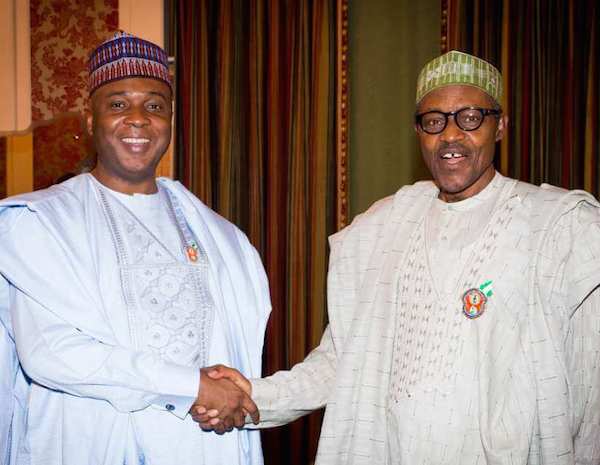
The Senate’s decision signals an escalation of the increasing disagreements between the Presidency and the Senate.
After a close-door meeting yesterday, the Senate signalled it was in a “war mood” as it vowed that it would not be intimidated by external forces.

This came barely 24 hours after Senate President, Bukola Saraki, alleged that the Senate was being blackmailed and witch-hunted for insisting that the retroactive customs duty on vehicles in Nigeria must be reversed.
The Senate also vowed that it would protect its integrity by doing whatever it takes to ensure that it is not taken for granted.
The Senate, which made the position after a closed-door session on Tuesday, said it took the decision following series of coordinated attacks against it by external forces.
However, the Senate , who made the disclosure, did not reveal the identities of the external forces.
“The Senate, in a closed session, discussed the various attacks on the National Assembly, especially on the Senate, for performing its constitutional duties.

“And the Senate resolved to defend the integrity of the Senate against such attacks and will not be intimidated from carrying our constitutional duties at all times,” Saraki stated.
The Senate’s position follows recent face-offs with key members of the executive, particularly the Comptroller-General of Nigerian Customs Service (NCS), Hameed Ali (retired), Secretary to the Government of the Federation (SGF) David Babachir Lawal, Attorney-General of the Federation, Abubakar Malami and Acting Chairman, Economic and Financial Crimes Commission (EFCC), Ibrahim Magu.
Last week, the Senate called for the resignation of the Comptroller-General of the Nigeria Customs Service (NCS), Hameed Ali, who they described as unfit to hold public office, even as they criticised the Attorney-General of the Federation Abubakar Malami, for writing to the Senate, asking them to put on hold, their investigation of Hameed Ali, over his directive on customs duties payments on imported cars.
In the same week, the Senate also clashed with the Secretary to the Government of the Federation (SGF), Babachir Lawal, who declined to attend a public hearing called by the Senate on allegations of having awarded contracts to companies that he had interest in, as head of the Presidential Initiative on the North-East. He has denied the allegations.
Even as the relationship between the Senate and the Presidency deteriorates; the 2017 budget is yet to be passed, three months into the year. Nigeria is in its first full recession since 1991 as lower oil prices and dollar shortages slow growth in Africa’s largest economy.
Indications are that the promise that the budget will be passed by the end of March is no longer realistic, as many of the committees going through the budget are yet to submit their report to the National Assembly. Now, the expectation is that the budget can only be passed by May, about the same time the 2016 budget was passed.
Senator Danjuma Goje, chairman of the budget appropriation committee in the Senate, says that the budget will be passed before May, almost two months later than the promised March .
This means that Nigeria’s Economic Growth and Recovery Plan (NEGRP), which has several critical implementation components, contained in the 2017 budget, will be delayed. Businesses waiting on the 2017 budget to rev up their operations for the year would now also have to wait until the second quarter of 2017.
But there are also other bills before the Senate that the business community is afraid may be delayed if the increasing conflict between the Presidency and the Senate is not resolved soon enough.
There is the Petroleum Industry Governance Bill (PIGB) which the oil industry is hoping will be passed in April, as promised by the Senate, but is now concerned that it may delayed. There are also the “National Collateral Registry Bill’’ and the “Credit Bureau Services Bill’’ which the National Assembly had promised would be passed by the end of April, to ease access to credit. It is part of 60-day ease of doing business initiative of the Federal Government.
Sources in the business community are also increasingly concerned that the Senate could delay the consideration of the 2017 budget if the relationship between it and the Presidency deteriorate further. Many people in the business community are surprised that a party that controls both the President and both chambers of the National Assembly, will have such a negative relationship with the House, wondering if the ruling All Progressive Congress (APC) can agree on a common direction and pursue it.
“The economic situation is too delicate for us to continue to have these quarrels between the executive and the National Assembly. They should put their acts together, so that we can have a common purpose and direction. The most urgent issue that should be on everyone’s mind right now, is how to put the economy back on the path of growth and not over minor issues” said a business analyst with one of the banks.
The increasing conflict between the Presidency and the Senate is seen as a reflection of the strangers that came together to form the APC and are now finding it difficult to work together as one government.
Owede Agbajilike