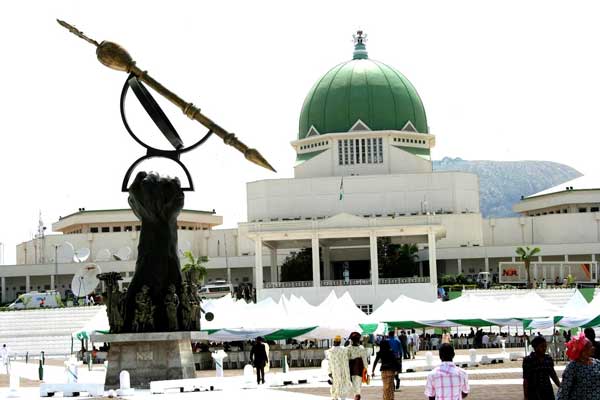
No doubt, the National Assembly is currently unsettled over issues bothering on financial impropriety worth N2 billion raised by the annual audit report of various agencies of government. The audit covers the three arms of government: Legislature, Executive and Judiciary. This time, the N2 billion transactions allegedly involved both chambers of the National Assembly, the Management as well as the National Assembly Service Commission (NASC), and the National Institute for Legislative Studies (NILS).
The report from the office of the Auditor General of the Federation (oAGF) showed that the House of Representatives incurred the highest infraction of N1.1 billon followed by National Assembly Management with N347.8 million; National Institute of Legislative Studies (NILS) to the tune of N246.5 million while the Senate’s hovers around N205.7 million; legislative aides N70 million and NASC worth N30 million.
The AGF’s annual report, was said to have revealed that the illegalities were perpetrated in 13 transactions
Though the report is still at the level of allegation, all organs of the National Assembly accused of the financial improprieties have the ample opportunity of clearing all the financial allegations. Sometime back the indebtedness of the National Assembly runs to about N10 million for newspapers’ subscription only. Likewise, the unpaid money to various contractors running to about N17 billion as well as allowances to security agencies remain hanging. All of these are issues begging for the attention of those at the helms of affairs and security agencies to look into with the view to ascertain the authenticity of who and who were involved in the allegation.

Based on the provisions of the 1999 Constitution (as amended), the two Chambers have the Standing Committees on Public Accounts manned by the opposition party, to receive and work on the allegations in the interest of the country. I recall vividly, some of the issues raised in the 2012 Audit report on the utilization of Service Wide Vote, revenues accrued from various sectors of the economy including operations of Nigerian National Petroleum Corporation (NNPC), Nigerian Police, among others. For me, the exercise which naturally suppose to ensure accountability and stewardship and expose corrupt tendencies of political holders and public officers by showcasing various infractions in the management of our commonwealth, has failed to achieve its set objectives. Rather, it can be best described as political or mere academic exercise. To a great extend none of these Public Account Committees has over the years made public their findings by announcing the amount recovered so far at any given time. I’m aware that at no time was any of the reports from the House Committee on Public Accounts laid and considered on the floor of the House. I challenge anybody within the Institution to prove me wrong. So, why wasting additional resources on the futile exercise?
Meanwhile, Nigerians are of high expectations that the 2017 budget will soon be passed. But I perceive we have to wait a little while, as usual, despite assurances from both Chambers. However, I envisage that the budget may be passed on or before March ending. But before then, I will be shedding light on some of the Zonal Intervention/Constituency project template of the National Assembly for which about N100 billion is allocated yearly. This is just an appetizer to be fully dished out next week, by God’s grace. But never let it out to anybody until I let the cat loose. While awaiting that, serious attention should be given to consideration of the all-important Petroleum Industry Governance bill, and other legislative framework that will boost the economy. Attention should be given to issues of national importance by passing Anti-Money laundering bill, among others sent by President Muhammadu Buhari since 2016 but we’ve not heard anything about them.
Meanwhile, the House during the past week, passed some notable bills including the “bill for an Act to repeal the Consumer Protection act, cap C25, Law of the Federation of Nigeria, 2004 and establish the Federal Competition and Consumer Protection Commission and the Competition and Consumer Protection Tribunal for the development and promotion of fair, efficient and competitive markets in the Nigeria economy. The legislative framework is to facilitate access by all citizens to safe products, secure the protection of rights for all consumers in Nigeria and for other related matters. Reportorial work will be rolled out next week on the bill which scaled through third reading last Thursday, after its report was considered by the lawmakers. Till then, do have a great weekend and rewarding week ahead.