The new board of the Niger Delta Development Commission (NDDC) shocked the nation recently when it revealed that whereas the 15-year Master Plan for the infrastructural uplift of the oil region earmarked $50 billion (N10 trillion at N200 per dollar) for the task, the area has already received $40 billion (N8 trillion or 80 percent) of the expected budget.
But despite the huge sums sunk into the Niger Delta, the region, sadly, is still at the take-off spot as there is little evidence to show for the sums spent, even as violent agitations for more funds to be allocated continue to rage. Meanwhile, pockets of billionaires have been created in the region amid mind-boggling poverty and want.
The yawning infrastructural and economic gaps that necessitated the creation of the defunct Oil Mineral Producing Areas Development Commission (OMPADEC), the NDDC, Ministry of Niger Delta, Amnesty Programme, and the allocation of 13 percent derivation fund to states in region remain conspicuously unbridged.
While some analysts are still trying to decipher why these programmes and agencies have failed to move the oil region from where it was in 2000 to where it ought to be 15 years after, some argue that the resurgence of militancy occasioning bombing of pipelines, vandalism, killing, abductions, and general violence by countless groups that have emerged in the region indicates that the Federal Government may have been merely throwing money at the problem without seeking concrete solution.

The expectation was that with N10 trillion, the Niger Delta Master Plan would in about 15 years transform the region to an economically viable and infrastructurally-stable area befitting of the goose that lays the golden egg. Such an attainment would breed peace through a satisfied populace so that Nigeria could freely produce oil to the tune of 2.4 million barrels per day amounting to N42.6 billion per day or N16 trillion per year.
The reverse has, however, largely been the case as most parts of the oil region have rather exploded in violent agitation, formation of terror-mongering organisations, and cancerous disagreements that disrupt operations such that oil corporations frequently declare force majore.
This is why Acting President Yemi Osinbajo have been shuttling across the oil-producing states meeting with stakeholders in an effort to save the oil economy by winning back the peace needed to meet 2.2-million-barrels-per-day production target. It seems Nigeria is back to the starting point in seeking a solution to the age-old Niger Delta conundrum.
A long history of agitation

Many have traced the origin of agitation in the region to the pre-independence time, especially pressures that led to the Willinks Commission which looked into the fears of the minorities of the Niger Delta and recommended a special fund for infrastructure to help the difficult terrains catch up with the rest of the country in development. This did not preclude the region from normal infrastructural development projects or funds. The failure to comply with this led to the rise of many activists such as Dapa Biriye.
Isaac Boro once added a violent spice by launching an armed revolution, even though some say it was actually against the rule of an easterner, not necessarily for development. For instance, Boro complained against siting a fish industry in Aba instead of in the riverine areas; a boatyard headquarters in Enugu instead of Port Harcourt, etc.
In the present democratic era, there emerged Asari Dokubo and his boys that complained that Abuja was built with oil wealth.
The political class adopted political strategies to resolve this matter sometimes by changing bed partners and allies. The likes of Okilo and Asari at one time or the other aligned with the North to position for power. This seemed to work for years, but discontent resumed after a Niger Deltan lost the presidency. Thus, the agitation progressed both in style, volume and fierceness from the Boro era (1966) to the Avengers in 2015.
In an interview, a foremost trade union leader and activist, Chika Onuegbu, traced the change of tone to what he called pen-violence.
Gains of agitation: financial windfall
The first thing that seems to come to mind while analysing the Niger Delta agitation since 1999 is that the region has grossed over N8.3 trillion in 15 years. A previous BDSUNDAY analysis indicated that so far, 13 percent oil revenue derivation to the states and local councils amounted to N5 trillion as at middle of 2016. The NDDC was expected to have earned an average of N200 billion per year for 15 years, making N3 trillion, while the Amnesty Programme got an average of N60 billion per year for five years, except in 2016 when it got only N20 billion, which sums up to N300 billion. These funds are outside the spending by other federal agencies, international donors and the steady spending by oil corporations and service companies in the form of corporate social responsibility projects. For instance, Indorama-Eleme has so far paid out over N14 billion to the host communities as equity, plus other projects they have executed for the Eleme and Elelenwo communities. Funds given to the Ministry of Niger Delta Affairs are said to be huge too, but the one that readily comes to mind is the N726 billion claimed for the East-West Road during the Goodluck Jonathan administration. Analysts say all of these may have crossed N9 trillion, if properly calculated.
Beyond financial windfalls coming to the region, there have been other big breaks. For instance, while the region demanded for fiscal federalism or resource control, they were handed the presidency on a platter of gold, after serving as vice-president for a short while. Before then, many pointed at creation of more states and local councils in the South-South. The Niger Delta currently controls the NDDC, NIMASA, Ministry of the Niger Delta, and Amnesty, outside the normal slots in other ministries and agencies.
NDDC
The NDDC is an interventionist agency. It claims to have been intervening as required by the Act that set it up. A report by the Commission says since inception it has awarded 8,557 projects out of which 3,424 have been completed and handed over to communities and states. There are 2,257 on-going projects whilst 2,506 are yet to be started for various reasons.
The project portfolio is distributed across civil works such as buildings, canalization and reclamation, jetties and shore protection, electrification, roads and bridges, water supply, flood control and erosion, furnishing and equipping of schools and health centres.
“Our programme portfolio covers training and capacity building for oil spill response, telecommunications, building technology, entrepreneurship development and waste-to-wealth, amongst others. For instance, a total of 72,000 pairs of plastic chairs and desks have been produced and are about to be distributed to schools across the region,” NDDC said in the report.
“The healthcare programmes have been quite extensive with over 1.2 million documented patients treated, 3,500 communities visited and 6,000 referral cases managed. Emergency relief materials were recently supplied to several communities such as Okerenkoko, Oporoza, Opobo, amongst others, seven healthcare facilities equipped, and over 30,000 protective kits against Lassa fever distributed.
“Our education programmes deserve a special mention: a total of 1,411 students have received scholarships since 2010 of which 1,066 were supported in M.Sc. and 345 in PhD programmes,” it said.
It further said five of the M.Sc. students graduated with distinction from Coventry University, England, and one from Aberdeen University. A PhD student, Ubong Peters, won the three-minute thesis competition in Australia; Augustine Osarogiagbon of Memorial University is so brilliant he completed his PhD in less than the stipulated time and has been offered a dual PhD programme with two graduate assistants to work with him and a post-doctoral fellowship lined up. Finally, Charles Igwe studying a PhD in Construction Engineering at Concordia University, Canada, saved the Montreal Area Municipality over $1 billion by redesigning the TURCOT interchange road construction project costing $3.67 billion.
The management says these positive results show the depth of talent within the Niger Delta and what can happen if the people just encourage the younger ones to stay focused on their education.
“We also have to create an enabling environment for them to return to and be productive citizens,” it said.
What states did with their money
There have been visible efforts by the nine states to develop the states. BDSUNDAY had earlier reported how today, Port Harcourt has become the home of Shell, NLNG, NDDC, two seaports, two airports, and over 2,000 companies, not discounting all federal agencies and the most vibrant oil-service companies. It is a billionaires’ playground.
Three states in the oil region alone plus the NDDC (Rivers, Delta and Akwa Ibom) run average annual budgets of N1.4 trillion. After corruption and wastages, the balance still helps to build numerous roads, schools, houses, buy beastly cars, and run high monthly wages. Thus, there have been some landmark projects which only rich states could have attempted.
For instance, Rivers State built 750MW gas turbine between 2002 and 2015. The state also built flyovers, dual carriageways, exotic buildings such as the tallest building in the South-South region (the 18-storey Point Block), the Obi Wali International Conference Centre, etc. The state under Chibuike Amaechi moved further to attempt building 500 modern primary schools at a go, 180 modern healthcare centres, world-class secondary schools built at N4.5 billion each, etc. It also attempted a N150-billion monorail project, a N160-billion University of Science and Tech new location project, and an N800-billion megacity.
Bayelsa built a new state capital without federal grant, built dualised expressways, started a central business district, built gas turbines, started roads across water called senatorial roads, a 19-storey tower, and an international airport.
Delta State built an airport, a new Government House in Asaba, transformed Warri into a modern city, and has launched a new Asaba city project.
Akwa Ibom has transformed the state into a modern state with an international airport, an international-standard hotel (Le Meridian), a seaport, flyovers, and a business centre.
Cross River even started off with and created Tinapa as one of Africa’s most famous festival centres before the Bakassi case and boundary adjustment robbed it of all oil wells.
In terms of human capital development, the oil region has moved steadily as brains from the region are in all parts of the world in search of scholarship. Most of the states run scholarship schemes in sensitive professional areas while the NDDC and most oil corporations offer same.
Truth is the Niger Delta region would not have been what it is without 13 percent fund and the other intervention funds. The zone is home to most of the exotic cars the white man could make, the best houses, roads, schools, etc. Yet, the story is yet to start.
The beast swallows the money
Nsima Ekere, the new NDDC CEO, has described corruption as “The Beast”, saying it must be tamed or the Niger Delta would completely be swallowed.
Ekere thinks the monster is so powerful that no amount is too small for it to swallow, squandering the chance of developing the region in the process.
First, if $50 billion was needed to transform the region and $40 billion was realized, how come the region still lacks water, good roads, good schools, good food, and a vibrant economy? Why has no industrial base been born such that the region, like Dubai, would be a manufacturing and high-tech hub that could replace hydrocarbon industrial base? Instead, the region seems to have developed a huge appetite for ostentation.
There emerged an idle class that feeds on oil wealth – chiefs, community leaders, politicians, youth leaders, etc. They fight with all their strength to capture a position of influence through which they could intimidate the oil companies into regular release of funds as a right. Soon, the system of becoming a leader turned violent and only the devilish could draw the sword. Due to petro-dollars and the high stakes involved, cult gangs emerged to help the rich to win power and soon, it became the norm to first raise a vicious gang before questing for power.
“The craze for petro-dollar has also led to a social dislocation and the overthrow of the elders, chiefs and monarchs as well as the rise of violent youths who now impose new ways of thinking. Immorality has taken over the hearts of the youths; values have somersaulted, and hard work seems dead because one year work in the farm can be paid for by one week work in the rig,” BDSUNDAY wrote in an earlier reported.
“Compensation for oil land runs into hundreds of millions of naira for few owners and rewards have blown over the minds of most men. A rent-seeking governance system has emerged in the area where chiefs and others live a false life of affluence without merit, a lifestyle that can only be sustained by blood and avarice. Corruption becomes the simplest form of crime.”
Two vices seem to stand tall in the region – violence and corruption. Instead of a hate for corruption, the monster seems to have won an embrace in the region and elsewhere. Oil is seen as a stolen mineral and anyone who helps to ‘re-steal’ it is seen somehow as a hero. This is why those who helped to defeat their brothers in power are viewed in very negative light, instead of being seen as heroes. Corruption may appear bad but if that is the only way the stolen crude is recaptured, most persons in the region do not mind. This analogy seems to have fuelled corruption in the region. This is how the ‘beast’ was born and why it has freely swallowed most of the over N8.3 trillion so far pumped into the Niger Delta.
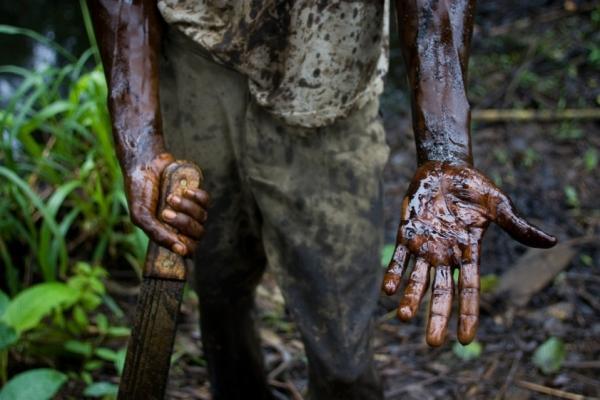
Now, oil is blamed for the hanging of Africa’s renowned playwright and environmentalist, Ken Saro-Wiwa, the burning down of Odi (Bayelsa) and Umuechem in Rivers State, as well as uncountable inter-communal wars that have consumed numerous heads. From Ukwa West in Abia State through the Imo River route to Bonny, the waters and creek-lines have been polluted and poisoned to 900 times higher than the level of benzene permissible in human veins. Rivers in the region have been condemned and fishing has ceased in most places. Farming has taken the backseat in a region that now runs after the petro-dollar in the ‘swamps full of dollars’, according to a source.
Itse Sagay, chairman of Presidential Advisory Committee on Anti-Corruption (PACAC), speaking to a huge audience at the ‘National Dialogue on Causes of Corruption: The Limitless Ramifications of Corruption’, held at the State House, alleged: “My dear friends you will not believe that with all we are going through, the Niger Delta Development Commission, NDDC, which is the other name for uncompleted projects, has just bought over 70 cars.
“Of those bought about 8 of them are Super Lexus SUVs costing N78m each and about 10 are Land Cruisers, costing N63m each. This money was taken from funds for infrastructure, water, housing, hospitals, schools, etc, without conscience; recklessly without a thought for the wretched people of the Niger Delta.”
Conclusion
A study released by the Trade Union Congress (TUC) once said that at least 40 percent of the budget is always stolen. This may mean that about N3 trillion out of the N8.3 trillion that has passed to the Niger Delta in the past 15 years may have been stolen.
The 13 percent is collected by the state governments and many say the real oil-bearing communities have not seen much of it. This is often because most of the powerful people usually come from non-oil communities. The governors have argued that the effect of oil pollution is not limited to oil-bearing communities. They also argue that oil well may be in one community, but the pipes run through most of the region; that roads, electricity, health, etc cannot be isolated in one spot; they are shared infrastructure but scholarships may be successfully isolated.
Some analysts say the Petroleum Industry Bill (PIB) may solve most of these problems as the allocation may no longer go to the states but directly to a fund set apart for the oil communities. Others have also suggested that instead of leaving a barrel of crude to the FG/NNPC, the Joint Venture partners, and the operators, the community should come into the sharing formula as a fourth partner. This way, the fourth partner would decide what to do with the share and be blamed or credited with the eventuality when posterity comes for judgment.