|
Getting your Trinity Audio player ready...
|
Three years after the Nigeria Customs Service (NCS) took over the Destination Inspection (DI) operations from the former service providers, Customs has dumped the multi-million dollar worth of inspection machines and has returned to 100 percent manual examination of goods.
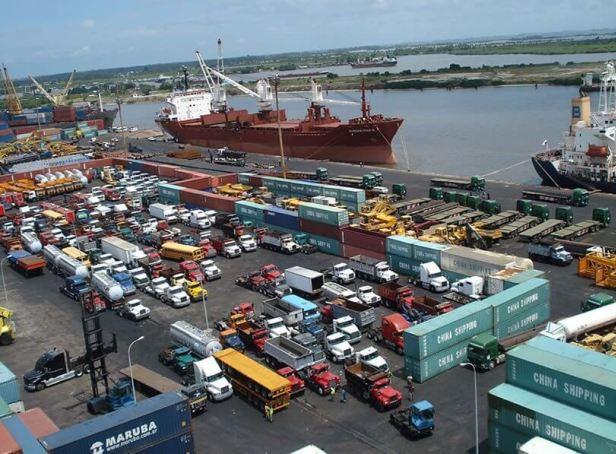
This development has compounded cost for importers, estimated to run into millions as businesses pay rent to terminal operators and demurrage to shipping companies for not clearing their goods within a specified time as a result of slow and cumbersome nature of manual inspection of containers at the seaports.
According to these importers and their agents, whose containers spend weeks at the nation’s seaports over delayed clearance, containers that were supposed to be cleared in seven days now take close to a month to be cleared due to the delay, despite the current downturn and low volume of business at the ports.
“It is worrisome that while cargo volume keeps declining due to economic downturn, foreign exchange crisis and unfriendly businechange crisis and unfriendly business environment force Nigerian importers to prefer ports in the neighbouring countries. Customs documentation and clearance processes have remained the same and largely manual,” Tony Anakebe, managing director of Gold-Link Investment Limited, a clearing and forwarding company in Lagos ports, lamented.
Anakebe faulted the recent pronouncement by Hameed Ali, comptroller-general of Customs, that all the containers coming into the port must be subjected to 100 percent physical examination to avert security risk of importing arms and ammunition. To Anakebe, the use of automated clearing system such as scanners has the capacity to detect items like ammunition, meaning that such should not be use as an excuse to stalling trade facilitation and fast track cargo clearance at the port.
“This poses serious threats to smooth movement of goods and also increase cost of doing business as importers experience man-hour loss over Customs’ use of manual cargo inspection procedure to examine goods,” he said.
Lucky Amiwero, a former member of the Presidential Committee of Destination Inspection, who identified the need to critically look at the breakdown scanners in the port for possible repairs, said the inspection machines while operational enabled trade facilitation for the benefit of businesses and the economy at large.
According to Amiwero, the present state of the scanning equipment can be blamed on negligence and inability of the government agencies that supervised the transfer of the equipment from the DI service providers to Customs to ensure due diligence before approving the handover.
“There is need to setup committee to reassess the scanner and other IT platforms at the ports by auditing the level of the breakdown and to put them back into operation. The fixed scanners are still very new judging from their ages that fall within three to five years, based on the date of installation and commencement of operation, while the mobile scanners, are within six to eight years old, which is still operational and acceptable internationally,” said Amewiro.
In a letter dated 13th February 2017 and addressed to the president and Commander-in-chief Federal Republic of Nigeria, Amewiro requested Mr. President to ensure that experts are brought to carry out audit of the scanners in the port and to make them operational.
The scanners as the border stations are not left out as Taupyen Selchang, Customs public relations officer of Seme border command confirmed that the scanner at the border was faulty and has been posing some serious challenges to their operations in recent times.
Recall the multi-million dollar scanners were acquired between January 2006 to December 2012, when the Federal Government contracted the DI Scheme to some service providers that include Cotecna, SGS and Global Scan on a Build, Own, Operate and Transfer (BOOT) basis, for a period of seven years.
The contract, which was extended by one year, was finally terminated in December 2013. At the termination of the contract, Customs became fully responsible for the inspection, valuation and classification of imports but has failed to continue utilising the modern inspection machines in the seaports.