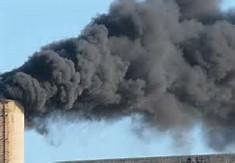
United States-trained environmental engineer has thrown some light into the plight (black soot) facing Port Harcourt residents, insisting it is petrochemical pollution in action. The man named Chukwudinma Ogbonna told BDSUNDAY in an exclusive interview that it is part of acid rain, coming most likely from crude oil that was not completely broken down during refining in what is popularly called ‘kpo-fire’ or heating of crude oil by fire to produce fuel.
The scientist reminded Nigerians that Kuwait suffered the same fate in the 19903 after the bombing of its oil fields. He said this action frees crude oil not completely broken down and they escape as particles into the atmosphere only to start dropping moments later. He explained that this is more possible if the atmosphere was already laden with gradual accumulation of particles over the years from combustible machines such as numerous cars as may be the case in Port Harcourt and other parts of the oil region.
He said such rare particles could come from heating crude oil to produce condensate (also used as gas or fuel), bombing of pipelines that set fire on oil, and gas flaring that discharged particles into the atmosphere till it can no longer hold it.
The Abia-born expert, who worked for many years in the Ministry of Environment after his return to Nigeria, said most cities in the US insist that cars coming for annual vehicle license renewal must undergo petrochemical pollution check by wearing what he called ‘catalytic converter’ that must recycle the smoke without allowing it into the atmosphere. This is also the case with big generating plants that ooze smoke into the atmosphere.
The expert said gas flaring was wrong and never done any more in the civilised world but most state governments in Nigeria charge fees to allow for pollution whereas the practice is to use the penalties to stop further pollution. He condemned the federal government for always giving deadlines for ending gas flaring without paying their own counterpart funding of 55 per cent as senior equity owners of the same oil companies that are flaring. He said the government only shifts the deadlines because they are the guilty party.
Ogbonna said he was a young officer decades ago when he came with an arm of the United Nations to test the Ogoni environment and could prove that pollution started long ago. “The zinc in Ogoni was always corroded”.
He said medical experts told him that the first threat is bronchitis and other forms of upper respiratory tract infections as a result of breathing in petrochemical particles before other associated impacts especially from water which may introduce carcinogen into the blood stream.
Groups are already mobilising to raise lawsuits to force the authorities to reveal the truth of the matter, saying months of claims of investigations seem to be delay tactics. Chinedu Amah, a Port Harcourt-based media consultant has launched a bid on social media to mobilise for a lawsuit against the soot phenomenon. Other residents have since taken to social media to raise alarm. Some said the silence on the matter from official circles was because it was not a PDP versus APC matter where their media machineries seem to be most effective.
Meanwhile, tension is growing in the Garden City. The cloudy atmosphere has added to the panic as most persons mistake the soot for the dusty clouds.
The tension may have forced the Rivers State Government to come out of its silent mode to set up what it called a task force to look into the menace. The task force is mandated to investigate and resolve the environmental challenge.
This was part of the resolutions of the State Executive Council meeting chaired by Governor Nyesom Ezenwo Wike. The task force to investigate the black soot has the Commissioner of Environment, a professor, Roseline Konya; Commissioner for Special Duties, Emeka Onowu, and the Commissioner for Information, Austin Tam-George, as members.
The committee, which would be backed by technical experts, would liaise with major stakeholders to resolve the environmental challenges posed by the black soot. Many citizens have called for the Ebola war approach in the present circumstances, saying acid rain is more dangerous because of its mass impact potentialities.
Some concerned residents have raised a twitter hashtag “Stop-The-Soot” #StopTheSoot, which has been trending on the twitter and other social media.
The hashtag reads: “Dear Port Harcourt residents, the time has come for us to compel the government to fish out the perpetrators, and put a stop to this hazard called black soot.
“We can no longer sit back and ignore this menace. Last year, we started a media movement, and the black soot stopped for a while; now it is back, and in greater intensity. The air we breathe is so polluted. You wake up in the morning and wipe your nostrils with a white handkerchief, and it turns black – what then does your lungs look like or that of your toddler?
“If you think you can close your windows and run air conditioners, what about the cost of diesel?
“Let’s ask ourselves how long will it take for PH residents to start lining up at hospitals with respiratory infections or perhaps cancer? Enough is enough.”
Also, the Rivers House of Assembly recently mandated its committee on Environment to check the activities of oil & gas based companies operating in the city, to ascertain if their operations were responsible for the soot.

|
Reply
|
 Reply to all Reply to all |
Forward
|
|
|