|
Getting your Trinity Audio player ready...
|
Nigerian seaports witnessed a significant drop in activities in 2016 largely due to six policy decisions that rather than encourage businesses, led to the reduction of the number of ships berthing, or goods coming into the country.
Most significant of the policies is government’s restriction on 41 selected items from having access to foreign exchange from the official window. This policy not only left importers and businesses stranded, but also deprived industries, including manufacturers of needed raw materials that served as critical input for production.
The ban of 41 items, along with a weaker naira and foreign exchange scarcity crippled business activities, leading to a sharp fall in trade and consequently seaport terminals operating at 50 percent below capacity due to low business.
This singular policy also forced many foreign shipping liners to quit Nigerian seaports, while the few remaining ones, either cut down the number of visits, or reduced the size of the vessels used in bringing consignments from different parts of the world into the Nigerian market.

With this, many Nigerians who were employed by these shipping lines and the terminals that handle these consignments, were forced into the labour market, as many of these companies resorted to cutting staff strength to reduce cost.
Frank Ukor, president of the Association of Registered Freight Forwarders in Nigeria (AREFFN) confirmed that the removal of 41 selected items from foreign exchange bidding by the CBN made many shipping companies withdraw their services from the Nigerian seaports and retrench a good number of their staff to cut cost.
“Many shipping companies that had been forced to close shop had since quit Nigeria, thus ‘making the future gloomier’. The situation is so terrible that over 6,000 workers have lost their jobs and many more are to go, thus putting their lives and families in jeopardy,” said Anthony Nted, president-general of the Maritime Workers Union of Nigeria (MWUN).
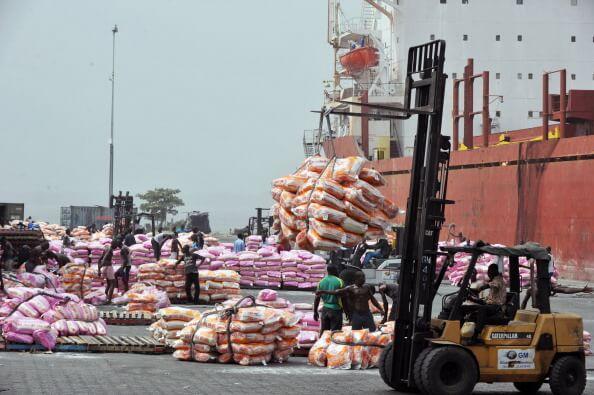
In the first quarter of 2016, the management of the Nigeria Customs Service (NCS) in response to the directive given to the Customs by the National Assembly, re-imposed ban on importation of rice through the land borders, a few months after the ban was lifted by Hameed Ibrahim Ali , comptroller-general of Customs, to curtail the rate of rice smuggling through the land borders.
The rice policy, which was welcomed by many terminal operators that invested in the development of bulk terminals, was described as ‘counterproductive,’ as it created room for heavy smuggling of rice through the border owing to the high import tariff of 70 percent on rice imported through the seaports.

Another government policy that shaped business decision in the second half of 2016, was the adjustment of exchange rate for import duty payment from N197 to US$ to a minimum of rate of N306 to the US$. This, not only left many imported containers stranded at the port as backlog of un-cleared cargo heightened, but also led to increased cost of importation.
“The year 2016 was a very difficult year that came with vicious challenges on shippers. Exchange rate for import duty for cargo clearing became a challenge, as the rate approved in the Form M became different from the rate the NCS introduced at the point of cargo clearing. This created untold financial hardship, as importers needed more foreign currency to clear their cargo,” observed Jonathan Nicole, president, Shippers Association of Lagos State.
In the first week of December, the NCS also placed a ban on importation of vehicles through land borders, in line with a presidential directive restricting all vehicle imports to Nigerian seaports only.
The policy, which is slated to take effect from 1st January 2017, was described by Vicky Haastrup, chairman of the Seaport Terminal Operators of Nigeria (STOAN), as capable of reducing smuggling of vehicles into the country so as to revive the operations of Roll-on-Roll-off (RORO) terminals that handle all types of vehicles in the seaport, if well implemented by Customs.
In addition, the unchanged national automotive policy that raised the duty paid on imported vehicles from 20 percent to 70 percent, was another significant policy that helped lower the volume of vehicles imported through the seaports and created an estimated annual revenue loss of N800 million, as many Nigerians diverted their vessels to Cotonou port in Benin Republic, where it was cheaper to clear and bring into Nigerian markets.
Haastrup further solicited for the review of the current auto policy that raised the duty paid on imported vehicles from 20 percent to 70 percent, to drive the new policy.
The ban on importation of certain species of fish, including allocation import quota to fishing companies operating in Nigeria, was another policy that helped to dry Nigerian seaports of volume in the year under review.