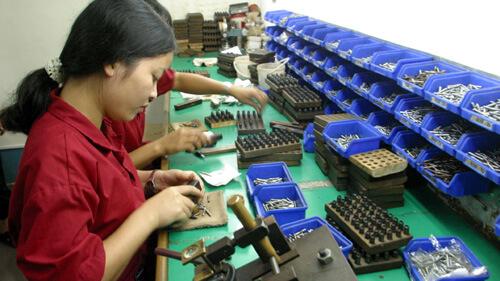
Vietnam’s rapidly growing manufacturing sector shows that there are many things Nigeria is not doing right, hence the stagnation in its own manufacturing sector.
“Government needs to identify products in which we have comparative advantage and provide incentives for potential investors,” said Ede Dafinone, CEO of Sapele Integrated Industries Limited, exporters of crumb rubber.
“We often lose our advantage due to infrastructure deficiency. We have an advantage at the level of growing crops, but we can also look at companies that can add value to the crops we have,” Dafinone said.
Vietnam started its industrial journey by identifying textiles, food processing, footwear and later, electronics and components, as areas of comparative advantage. Its policy was focused on building export-oriented industries that would compete globally.

The government of Vietnam took simple decisions in the 1980s to remove restrictions on imports and access to foreign exchange.
These steps were followed by continuing tax incentives for manufacturers and other investors, low-cost labour, and long coastline with increasingly modern and sophisticated port infrastructure, according to a KPMG report. Vietnam built modern and diversified infrastructure, with 3,200km of railway lines and highly developed ports, such as Hai Phong, Da Nang and Ho Chi Minh City, designed to facilitate trade, rather than drive revenue.
Two enterprise laws that hampered investments were annulled, and exporters that had contracts with foreign partners were reimbursed for their import duties when they imported raw materials and intermediate inputs, according to Houng Xuan Tran of the University of Wollongong, in a paper entitled, ‘The Evolutions of Productivity in Vietnam’s Manufacturing Sector’.
Export restrictions were removed, and multinationals and other categories of foreign investors incentivised into put money in the country. Free trade agreements were also expanded.
The results of all these, were that over half of the US Fortune 100 companies had establishments in Vietnam by 2007.

Samsung Electronics (SSNLF) recently pumped $11 billion into the country. China, including Taiwan, Hong Kong and Macau, has more than 4,759 projects worth up to $56.7 billion in Vietnam, mainly focused on the processing and manufacturing industries. Foreign Direct Investment was $21.92 billion in 2014, $23 billion in 2015 and $11.2 billion in half year 2016. In 2014, FDI projects from manufacturing amounted to $ 15.5 billion.
The Vietnam economy saw 6.4 percent growth in the third quarter of 2016 due to a spike in the manufacturing sector, which surged 11 percent between January and September, on the back of high electronic exports.
According to Vietnam’s Ministry of Planning and Investment, in October alone, more than 10,000 businesses with total capital of $3.6 billion were established in Vietnam. Approximately 2,000 businesses resumed their operation in October, 9.8 percent more than in the previous month. Vietnam is 82 (out of 198) in World Bank’s Doing Business Index.
This contrast with Nigeria, where the foreign exchange market is closely controlled discouraging foreign exchange inflows making it difficult for manufacturers to access dollars for their input.
Manufacturers also have to contend with power outages, which occur six to seven times in 24 hours in industrial zones. There are yet no full concessions in industries where Nigeria has comparative advantage, such as cocoa and chocolates, rubber and plastics, footwear, adhesives, palm oil and cosmetics, among others.
According to Muda Yusuf, director-general of the Lagos Chamber of Commerce and Industry (LCCI), energy laws still hamper investments. Yusuf said the energy sector needs a better policy that will make power cheap for industries. He said Nigeria needs a stable and consistent foreign exchange policy, including guaranteed single-digit credit and low taxes.
Frank Jacobs, president, Manufacturers Association of Nigeria, believes the Ajaokuta Steel Complex needs to be revived, to provide inputs to manufacturers. Vietnam’s Hoa Phat Group and Hoa Sen are already giving Chinese steel companies a run for their money.
There are up to 19 agencies operating at major Nigerian ports, delaying import of raw materials and export of products, with the attendant multiple charges. Nigeria’s ranks 169 in the World Bank’s Doing Business Index. Procuring land and getting justice from courts take a long time. Railways are barely working, while roads in many states are in deplorable condition.
Vietnam and Nigeria have a number of things in common. Both are oil-producing states and have young demography of 60 percent and above.
“Unlike Vietnam that has trained manpower and cheap labour, our manpower here is poorly trained. I told you a story of how I waited for over six months to get someone to work in my chemical department. The educational institutions do not satisfy industry needs,” said Mathhew Ibeabuchi, CEO of MD Services Limited, whose subsidiary produces chemicals.
Nigeria’s first ten export commodities are cocoa, sesame seeds, cashew, hides &skins, frozen shrimps, cotton, and gum Arabic, among others.
Nigeria’s FDI in 2014 was $4.7 billion and declined to $3.4 billion in 2015.
Of the $539.34 billion worth of exports between 2010 and 2014, according to data from the International Trade Centre, crude oil and distillation products made up 89 percent share. Data from theITC collated by BusinessDay show that while rubber contributed just 3.82 percent of exports, cocoa contributed 1.7 percent within the period. Similarly, raw hides, leather and skins (other than furskins) contributed only 1.15 percent.
In 2014 and 2015, cocoa made up 25 to 30 percent of total non-oil exports.
“Consider that the only export incentive has been in suspension for three years. It is about policy inconsistency which is not helping manufacturers and exporters,” said Tunde Oyelola, chairman, Manufacturers Association of Nigeria Export Group.
ODINAKA ANUDU