|
Getting your Trinity Audio player ready...
|
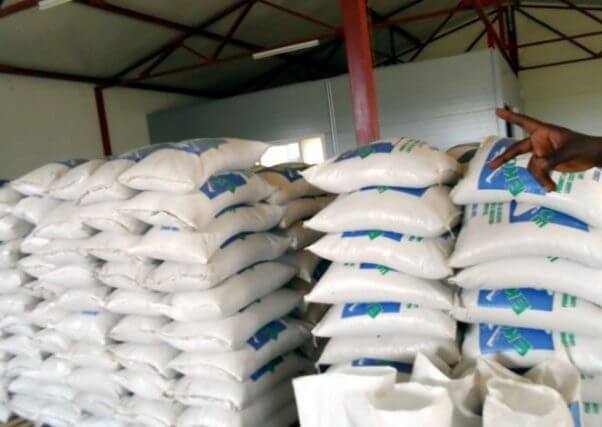
It’s official: Lagosians can expect to have locally-produced rice for consumption this Christmas, as the state government’s partnership with Kebbi State has finally borne what is known as LAKE Rice. Formed from Lagos and Kebbi, the rice will be sold for N13,000 per 50kg bag. Sanni Okanlawon, special adviser on food security to the Lagos State Governor broke the news yesterday at the LCCI National Agriculture Stakeholders’ Summit.
“In March,” he said, “we signed an MOU with Kebbi to collaborate on agriculture and commodity development; not only rice, (but importantly) to deliver rice to Lagosians before Christmas… and since we have promised Lagosians that we will deliver rice in December, we are still on course and by 15th December, we should take delivery of the first consignment. “The rice is nutritious and very wholesome, away from the ‘plastic’ consumed with imported rice, though this (LAKE) rice is parboiled, it is not polished, as that would have washed all its nutrients away,” Okanlawon added. The rice is being produced in Kebbi and, according to Okanlawon, will be sufficient to feed at least a quarter of the population of Lagos State (approximately five million people).
Okanlawon added that the state government has constituted a committee to oversee the handling of the rice, such that it would not be adulterated nor hijacked by ‘money bags’. It is to be distributed through the 20 Local governments and 37 LCDAs where strict monitoring is to be enforced. Once prospective buyers pay money into the bank, they are to proceed to a local council secretariat with their teller and pick up the quantities of rice paid for. The introduction, last year, of the Central Bank of Nigeria’s Anchor Borrowers’ programme has seen rice production in Kebbi State grow exponentially to 1.1million tonnes of paddy rice from the dry season planting alone.
Lagos State, which is seen as a major off-taker of the increasing local rice production, is scaling up its rice milling capacity from 2.5 metric tonnes to 42.5 metric tonnes per day. With the required purchasing power and market, Lagos State has an estimated consumption of over 798,000 metric tonnes of milled rice per year, which is equivalent to 15.96 million units of 50 kg bags, and if sold at N13, 000 per bag, this will give N207 billion per annum. Oluwatoyin Suarau, Lagos State commissioner for agriculture, told BusinessDay that the state is allocating five additional hectares of land in partnership with the private sector to expand the capacity of the Rice Processing Mill in Imota, Ikorodu, to achieve the expansion from 2.5 metric tonnes, to 42.5 metric tonnes per day.

Stakeholders at the summit applauded the outcome of the partnership as a sign of stronger collaborations among governments at different levels in developing agriculture in Nigeria. “These are areas we should be inching towards; collaborations, and real massive agro-processing. Kebbi has (abundance of) rice paddy, while Lagos has milling facility so the two states coming together is a complementary effort other states should emulate to address their food security concerns,” remarked Tunji Falade, CEO, Kingsway Quality Foods Ltd.
He added “As they have started, I feel it is going to jumpstart several other collaborations like this which will help in food security, poverty alleviation, wealth creation, unemployment and so on.” Adeola Elliot, chairman, Agriculture and Allied Group, LCCI, expressed the view that meeting the food security needs of Nigeria would be achieved when all stakeholders; cutting across both the private and public sector, resolve to work together for the development of agriculture. He explained that every player in the agriculture sector needs to define their roles and work consciously towards delivering the results expected of them. “We are signing an MOU with the Lagos State Government to have a working relationship so that we can guide them on what should be done.
It will enable the facilitation of funding to authentic farmers and other players in the sector when such is available. In the same vein, we have been inviting investors to the country, and matching them with different local governments where their desired cultivation can be best actualised.
“For instance, coconut production in Badagry which is now being commercialised with the establishment of a company in that regard, and which has also witnessed the invitation of Brazilian investors who are expected to expand the potentials there,” said Elliot in elaborating on the potentials for increased partnerships between public and private sector players in the development of agriculture in Nigeria.
CALEB OJEWALE