|
Getting your Trinity Audio player ready...
|
The potential for rice production in some south-eastern states is not peaking, as cultivation suffers from poor practices in many farms, while the processing of rice is itself lacking adequate mechanisation.
Government is however wading in to step up mechanisation, starting with the provision of threshers, harvesters, winnowers and parboiling machines and the pace is gathering momentum.
Some industry stakeholders however say they would prefer for the effort to be eventually private sector led, as this would be more market-driven and sustainable in the long run.
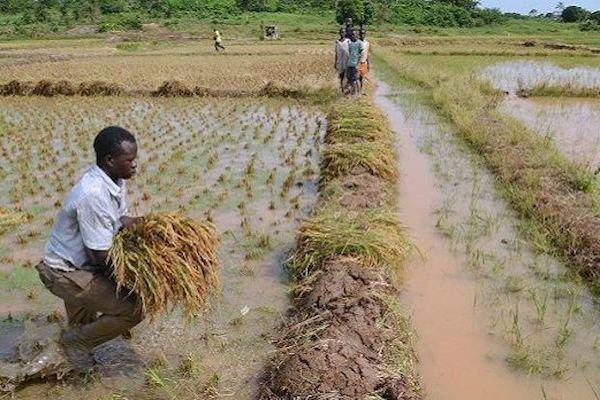
BusinessDay’s visit to Ebonyi and Anambra, and also Obubra LGA in Cross River state, shows that many rice farms had varying degrees of weed control problems with significant impact on farm yields. Apart, from the weed challenges, farmers generally appear to have inadequate knowledge on standard farm practices, which will improve on productivity and increase their contribution towards Nigeria’s quest for sufficiency in rice production.

Uchenna Orji, Ebonyi state commisoner for Agriculture, related with these observations, saying “We try to use agrochemicals but manmade materials cannot do all the perfect work. We have seen that those agro chemicals are not perfect on the field, as the weed killers are not working effectively.”
Orji also explains, “yield has been low, with us having maximum of three tonnes per hectare. We also gathered that why we are having a lot of challenges include lack of knowledge on proper agronomic practices in rice cultivation. Furthermore, lack of incentives which accounts for them sometimes starting late. Many times they lack funding to really take care or maintain the farms.”
“The little herbicides provided are insufficient and we constantly appeal to the government at all levels to come to our aid,” laments Sunday Oketa, chairman, rice farmers, Nkeleke Unuhu Community, Izzi LGA, Ebonyi state.
For his part, Akai Egwuonwu, chairman, Stine Industries, which produces Anambra Rice, explains that adopting best farm practices will see farmers report better yields.
“In Anambra, farmers who have decided to put in the best practices, get between six and eight tonnes per hectare. Some others are getting 4.5 tonnes per hectare. But, on average, the yield has gone up from 1.5, 2.5 tonnes per hectare, which was the norm, to a minimum of four tonnes now,” says Egwuonwu.

Generally, most farms lack mechanisation which is on the one hand, a challenge for achieving increased productivity, while on the other hand, it presents an opportunity for investments in critical machineries.
“If equipment like tractors, harvesters, reapers, threshers can be purchased and shared for use, Ebonyi will surprise the whole nation in terms of output,” says Oketa.
Rotimi Fashola, a renowned consultant on rice production, who is the Senior Partner, OITFash Consult also said that “If we really want to improve on rice production, there is no alternative, other than to mechanise it; from land preparation to harvest.”
Fashola explained that efficiency increases with mechanisation and farmers will lose about 40 percent or more of crops when harvesting is done manually, but with a combined harvester for instance, loss will be reduced to as low as 10 percent. The time it takes to harvest is also reduced considerably.
It was also observed that Ebonyi state lacked modern, mechanical parboiling units and dryers.
Olughu Azubuike, site manager, at the state owned rice mill in Iboko, said “The parboiling unit is not yet ready, but the Indians are working on it and it should be ready in a few weeks.”
Presently, parboiling is done locally with the use of large drums placed on burning logs of wood, while drying is done by sun.
“The biggest challenge we have is that; look at a cluster as big as this, it does not have a parboiling machine and drying machine. So we suffer losses, especially during the rainy season because, here, we parboil our rice with pots and subsequently sun-dry it,” said Joseph Ununu, chairman, Abakaliki Rice Mill Owners Industrial Association.
Ununu further said, “When we have challenges of rain, anybody that dries rice by sun that day will cry because all the rice will be destroyed by rain.”
Orji, the Ebonyi commissioner for agric, however seemed to offer hope to the plight of rice producers, saying “the era of parboiling in a very crude way is going to be a thing of the past because apart from rice mills, government has also started fixing the parboiling plants of eight metric tonnes capacity, for each of the three major rice mills in Ebonyi.
“The government will also order for more parboiling plants to service smaller mills in the state,” Orji said.
Experts however express the opinion that it may be preferable for the mechanisation investments to be private sector driven so as to ensure sustainability and efficiency.
CALEB OJEWALE