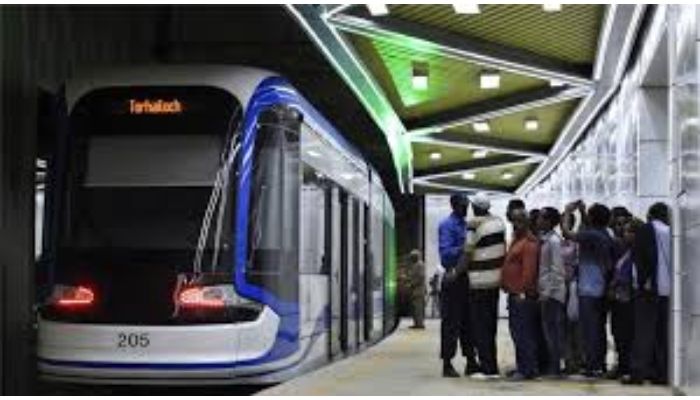
The standard-gauge rail line in Ethiopia will be officially inaugurated this week, stretches 470 miles from the capital, Addis Ababa, to the port of Djibouti, which handles 90 percent of the landlocked country’s trade and is its main window to the outside world. Seventy percent of the $3.4 billion project is financed by China’s Export-Import Bank, and it is one of the biggest of the mega-projects that Ethiopia says will transform its largely agricultural economy — once known for little more than famine and coffee — into East Africa’s manufacturing hub.
”Our economy is one of the fastest-growing economies in Africa and the world, so at the end of the day, when the train is connected to the port and transporting that much freight, . . . it will add value,” said Mekonnen Getachew, the railway’s project manager, speaking after a recent trial run for journalists .
Between 2005 and 2015, Ethiopia’s economy grew at an average rate of 10 percent a year, and the country took pride in its reputation as Africa’s latest success story. But that is starting to unravel, with the worst drought in 50 years halving the growth rate and widespread social unrest erupting in two of the country’s most populous regions. The drought’s effect has been so dire that the new railroad was pressed into service in November, before construction was even completed, to get emergency imports of wheat closer to famine-stricken areas.
An Ethiopian marathon runner alerted the world of his country’s internal problems at this year’s Olympics in Rio de Janeiro.

Without the train, Ethiopia’s imports and exports must travel between Djibouti and Addis Ababa on a winding, pitted road plied by more than 1,500 trucks daily, a trip that takes two days. When the railroad is fully operational, travel time for freight will be cut to just 12 hours — and 10 hours for the faster passenger trains.
The new line actually replaces a narrow-gauge railroad built by France starting in 1894, when it controlled Djibouti. The French left behind elegant, arcaded train stations, inscribed “Chemin de Fer Djibouto-Ethiopien,” in the heart of Addis Ababa and in the eastern city of Dire Dawa, but the line was largely defunct by the mid-2000s, a victim of war and neglect.
The century-old tracks can still be seen in places from the new train, but the Chinese elected to build all new stations. The palatial multistory buildings stand well outside cities and towns, suggesting that the new line will be used more for freight than for passengers.
The rail link to Djibouti will be just the beginning, the government says. Plans have been made for 1,500 more miles of track to criss-cross the country, including to its borders with Kenya, Sudan and South Sudan — all part of an African Union goal of once more uniting the continent by rail.

According to the China Global Investment tracker, Beijing has poured more than $20.6 billion into Ethiopia since 2005, much of it in low-interest loans to build infrastructure, such as roads, rail lines and telecommunication.
On the train, with its clean, blond-wood interiors, loudspeakers announce the stations in three languages: Amharic, English and Chinese. All the attendants are Chinese. For its first five years, the new railway will be managed by a Chinese company to allow time to train enough Ethiopians to take over running it.
The train line is a key part of the government’s strategy to industrialize the country by luring foreign investment — and the 70-mile trip last weekend between Addis Ababa and Adama attests to the plan’s success so far. From the window, the view includes not just traditional farms but also greenhouses marking the country’s burgeoning commercial flower industry and distant plumes of smoke from new factories.
SOURCE: WASHINGTON POST