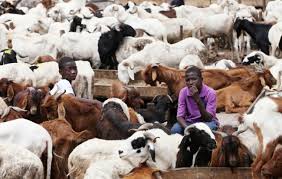
Ram sellers in Nigeria are groaning over what they describe as the lowest sales they have ever recorded at Eid-el-kabir celebrations as a result of the rise in the price of dollar, which has had a far reaching impact on Cfa, their currency of trade, BusinessDay findings show.
“The market is dull because rams are very expensive. We import rams from Niger Republic, Chad and Cameroon. We normally get about 300 to 350 for 1000Cfa, but today it is going for almost 600 to 750. The exchange rate is the main issue,” Hassan Idris, secretary general of Gbagada Lagos Ram Association, says.
Eid-el-Kabir, also called ‘sacrifice feast,’ is an annual festival widely celebrated on the 10th day of the Muslim lunar month of Dhul Hijja and characterised with the slaughtering of rams, but from findings, this year’s celebration is unusual due to the general level in the economy that has reduced disposable income of Nigerians.

BusinessDay survey in Lagos markets reveals that the turnout is very poor as retailers struggle to get the attention of few buyers who had made their way into the market.
“People are buying small. This time last year, I sold more than 20 rams, but all I have been able to sell is just seven rams,” Ibrahim Dmk, a ram retailer, says.
Even with his price, which is way below when compared with the other retailers, Ibrahim said the patronage is not encouraging.
“If I change my N1 million to Cfa I usually get 1,200,000Cfa, but as naira has come down, I now get between 850,000 to 900,000Cfa, that is why ram is very costly. I only added N5,000 to the price of my rams and my gain is N2,000, but customers are still saying there is no money to buy,” Ibrahim laments.
“The price of rams from the North is very high and the money to transport it from there has also gone up. After spending so much money to bring the rams down here, to see buyers is another problem. I sold more than 15 rams last year but I have not sold up to five rams this time,” Umaru Adamu, another ram retailer, complains.

A further survey shows that most rams had their prices increased significantly.
A ram that was between N45,000 to N50,000 last September, is now sold for N75,000. The sizes that was sold at N100,000 last year is now N120,000, N150,000 now N175,000, and N200,000 now N240,000.
Some Muslim faithful who spoke with BusinessDay say that irrespective of the present economic meltdown, the feast of sacrifice is what every devoted Muslim should partake in.
Ileyemi Olawale, secretary of a cooperative in his office, says they had to solicit for the help of their cooperatives because of the difficult times.
“We cannot afford the rams but not withstanding, we must buy it. Being a Muslim, Almighty Allah said we should use the ram for the sacrifice instead of killing ourselves.
“The ram sellers believe this is their time that is why the ram is expensive. Look at me now, we use to do contribution and we wanted to pay children’s school fees, which is why we the Muslims went to the cooperatives to assist us. That is why I’m buying up to 40 rams,” Olawale explains.
“Last year, I bought the big ram but this year, I am buying the small one because rams are very expensive and I cannot afford it. The one I bought for N40,000 last year, they say is N75,000. I will try and buy one ram today because of my wife and children are waiting for it at home. They will feel bad if my neighbour kill ram and I don’t,” Desoof Isaah, a Senegalese who resides in Oworoshoki area of Lagos State, says.
For Abdulazz Akinyemi, a real estate businessman, he is buying more rams than he did the previous year because he had this festivity, which comes once in a year planned months ahead.
“This is an annual ritual for the Muslims. It depends on individual planning. I planned for all these over three months ago as well as the children’s school fees this particular month. If you are someone that is saving towards a purpose at least you will be able to afford to buy rams this period no matter what,” Akinyemi says.
Findings also show that the prices of foodstuffs, which are in high demand during this festivity, have also gained their way up.
A visit to Mile 12 Market in Lagos shows that consumers are not shopping as the season demand.
As of Saturday, a basket of fresh tomatoes was sold at N9,000 against N5,500 sold a week ago, a basket of fresh pepper rose to N17,000 from N12,000, just as a 50kg bag of onions now goes for between N34,000 and N36,000, as against N18,000 sold a couple of weeks ago.
“The onions they are bringing in from Sokoto are not enough to feed the entire country, so we also import from Niger Republic, but because of the foreign exchange, no one is importing again. That is why onions are expensive now. We also import 15 to 20 trucks of fresh tomatoes carrying about 18 tons of baskets, which is about 460 baskets,” explains Biliya Adam, secretary of perishable goods section at Mile 12 Market.