Current happenings in Nigeria convey to us that the man on the street is desperately angry and wants a change. Just like the late gospel maestro, Sonny Okosun buttressed in his song, “a hungry man is an angry man.”
Over time, most of those who should have constituted the middle class, the working-class or what locals call the ‘average man’ have been deprived the gains of growth. They have had so much to grapple with in Nigeria such as income inequality, unmet expectations, poor state of the economy and their growing needs.
Interestingly, a new report from McKinsey Global Institute with the title ‘Poorer than their parents: Flat or Falling Incomes in Advanced Economies’ shows that the trend in stagnating or declining incomes for middle class workers is a global phenomenon, hunting workers even in affluent countries.
The study examined the prospects for over 800 million workers in 25 advanced countries and found that the younger generation is at a serious risk of ending up, even poorer than their parents.
All things considered, one would expect that as an economy grows, the paychecks of wage earners should also grow. But the opposite is the case as McKinsey’s report shows 65 to 70 percent of income earners saw their paychecks stagnate or decline between 2005 and 2014.
This is the situation in Nigeria. Many workers cannot recall the last time they were given a wage raise to match the rising inflation rate and increasing cost of living. In the past few weeks, inflation has risen to 16.4 percent in Nigeria, a 20 year high.
In affirming this wage stagnancy, a doctor who would rather remain anonymous disclosed, “I have practised for 3 years, but my account does not reflect it.”
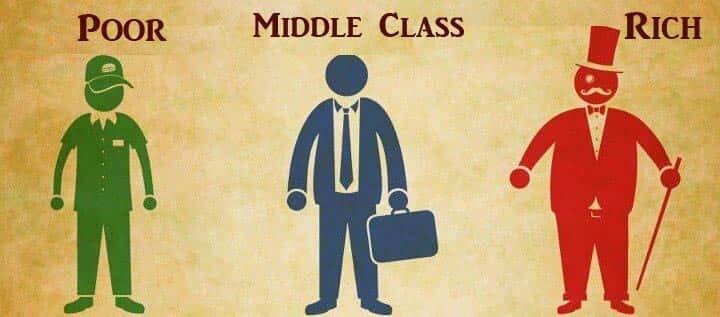
Who is the middle class?
The common measures of what constitutes middle class vary significantly among cultures. A sizable and healthy middle-class can be viewed as a characteristic of a healthy society.
The middle class can also be termed as a broad group of people in contemporary society who fall socio-economically between the working class and upper class.
The African Development Bank defines the middle class in Africa as people who spend the equivalent of $2 to $20 a day-to an assessment based on the average cost of living.
In his book, “Future of History”, Francis Fukuyama cited the importance of the middle class, suggesting that any government concerned about the sustainable development had to pay attention to what happens to this group.
Evangeline Wiles, the managing director, Kaymu Nigeria, once pointed to the West African country’s economic growth as leading to a strong increase in its middle class.
Wiles upheld that an economy without a mass group of these powerful consumers (the middle class), its foundation cannot be sustained in the long run.
All these point to the fact that the middle class is a national resource Nigeria cannot do without.
Regrettably, many working class Nigerians cannot meet their financial obligations due to the present recession that has affected and changed the lifestyle and spending patterns of this particular set of individuals.
Many of the people in this class have moved from highbrow areas to low cost areas because of the economic realities. In a telephone chat, Chucks Davies, an estate developer at Ikeja area, revealed “In the last few months, we have recorded a high rate of tenants moving from Ikeja to other areas, particularly Ibeju-Lekki area because the place is just developing, hence rents are cheaper and people can afford it.”
Money, of course provides the wherewithal for acquiring what is considered the traditional bedrocks of a middle-class: adequate health-care, a stable job, good schools for the children, affordable rent, and at least, a car.
The cart may also include a range of income depending on the location. Consumption was also once useful in defining the class but that is no longer tenable, as the economy obviously is playing a different tune. People who thought they were economically stable are now finding themselves, even poorer.
Stephen Awosika and Sydney Evans’ stories depict further what the typical middle class Nigerian is currently going through.
Sydney was leaving Abuja finally to relocate to Kano where his late father had left him a house and a small furniture business. Sydney is a graduate of Chemical Engineering and was laid off in May by the construction firm he was working with in Abuja. Survival has been very tough and the present economic crunch seems to have squeezed what was left out of every effort to make ends meet. He was planning on vacating his apartment, as he could no longer cope with the rise in rent.
Stephen himself had just taken a pay cut from the oil sector company he works with. The last contract the company executed was in the month of April. These days Stephen and his colleagues could stay for days in the office without lifting a file. It was getting really frustrating. So far, the management has sacked five of his colleagues.
He was asked to stay because he was the most senior engineer at the firm. Nonetheless, he knew his time was marked. Paying salaries was becoming a major challenge. He had been owed up to three months. In fact, as he lay on the doctor’s bed, he was thinking of where he was going to get money to treat whatever it was the doctor said was wrong with his back.
Getting home later, Stephen knew he had a decision to make. One of those was inevitable; he was leaving Abuja too. He will find treatment in his birth town, Ibadan.
The doctor had told him that he had neuropathic pain, which will require special treatment that could cost close to a million naira. “At this time! Where on earth will I get that kind of money? He thought out loudly.
In the words of the philosopher, Aristotle “Great then is the good fortune of a state in which the citizens have a moderate and sufficient property; for where some people possess much, and the others nothing… a tyranny may grow out of either extreme.
A wide swath of the middle class is in danger of being erased from the country’s demographic reckoning, even as Charles Soludo, the former Central Bank of Nigeria (CBN) Governor, has highlighted the need to bridge this wide gap in order to create inclusive growth in Nigeria.
Soludo says the country is creating two sets of Nigerians today- those who have enough to spare and those who are trapped in a vicious cycle of poverty. This, he emphasised, at the fourth ‘Progressive Governance Lecture Series in Kaduna on building the economy of states which was held on August 25.
At the moment, polarisation of the workforce and inequality is gradually hollowing out the middle-class in Nigeria. This raises urgent questions for policymakers.