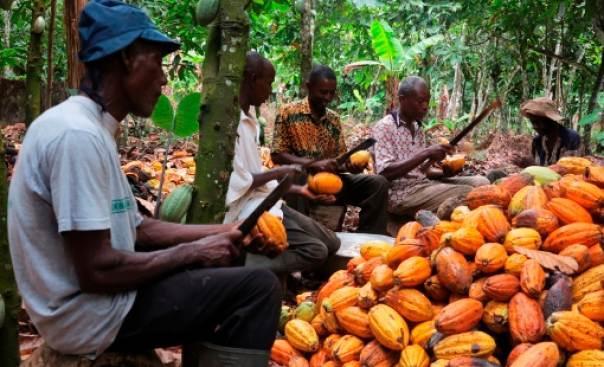
Nigeria’s cocoa industry is badly hurt by lack of investments that has seen many trees age without being replaced. It takes between four and five years for a cocoa tree to produce fruit, while the competitive productive tenure of the tree is between 10 and 15 years.
Furthermore, the average age of cocoa farmers in Nigeria today is 60 years, while most cocoa trees in the country are between 20 and 40 years,experts say.
Similarly, high input costs, poor weather, foreign exchange scarcity, and financial crisis remain obstacles to the sector, hurting output by 26 percent and export by 59 percent.
“There are no new investments taking place in the industry, and most of the cocoa trees are very old,” said Akin Olusuyi, chairman, Cocoa Processors Association of Nigeria (COPAN), in a telephone interview.

“Cocoa production has been declining for some time now, but the current rate is very high as a result of cumulative effects. The government needs to provide funds and attract young people into cocoa farming,” Olusuyi told BusinessDay.
Nigeria, the world’s fourth largest cocoa producer and supplier, saw the value of its global supply decline by 59 percent, from $666.4 million in 2014 to $270.7 million in 2015, according to Nigeria’s non-oil export data, compiled by Cobalt Services, and obtained by BusinessDay.
The country’s cocoa industry is currently plagued by low productivity of less than 0.350 tons per hectare. The country’s two cocoa harvests include the smaller midcrop from April to June, and the main crop from October to December. The midcrop normally accounts for about 30 percent of Nigeria’s cocoa output.
“The average age of a cocoa farmer in Nigeria today is 60 years. For a crop that is highly labour-intensive, 60 years will not give the maximum impact in the industry,” Sayima Rima, president, Cocoa Association of Nigeria, told BusinessDay.
At an event tagged ‘Back to Agriculture’ organised by the Centre for Values in Leadership (CVL) recently, Pat Utomi, a renowed economist and CEO of the organisation, said there was a need to make agriculture attractive to the youth through incentives.

Another challenge facing the sector is the crisis rocking the 65,000 capacity Multritrex Integrated, the country’s largest cocoa processor, which has cut industry production by over 26 percent, according to calculations.
Multritrex was shut down by the Asset Management Corporation of Nigeria (AMNCON) over a N5 billion debt. Company officials told BusinessDay that though the firm had been handed over to a new receivership, production was at a peripheral level.
“Since AMCON took over Multitrex Foods, nothing meaningful has been achieved. The best option is to work out a plan so that the business can continue,” Olusuyi said.
Poor weather has also been tagged as one key issue that has cut output. Bloomberg recently reported that Nigeria’s cocoa midcrop output could fall by as much as 70 percent this year from the previous season, after unfavorable weather took a toll on the crop earlier in 2016.
Speaking with BusinessDay, Hakkem Adebisi, a cocoa farmer in Ajebandele in Ondo State, said the late onset of rains in the early part of the year reduced output considerably.
“Farmers are still farming the same quantity as last year but the output now is very low, compared to last year. Owing to low output, the farm-gate price for a kilo of cocoa beans has increased by about 38 percent from between N550 and N650 per kilo in December, 2015 to N900 now,” said Adebisi.
Cocoa constituted 3.7 percent of the country’s total export in Q1, 2016 with N46.7billion ($153million) of the country total export of N1.3 trillion, according to the National Bureau of Statistics (NBS).
Failure to sustain and improve Nigeria’s production of cocoa over the years has led to its sharp decline and productivity at less than 0.350ton/hectare when other leading countries churn out between two and five tons per hectare of improved variety. The daily average price of cocoa beans by the International Cocoa Organisation (ICCO) is $3,050 per ton.
This challenge is further accentuated by lack of planting materials for cocoa, which is greatly affecting cultivation of new cocoa plantations in Nigeria.
“The production level of cocoa this year has declined due to some factors. Changing pattern of rainfall, temperature, high exchange rate, poor infrastructure and high interest rates are some of the challenges affecting cocoa output in the country currently,” said Malachy Akoroda, executive director, Cocoa Research Institute of Nigeria (CRIN).
Ranjana Bhattacharjee, senior researcher, International Institute of Tropical Agriculture (IITA), Ibadan, said the use of high quality planting materials in the right environment and management plus market demands must all be linked and developed to increase Nigeria’s cocoa yield.
“There is a need to develop more hybrid varieties,” Bhattacharjee said.