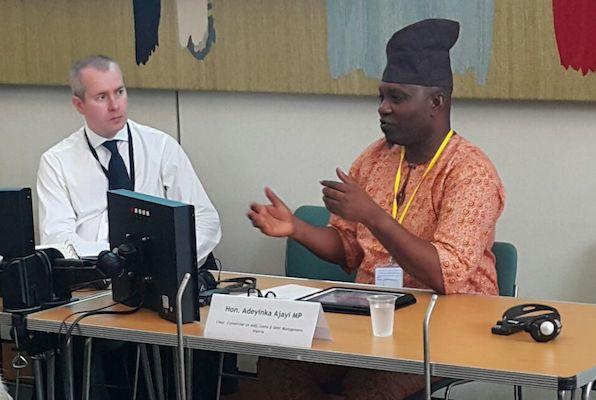
Adeyinka Ajayi, chairman, House of Representatives’ Committee on Aids, Loans and Debt Management, addressed delegates from Commonwealth Parliamentary Association UK (CPA UK) who represented 33 countries at the just concluded 6th Westminster Workshop with the theme: ‘Parliamentary financial oversight of aid effectiveness.’ Critical issues raised during the high level working breakfast with the OECD include how best to reduce tax evasion and avoidance, and the role of parliamentarians. KEHINDE AKINTOLA was there.
How best can a committee function?
The effectiveness of a parliamentary committee is also a function of its size. For a committee to be effective, the size must not be too large. A relatively small-sized committee made up of technically competent and long standing members has a higher chance of being effective.
Adequate funding: This obviously cannot be overemphasized. Adequate funding either from the national budget or from other sources such as development partners is needed for a committee to be effective. Situation where a committee is not adequately funded to carry out its responsibility carryover hire required hands by way of consultants and has to rely on the Executive or lobbyists before it can carry out its business will render the committee ineffective and may totally rob it of its independence through undue influence and or interference.
Integrity: The members of the Committee must not only possess but must also exhibit this quality so that the hunter will not become the hunted. I am sure in our different parliaments; we all can find example such cases. Accountability, openness and public access to Committee’s work also do have a positive impact on the effectiveness of committees.
What’s your personal experience and suggestions?
The best solution for Aid effectiveness is for aid to be brought into budget. National annual budget is an existing instrument which periodically brings together all sources of government revenue and framework for expenditure.
Bringing aid into budget will not only address key aid effectiveness issues; but will also reduce the negative impact of poorly-managed aid on the effective use of domestic resource.
Systematically, bringing all forms of aid into budget would mean that parliaments can use their existing powers of budgetary oversight to hold their Executives to account for the use of aid.
This practice is also in line with recent international commitments. The Paris declaration and the Accra agenda for action are clear in their resolve to report aid on budget and use country systems, in other words, the use of domestic systems for managing and implementing the budget throughout the budget circle.
Aid budget oversight
Oversight is clearly strengthened when aid funds are captured by donor and recipient parliaments as part of the budget approval process and monitored through normal parliamentary processes and mechanisms.
Oversight is further fortified when it is included as part of the processing of audit statements. Capturing aid funds in national budgets also improves the Executive’s ability to manage aid well-together with domestic resources as we saw in the example of the Ministry of Health in Liberia.
If aid funds are reflected in budget, integrated into strategic planning processes, and integrated into budget preparation. It will help the Parliament obtain good information on government expenditure; capacity to interrogate spending and results and due process in accessing relevant documents.
Given international commitment such as the Paris Declaration and the Accra Agenda for Action, partner country parliamentarians can take an increasingly active role in budget and aid management, by making sure that aid given to each country is listed within the budget of that country for the year of receipt.
Consequently, Parliamentarians individually and Parliaments as institutions would need to work in partnership with other institutions within their country and internationally to tap into public policy and aid management expertise by drawing on civil society organisations, research institutions and think tanks for support in harnessing bilateral and multilateral aid. On the African continent for example, parliament’s partners with Pan-African parliament, NEPAD, regional parliamentary bodies and national parliaments; effort should be made to reach out to civil society organisations in achieving the desired results.
How best can aids from Donor agencies be monitored?
In the spirit of the Paris declaration, compliance implies that donor agencies need to ensure that the aid they deliver is monitored and the aid mandate is complied with in line with the mandate of the stakeholders, furthermore development of a parliamentary voice in aid management donor, parliaments and agencies are encouraged to: publicly disclose regular, detailed and timely information on volume, allocation and available aid, results of development and expenditure to enable more accurate budgeting process, accounting and auditing by developing countries. With the result of its oversight functions donor parliaments should entail holding their aid agencies to account for the proper use of aid funds as well as their effective use for the achievement of the development results, with donor agencies implementation of the Paris Declaration and Accra Agenda for Action, this would entail ensuring that donor agencies, amongst others, help build capacity of partner country parliaments and provide regular, detailed and timely information on aid at the partner country level to partner country governments for inclusion on budget and on report.
Building effective partnerships, networks and joint mechanism of oversight between donor and partner country parliamentarian offers advantages for those on both sides of the aid equation.
Nigerian experience – Work in progress
in Nigeria, parliamentary oversight on aid spending has mostly been uncoordinated and often times left unattended to due mainly to the information gap between the Donors and the parliament. Until recently when the House of Representatives set up a Committee now known as Aid, Loans and Debt Management, little or no attention was paid to, let alone appreciate the significance and impact of Aid funds in national development by the National Assembly.
in Nigeria, parliamentary oversight on aid spending has mostly been uncoordinated and often times left unattended to due mainly to the information gap between the Donors and the parliament. Until recently when the House of Representatives set up a Committee now known as Aid, Loans and Debt Management, little or no attention was paid to, let alone appreciate the significance and impact of Aid funds in national development by the National Assembly.
The practice was to mostly leave the parliamentary standing committees which oversight line ministries to stumble on information concerning the receipt of budget support from Donor agencies. Usually the funds would either have been utilised or otherwise frittered away even before the line-Committees become aware of the information on the incidence of the aid.
There was also the issue of conflict of jurisdictions between another standing committee of the House of Representatives which is Committee on Donor agencies and civil societies. The jurisdictions of the two committees have now been streamlined and clearly defined in the 8th Assembly such that my committee now has full and direct mandate to oversight Aid funds with or without a loan component.
With the resolution of the Jurisdictional issue regarding the Committee and my subsequent emergence as the Chair, we have set out a work-plan which includes the following: develop capacity of the committee leadership and members; develop and equip a secretariat to provide required technical and administrative support; collate useful and vital information on all Donor agency activities using Line Committees as a resource partners, and establish contact and a significant line of communication between the Committee and Donor agencies and Parliaments in their respective countries of domicile.
Conclusion
The success of democracy in any nation depends on the vibrancy and efficiency of the legislature. For the legislature to meet the aspirations of the electorate, it must adopt creative ways of oiling its committee system, which has proven very effectual in carrying out background work as well as overt processes that make lawmaking possible and pleasurable.
Donor agencies should strive to ensure that Aid flows are captured in National Annual Budgets to enable respective Parliaments oversight over aid allocated to any Ministry Department or Agency of government.
The success of democracy in any nation depends on the vibrancy and efficiency of the legislature. For the legislature to meet the aspirations of the electorate, it must adopt creative ways of oiling its committee system, which has proven very effectual in carrying out background work as well as overt processes that make lawmaking possible and pleasurable.
Donor agencies should strive to ensure that Aid flows are captured in National Annual Budgets to enable respective Parliaments oversight over aid allocated to any Ministry Department or Agency of government.