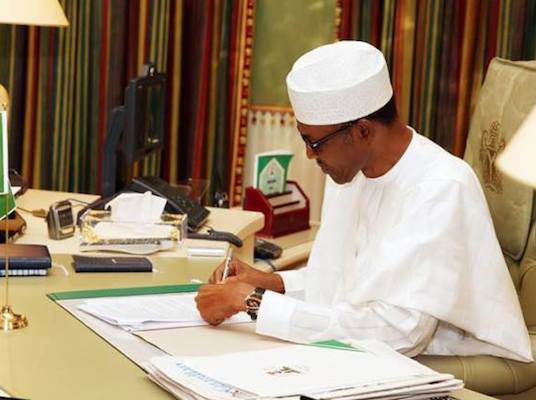
President Muhammadu Buhari’s delay in reconstituting the boards of agencies and parastatals, which he disbanded since July last year, is seen by many as hurting the country and further depressing Africa’s largest economy which is struggling to avoid recession.
Observers are particularly concerned that this situation, like many others in which the President has failed to take quick, decisive action is setting the ground for failure, with its adverse effects on the lives of citizens.
They further say that the tardiness and unnecessary delays which are becoming a virtue in governance, are rather festering the very corruption which government is out to tackle.
For instance, the non composition of the boards in some of the government parastatals and departments such as the National Electricity Regulatory Commission, (NERC), Pension Transitional Arrangement Directorate (PTAD), among others, is creating confusion and delays in implementation of some polices that would have impacted positively on the citizens.

This is considering that the boards of different agencies are saddled with various responsibilities, including major direction for the agencies, most of which are major financial decisions.
As contained in the enabling laws of parastatals, a minister is limited in approval of contracts and has to confer with the board for the award of contracts for certain amounts. This may however, limit the implementation of the 2016 budget in different agencies of government.
A constitutional lawyer, Mike Ozekhome, commenting on the delayed reconstitution of boards of Ministries Departments and Agencies (MDAs), said government must decisive and brisk to save a tottering economy.
According to Ozekhome, without the boards of these agencies in place, the machinery of government is at a standstill and may in effect set the pace for failure in the economy.
“Of course, it does,” he said, agreeing that the delay indeed affected the running of government.

“The machinery of government is at a standstill. It’s never been this bad. The government should put its act together and save our tottering economy. When you do not constitute boards which serve as the engine rooms that drive economic development, then the government has prepared very fertile ground for failure,” Ozekhome told BisinessDay in a telephone conversation.
Socio-economic watchers say the slowness in decision making is the trend for the Buhari-led government, looking at how long it took him to appoint his cabinet, for instance.
Buhari, only recently, through the Foreign Affairs Ministry, finally submitted a list of 47 ambassadors to the National Assembly, 11 months after he recalled non-career ambassadors.
Eze Onyekpere, lead director, Centre for Social Justice, agrees with Ozekhome’s position on the matter, specifically saying that the President’s delay in reconstituting boards of MDAs was a disservice to the nation, noting that this had become the trajectory of the incumbent government.
“The boards of MDAs are created by law with specific roles and tasks for the good governance of the MDAs. These include policy decisions, appointments, discipline, promotions and ensuring that the agency’s objectives are realised. If the boards were not important, the law would not have made provision for them.
“Therefore, it is a disservice to the nation for the President to vacate existing boards and fail, refuse and neglect to replace the boards with new appointees.
“Rather, it portrays the government as not ready to govern. Discerning Nigerians are not surprised because this is the pattern and trajectory of the current government from day one. Recall the time wasted in the appointment of ministers. Thus, this is the trend” Onyekpere told BusinessDay.
President Buhari had in November last year empowered a committee made up mostly officials of All Progressives Congress (APC) to work on positions in Federal Government boards, parastatals and agencies. The committee is chaired by the Secretary to Government of the Federation, Babachir Lawal.
However, eight months later, the committee seems to still be taking its time to come up with the list of nominees. APC national chairman, John Odigie-Oyegun, had told journalists penultimate week in Abuja, that the delay was largely due to the merger of some of the government ministries by the Buhari-led administration. Oyegun also talked of a possible merger of some of the boards, following the merger of federal ministries.
The President had before appointing ministers into his cabinet, cut down on the number of ministries from 42 to 24.
Already, names of 1,850 party members in 36 states and the Federal Capital Territory (FCT) have been submitted for consideration as members of boards of agencies, parastatals, and commissions of the Federal Government.
When contacted, media aides in the office of the Secretary to the Government of the Federation said they could not comment on how far the committee had gone, but insisted, “they are on the matter.”
Elizabeth Archibong