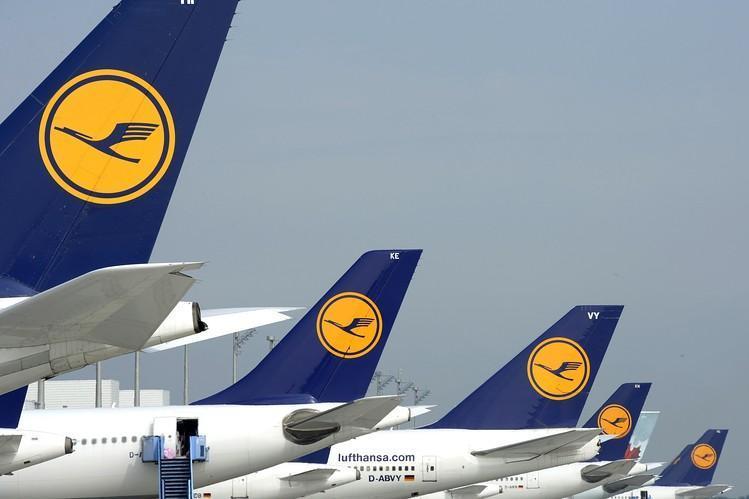
Despite the recent withdrawal of Iberia Airlines and United Airlines from Nigeria over the US$700 million stuck in the country, Deutsche Lufthansa AG sees prospects in the Nigerian economy, as it closely monitors its flights to the country.
The capital controls and unorthodox FX policies enacted by the Federal Government have continued to impact airline operators negatively as their funds trapped in Nigeria rose to $700 million in April from about $500 million in January.
The consequence of this is the restricted sales of cheap ticket classes in naira.
The German carrier’s commitment to Nigeria is coming after U.S. carrier, United Airlines halted flights to the country and Iberia of Spain stopped a route to Lagos, the commercial capital.

“We always take a very thorough and cautious approach. There will be no erratic decisions on our side. The size and magnitude of Nigeria as a market is so immense,” Claus Becker, Lufthansa’s managing director for sub-Saharan Africa, said in an interview on Monday.
Analysts in the aviation sector say that with a population of over 170million people and a GDP of over 13 percent and the Central Bank of Nigeria’s projections that this number will shoot up to 15 percent very soon, opportunity lies in the country’s economy.
BusinessDay checks reveal that the airline flies daily from Lagos to Germany and from Abuja to Germany with a load factor of 70 to 75 seats for each state.
Wole Shadare, a passenger who recently flew with the airline said Lufthansa has continued to have a good load factor despite the forex scarcity and the economic downturn in the country.
However, Nigeria owes airlines outstanding air fares to the tune of US$700 million as the oil-price slump depletes reserves of the U.S. currency and prompts the government to limit the amount of money that can be moved abroad.

The aviation industry awaits payment of about $700 million in outstanding air fares in the country which is struggling to cope with depleted U.S. currency reserves.
The International Air Transport Association (IATA) is in talks with the Nigerian government about the non-payment of fares and may reach a solution in the next few weeks, he said.
BusinessDay checks reveal that the decision by United Airlines to stop flying into Nigeria, its only route to Africa, like its Spanish counterpart, is due to the airline’s inability to repatriate to its home country, money from tickets sold in Nigeria.
Jonathan Guerin, United Airline spokesman, confirmed the planned pull out, saying that, “Repatriation has been a significant issue, as has been the downturn in the energy sector.”
John Ojikutu, Secretary-General, Aviation Round Table Initiative, told BusinessDay that with over $700million stuck in Nigeria, each of the 25 international airlines operating in the county has nothing less than S20 million dollars stuck in the country.
Ojikutu said this amount can affect the operations of these airlines and could cause more airlines to pull out of the country.
A travel agent who craved anonymity told BusinessDay that since the forex challenge, Virgin Atlantic, which often flies full load to various destinations, now travels a significant number of empty seats.
The source further observed that the flights have been reduced from five times to about three times weekly as a result of the biting forex policy.
The source warned that if the trend continues, most foreign airlines may have to pull out of Nigeria as Iberia airline did months ago.
The CBN’s increase in dollar sales in March and April is leading to external reserves haemorrhaging, thereby resulting in restricted sales of cheap ticket classes in naira.
Total forex sold by the CBN in April was $699m. The naira traded flat at N321/$ at the parallel market in April. The official/parallel corridor remained at 62%. This is sharply lower than the February figure of 101%.
Wole Shadare, an expert in the aviation sector says this development may result in fewer investments in the country’s aviation sector and loss of aviation jobs, as many airlines may be faced with the option of laying off staff since they are unable to pay overhead costs.
Ifeoma Okeke