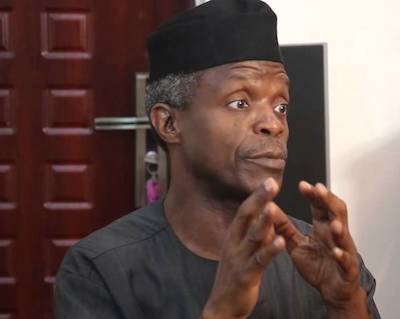
Nigeria needs a “substantial revaluation” of its foreign exchange policies, Vice President Yemi Osinbajo said on Wednesday, as Africa’s top oil producer and biggest economy faces dollar shortages and complaints from investors about capital controls that have brought the economy near comatose.
Osinbajo told a Lagos business conference he hoped to persuade the central bank (CBN) to change some polices to improve foreign exchange supply, Reuters reports.
“We believe there must be some substantial revaluation for the foreign exchange policy,” Osinbajo said, adding this would help boost foreign exchange supply, encourage capital import and a free flow of remittances.
Devaluation is said to be driven by the need to boost FDI or capital importation, ease remittances, export proceed inflows and ease interest rate pressure, with the aim of supporting the funding of the FX market for petrol importers.

Government yesterday commenced efforts toward full deregulation of the downstream oil sector, as fuel importation was deregulated, paving the way for free market activity in the sector.
The vice president who addressed the over 100 investors and corporate representatives at the 7th edition of the Rencap annual pan Africa 1:1 investor conference, also spoke on some key areas -quick deliverables in the budget that the government intends to focus on, including power, transportation-rail project,housing etc.
Bismarck Rewane, chief executive, Financcial Derivatives Company yesterday hailed government’s moves towards full deregulation of the downstream sector, but insisted that this be followed with devaluation of the embattled currency.
“We must follow this with naira adjustment to say around N230 to the USD and if this happens, we will begin to see the parallel market rates drop to around N255 as we inch towards equilibrium. So what will be required will be a minimal naira adjustment. A very good start,” Rewane said.
Some analysts said last night, that Osinbajo’s revelation is a welcome one, since president Buhari had refused to devalue, despite public outcry for it in the past few months.

Buhari’s challenge was said to be exemplified by the fuel crisis, considered by some analysts as the worst in living memory.
This is so because the nation’s refineries have been mismanaged for so long, compelling Nigeria to rely only on imports of fuel, a development Buhari had adduced for his reluctance to devalue the naira ,which has been fixed at an unrealistic level against the dollar, which does not fluctuate with Nigeria’s changing fortunes.
The resulting distortions have continued to create a gaping spread between parallel and official exchange rates that encourages the very corruption Buhari has vowed to stop.
Although the analysts see this as a tough choice, given the tougher political environment, they agree that Nigerians are becoming impatient for the gains they voted for and have little appetite for further pain.
Without investment, they further argue, the country will neither grow nor diversify from its crippling dependency on oil.
This is because no investor will put money into an economy at one exchange rate, knowing that to take it out again might require losing a third of its dollar value.
The president, they argue, wants to eliminate the wasteful patronage on which the elites have thrived, and create an economy more dynamic in creating jobs for the masses. These are laudable long-term aims for which his government has yet to articulate a convincing strategy and expectations are higher even as one year of the life of this administration is gone without most of promises delivered.
“No economy can survive without fuel, electricity or foreign exchange,” an analyst said last night.
John Omachonu, with agency reports