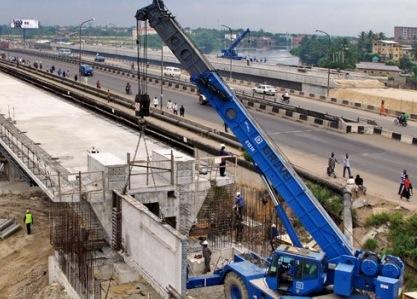
The continued delay in the passage of the 2016 budget caused by the disagreement between the executive and the legislatures over irregularities is increasingly undermining the growth of Nigeria’s construction industry as Julius Berger Plc got squeezed on the back of slow construction activities.
For the first three months through March 2016, Julius Berger’s net income fell by 75 percent to N251.26 million from N1.03 billion as at March 2015.
Sales were down by 34 percent as the company’s operation gets hit by economic slowdown that hindered it from embarking on projects in the pipeline.
Analysts say had the budget being passed earlier, construction activities would have picked and companies operating in the industry would have had revenue on an upward trajectory.

The record budget was delayed after the executive alleged in January that the document contained several mistakes and discrepancies.
Buhari presented a record N6.1 trillion ($30.6 billion) spending plan on Dec. 22, saying expenditure needed to increase about 20 percent from 2015 to stimulate the economy of Africa’s biggest oil producer, which has been hammered by the slump in crude prices.
Growth fell to 2.8 percent last year, the slowest pace since 1999.
Analysts opined that the budget stimulus would increase capital expenditure spending and hence trickle down to the top lines of construction firms and other companies that deal in building material.
As a result of the aforementioned challenges, Julius Berger’s net margin, a measure of profitability and efficiency fell to less than 1 percent in 2016 from 2.36 percent in 2015.

The construction company wasn’t efficient in managing direct costs attributable to projects as gross profit dropped by 28.15 percent to N7.17 billion in the period under review as against N9.98 billion as at March 2015.
Julius Berger’s asset turnover, reduced to 0.28x in 2016 from 0.34x in 2015. A lower ratio implies that the company is generating less revenue per dollar of assets. Since there no cash flows to purchase plats and equipments, total assets dropped 21.60 percent.
Julius Berger’s cost of sales reduced by 35.76 percent to N21.52 billion in the period under review while administrative expenses reduced by 53.84 percent to N3.72 billion.
There is a glimmer of hope for companies in the industry as the 2016 budget will be approved by the president this week after much delay.
Such passage will help kick start construction activities and also make cash flow available to Julius Berger to settle some of the debt owed to banks.
Julius Berger’s finance costs increased by 2732 percent to N3.17 billion.
The company’s share price closed at N43.60 on the floor of the floor of the exchange while market capitalization was N56.76 billion.