Eight years after the immediate past government of Lagos State, took the bull by the horn, and moved in the state task force on environmental and other special offences, to clear Oshodi of its many years of accumulated filth, giving it some touch of modernity, in an exploit largely applauded by the generality of the populace, the new administration of Governor Akinwunmi Ambode seems determined to accomplish whatever may have been left undone by the previous.
Although there had been back and forth discussions on this agenda since the administration came on board in May 2015, the signal became clearer on Monday, January 3, 2016 when Steve Ayorinde, the state commissioner for Information and Strategy, issued a statement that there was no receding on the planned transformation of the entire loop in Oshodi, stretching towards the popular PWD bus stop on Agege Motor Road.
A major component of the planned transformation, according to the Ambode led government, will be the redevelopment of the about forty-year-old Owonifari Market at Oshodi, into an ultra modern bus terminus that befits the status of a mega-city that Lagos is. The project, government said would commence this year as the design is ready. According to Ayorinde, the site the market is situated is contrary to the Lagos master plan which earmarked that area for a terminus.
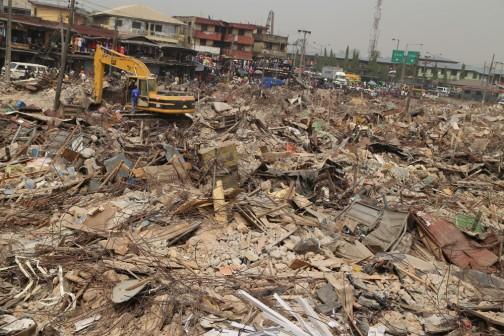
By the wee hours of Tuesday, before traders could resume at the market, bulldozers had begun work. Hours later, the entire shops within the market had been reduced to rubble. Government was swift and calculative, but the action left the traders devastated, with their means of livelihood filtered away.

The traders are angry, describing the government’s action as insensitive, brutal, callous and undemocratic. They claimed they were never given enough notice to be able to evacuate the wares.
“What government would throw its citizens into this level of hardship at the beginning of the year when families are trying to recoup having expended much to mark the Christmas and the New Year festivities? Is this what we voted for? Asked Ebenezer Achum, who claimed he had been selling in the market for seven years before Tuesday’s demolition.
“I have to start all over again at my age. It is frustrating, said Achum who was seen on Thursday salvaging broken pieces of what looked like electronic gadgets from the rubble.
Halimah Dosu, a trader who was met on Wednesday, a day after the shops were brought down, said she had been trading in the market for 20 years, and that the development has left her in the cold
Although she admitted the knowledge of plans by the state government to relocate the affected traders to Isopakowodowo Market not too far from the demolished site, she said aside the prohibitive cost of renting a shop in the alternative proposed by the government, the Isopakowodowo Market would not accommodate the dislodged traders.

She also lamented the high cost of another alternative market, the Arena, opposite the popular Bolade bus stop on Agege Motor road, saying following the demolition of Awonifari Market, the developers of the Area shopping complex have marked up their annual rent with a shop now going for N300,000. “What are we selling to pay N300,000 per annum? She queried.
But amid the controversy and rage, the state government said it acted responsibly and that no trader lost any valuable asset to the demolition which it claimed was carried in the best interest of the residents of Lagos. According to the government officials, the market was demolished in order to transform the state to a model Afican megacity and will therefore not be blackmailed.
At an inter-ministerial briefing involving Steve Ayorinde, commissioner for Information & Strategy; Wasiu Anifowoshe, physical planning and urban development; Babatunde Adejare, environment; Muslim Folami, local government and community affairs, on Thursday, the government restated the resolve to go ahead with the redevelopment of the area and turn it into a beautiful terminus that competes with the best around the world.
The officials said the issue had been on for about ten years and throughout this period, the government had engaged the leadership of the market and sensitised them on the need to relocate the market.
“For 10 years, there has been back-and-forth engagement between the state government and the leadership of the market. But in the last three years, the leadership of the market has refused to relocate. The last administration built Isopakodowo Market close to Bolade and not far from the main Oshodi. Isopakodowo Market has almost 600 shops without counting the K-clamps, which will accommodate over 1,000 traders at the market.
“Satisfied that we have provided a befitting alternative, we started another round of engagement with the leadership of the market. Ultimately, Governor Akinwunmi Ambode appealed through the commissioner for Local Government and Community Affairs to invite the leadership of the market to the executive council meeting.
He explained that the leadership of the market met with the Governor Ambode on December 16, 2015 at the EXCO Chamber where, according to him, the governor again pleaded with the traders and reiterated his plan to transform Oshodi.
“He asked them to relocate to Isopakodowo Market, which had been ready by that time. A few of them expressed certain misgivings. But largely, they agreed to relocate. We all agreed that discussion should continue, particularly on how much to pay for each shop at Isopakodowo Market.
“After that, Governor Ambode went on a tour of the area in company of some members of the State Executive Council. We had a meeting with the leadership of the market. Based on the proposition from their leadership, they said they were willing to pay N5, 000 for each shop.
“There is no market in Lagos or anywhere in Nigeria where N5, 000 will be paid for a shop in month. But the governor agreed with them. After this, we served them quit notice from the loop where they have been. As a result, a good number of the traders packed their wares before the market was demolished.
Steve further explained the prompt demolition o the market following the expiration of the seven days given the traders was equally informed by intelligence report that there was a bunker in the market.
“We got intelligence report that a lot of criminal activities were going there. The report that untoward activities were happening there necessitated that the state should move to safeguard lives and properties. It was meant to ensure that there was no breach of public order. That was what led to the demolition exercise that took place on Tuesday evening.”
The commissioner explained that the intention of the government was not to destroy any goods, noting that goods were not destroyed because almost all of them had moved out.
“As a government, we cannot be blackmailed because we have done everything humanly possible to avoid undue destruction of properties. The hallmark of this government is compassion. The intention was not to make life unbearable for the traders. We believe strongly that the Isopakodowo Market alternative that we have provided is very ideal.
“What we have done is in public interest. The aim of the government is to ensure that the area conforms with the type of image we want for Lagos; restore sanity to Oshodi; beautify the market; construct the world class bus terminus and ensure that people who use that place enjoy what it means to go to market in a megacity.
“We also believe the exercise will largely reduce the gridlocks associated with the area. It will reduce the criminalities that are rampant around Oshodi. What we have done is in the interest of the generality of Lagos residents. There was nothing hidden about what we did. There was no casualty. There was nothing untoward about our discussion with them. They all agreed to relocate,” said Ayorinde.
Obinna Nwosu, the public relations officer of the demolished market executive, said the leadership was still studying the proposal by the government to move them to the alternative being provided.
JOSHUA BASSEY