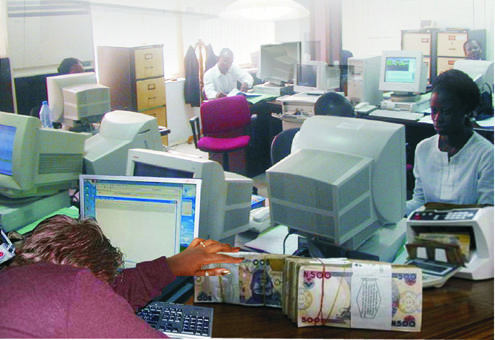
As the New Year ushers in deposit money banks’ (DMBs) zero Commission on Turnover (COT) regime, some analysts say this would have a huge negative impact on their non-interest income.
This is because banks had relied heavily on the sources which are usually not regulated by law, as a major part of their income streams, particularly given the regulatory headwinds and high operating cost due to decayed infrastructure.
The banks non interest income is mainly from service and penalty charges, as well as from asset sales and property leasing.
Unlike interest income, this is largely unaffected by economic and financial market cycles and is usually not controlled by law or regulation.

The Central Bank of Nigeria (CBN) had introduced a gradual phase out of COT from N3 per mile in 2013, to N2 per mile in 2014, N1 per mile in 2015 and zero COT in 2016.
Consequently, bank operators and analysts are of the view that 2016 will remain a tough year, as banks asset quality and earnings are expected to come under continued pressure.
However, analysts expect cost containment and technology innovations aimed at boosting efficiency and productivity to be the main investment objective for banks going forward.
According to a the top Nigerian banker who does not want to be named, traditional branch banking will be on the decline and lower cost operators such as Microfinance banks and agency banking will begin to fill the void where commercial banks are unable to go because of their high cost structure.
“Everyone is watching the foreign exchange policy and rightly so, as this will determine many things,” he added.

“ We expect the CBN’s policy demand management to continue, whilst we also look for the harmonisation between parallel market and official rates, in order to improve supply of Forex into the official markets”, the banker said.
Chukwuka Monye, director-general, Delta State Economic Summit Group, said that in 2016, banks would have to seek out new ways to raise or at least sustain their profit levels,as the CBN insists on fixing the naira at its current rate, despite slowing economic growth, reduced foreign exchange earnings, dwindling oil prices, depleting external reserves and increasing inflationary pressures.
On the other hand, the banking sector operators have decried the huge impact of illiquidity and non-availability of foreign exchange on revenues deposit growth and asset quality.
Low oil prices have continued to fuel turbulence in the foreign exchange market and a bearish situation in the stock market, as investors continue to divest their portfolios away from the Nigerian market.
“The year 2015 was a very challenging year, with much of the effects of the challenges still spilling into 2016”, another banker who craved anonymity told BusinessDay.
The source however said there is greater seriousness and commitment to diversifying the economy, adding that loosening of monetary policy which started very late in the year, is a positive for loan growth but a negative on interest margins for the industry.
Boladeola Agbola, executive director, Cashcraft Asset Management Limited, observed that the dwindling fortunes of the nation as crude oil prices declined from about $50per barrel in January to about $37 in December, impacted negatively on business activities, and most especially access of banks to foreign exchange.
Banks could not open letters of credit for their clients as they use to because there is no foreign exchange to back it up which means reduced income for the industry .Credit to clients also shrank as the economic growth slows down .
Agbola said the implementation of the Treasury Single Account policy during the year, effectively reduced government borrowing. This led to a crash in treasury bills rates and loss of spread by banks.
As the economy weakens, credit collection became seriously hampered, which implies possible escalation in loans loss provisioning for the banks, as they close their accounts for the year.
“Overall, it is doubtful if the banks might have had a good year. The year 2016 may be likewise challenging, given the outlook of the crude oil market which might deteriorate further.”