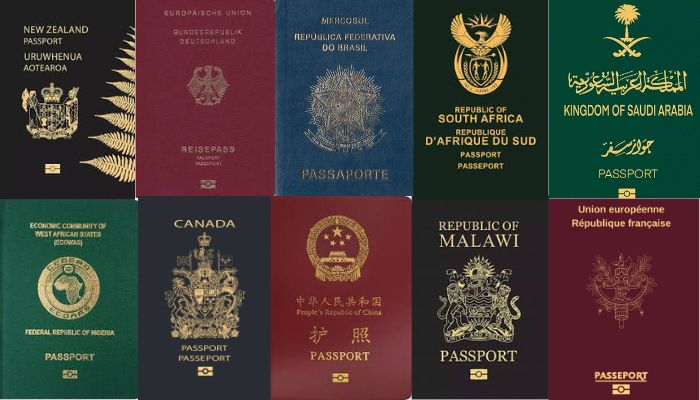
We continue the journey with no one talking with me. But I stay busy writing down my experiences and reviewing the pictures taken with extreme carefulness or else my iPad will be seized by border security men on discovering that I am taking pictures. I guess their fear is being caught collecting illegal fees from supposedly free citizens of ECOWAS.
About 30 minutes into the Togo-Ghana border at Aflao, the rain starts falling and forces our driver to slow down to about 80 kilometres per hour. However, we get to the border by 5:15pm. The Aflao border is clean, simple building, less busy (probably because of the rain) and few crossing barriers.
Yet, our bus conductor pays for the stamping of the passports. As usual, I trail behind him with my passport to sort myself. “Hello my Nigerian friend, we will stamp your passport but you will give us something for kola,” a dark Ghanaian immigration officer says. I almost fall in love with his politeness, but caution prevails and keeps me on guard.
I smile hand over my passport and wait while he stamps it. After stamping he extends the passport to me, but another officer swiftly collects it and starts looking at it from page to page. At this point, the bus conductor takes the stamped passports and leaves, saying, “Accra is 45 minutes from here. With 70 Cedi, you can find your way.”

That singular action encourages the immigration officer to hold unto my passport, hoping that I will play ball. He later asks: “How much do you have?” “I do not have Cedi,” I answer. “But you have Naira. Bring N1,000, I will change it over there,” he says, pointing outside the office.
“I paid for my hotel online. The money with me is for feeding and transport within Accra,” he gets angry on hearing that and tells the other officer to give me my passport and send me back to where I am coming from. The officer obeys.
As I walk towards the Togolese side of the border, a foreigner in his early 30s beckons on me to come join him in ‘no man’s land.’ I get closer and discovers he is also in my shoes, but he is at a point neither Togolese or Ghanaian securities can confront him. I am joining him, but miss taking pictures because that will worsen our case, he advises.
After about 15 minutes on the neutral ground, a beautiful Ghanaian officer approaches and beckons on us to follow her. “Damn, she is beautiful,” James, my temporary friend from Australia, enthuses. But truly, the lady is beautiful, especially if you like them curvy.
“Hello sirs, you can proceed on your journey. We are sorry for the delay,” she says. That is still polite, but I keep wondering if it is because of the Australian. Now in Ghana, I did not mind looking for our bus because I already have my carry-on bag with me since the threat of leaving me behind at the Benin Republic-Togo border.

I walk a distance to get some snacks and soft drink having eaten nothing till now, apart from the half-cook rice and a slice of meat serve in the bus as complementary to our fare.
While munching the snacks, the conductor appears, saying that he is coming from the security post to ask after me, but a white guy points to this direction. “Thanks James,” I say to my own hearing.
“Please, let’s go. You are just lucky that we are refuelling and some are refreshing,” the conductor says. I did not say anything but stand and follow him.
But I am disappointed on getting into the bus, many of the passengers suddenly become friendly and voice out how much they spend on the road. Then I discover that certain loads attract heavy bribes at all the borders. “We cannot continue like this, how can you spend a quarter of the value of your goods on bribing security, how do they expect us to make profit,” a middle-aged man voices out.
I smile and the man notices my smile. “I love your guts, it is just that I have four big loads else I will insist on not paying any money like you,” he says. Are your goods contraband or genuine, I ask. “Whether contraband or genuine, you must pay or your goods will not cross the border. They can offload them and ask other passengers that comply to go and leave, and your loads behind,” he laments.
From there, the bus scene becomes more jovial until we get to Accra and disperse to our various locations. “Heh! Please tell me, who are you. You are very lucky because I have seen immigration detain some stubborn people like you for days in some borders. Go thank your God, you are lucky,” he says, showing concern.
“When are you returning,” I ask him. “No. Do not join me back to Lagos. Go and fly Arik Air, nobody will disturb you there,” he advises. On getting to my hotel room and try some calculations, I discover the huge amount in Naira, CFA Franc and Cedi security personnel make illegally at the West African borders, despite ECOWAS Protocol on free movement across its borders. Roughly, over $1 million is illegal made every day at the borders.
For instance, my bus sits 54 passengers and three buses leave the station everyday to Accra, totalling about 150 passengers who all pay N1,000 each before adding money to settled security for their loads.
I see about five luxury buses from different transport companies at the borders. The mini luxury buses, especially18-seaters double the fleet number on that route because of their speed advantage. There are other commercial drivers that use different salon cars and lots of private car owners that cross the border every day.
If about 5,000 people pass each border post and pay N1,000, that means they contribute about N5 million illegally to the border officials. Same amount is paid by people coming back through those borders that same day, meaning about N10 million daily that has no receipt.
Besides the breach of the treaty on free movement signed by their governments, the corruption at these borders makes it easy for arms to be easily transported as long as money will change hands. This is a further threat to the fight against insurgency in some West African countries, especially Nigeria.
Yet, illicit drugs, contraband goods and human trafficking still thrive across these borders because the officials are after the colour and weight of what greases their palms.
Well, these confirm the unwholesome handshakes at the borders, which governments lack will power to fight and hence pay lip services to. Of course, security officials take advantage of these lapses to live large, while crime thrives and genuine businesses and tourism suffer.
However, my return-leg experience is not different. It is just repetition of similar occurrences that speak volume of corruption across the West African borders.
OBINNA EMELIKE