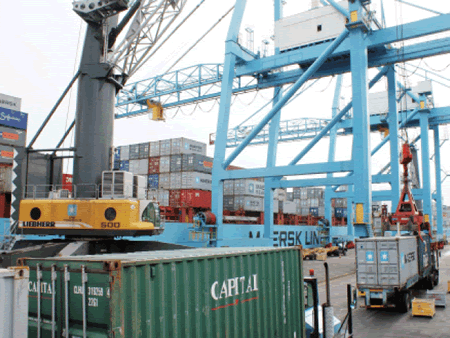
Nigerian seaports have recorded over N15 billion loss of revenue to the three-day warning strike embarked on by workers in the nation’s maritime sector.
This has resulted to the consequential pile-up of un-offloaded vessels and none evacuated containers from ports in the past three days, analysts have said.
Analysts fear that unless averted the economy will be severely hurt as governments, private sector players and port operators risk further loss of billions of naira, especially this time of the year when increase in volume of cargoes is expected ahead of the Christmas and new year celebrations.
According to the analysts, a prolonged strike will pressure port users and Nigerian importers to divert their goods to nearby Cotonou port in Benin Republic, and this will not only deny the government income, but also create jobs for the economy of Benin Republic at the expense of Nigerians.

BusinessDay search reveals that the Federal Government rakes in billions of naira daily from the ports while Lagos State gets its fair through the implementation of the “wharf landing” fee introduced by the former governor, Babatunde Fashola, which requires every 40-footer container leaving any of the ports in Lagos to pay N1,000.
The three-day warning strike, which started Thursday last week, will likely be relaxed today (Monday) to allow the Federal Government and the various agencies involved in ports operations, including Nigerian Ports Authority, take action, disclosed Nted Emmanuel, president-general, Maritime Union Workers of Nigeria (MWUN), who spoke with our correspondent.
“The economy will lose heavily to the strike as it is estimated that agents, government, importers and operators lost over N5 billion daily to lack of port operations, which will likely amounts to N15 billion in the whole of three days,” said Tony Anakebe, a maritime analyst.
The implication of the strike, he said, is that a lot of ships that are on the high sea will not be able to berth and the Federal Government will be forced to pay demurrage to those shipping lines that are delayed on the sea.
He further noted that apart from lack of operations in the marine side, that terminal operator and the Nigeria Customs Service (NCS) would not be able to work, meaning that there would not be any physical examination taking place at the port.

“At the end of the strike, the importer would be forced to pay demurrage to shipping companies and storage to terminal operators for late clearance of consignment due to the strike. The masses will be the ultimate losers as the importer will take the extra cost to the end user of the imported commodities,” Anakebe said.
Emma Nwabunwanne, an importer, who expressed grief that the importers, who were the owners of the un-cleared, would bear a huge loss resulting from the storage and demurrage charges, which they would be mandated to pay to terminal operators and shipping companies for not taking delivery of their consignment as of when due. The loss would be passed unto the end users by way of hike in market price of imported goods, he said.
According to him, the strike will have enormous impact, especially in the area of cargo clearance processing owing to the fact that it is the dockworkers that offload containers and take them to the examination bay and the scanning site for Customs to inspect, and these operations will be halted within these three days.
He called on the workers and the authorities involved to come to agreement, even as he suggested that both parties should have discussion to resolve all the outstanding issues for port business to go on. He further called for onward transfer of incoming cargoes to bounded terminals to decongest Apapa port.
The strike is meant to protest unpaid wages of tally clerks and onboard security men by the NPA for nine months.
According to Nted, the union had five different meetings with the management of NPA during which the Federal Ministry of Transport advised the NPA to offset the arrears.
“But unfortunately, nothing has been done, and we are asking who is committing this illegality? Over 3,000 tally clerks and onboard security men are affected by the non-payment of the salaries,” he said.
On the use of foreigners on board foreign vessels for midstream discharge as against the engagement of registered dockworkers, Nted noted that it was illegal and against the Nigeria Maritime Administration and Safety Agency (NIMASA) Act, which stipulates that stevedoring services (loading /offloading of vessels in our ports, jetties terminal – on and offshore operations must be handled exclusively by registered dockworkers only.
“This has been going on a long and we have brought the attention of NPA management to it to no avail. We believe some officials of NPA are conniving with some operators to breach the law for personal gains,” Nted said.
JOSHUA BASSEY & AMAKA ANAGOR-EWUZIE