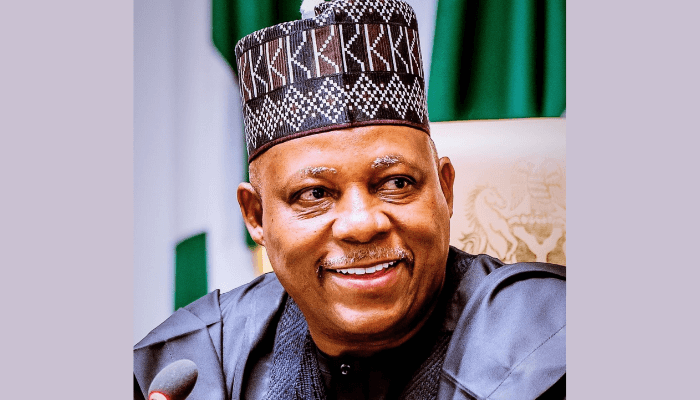
The ruling All Progressives Congress (APC) is faced with fresh controversies over Vice President Kashim Shettima ahead of the 2027 general elections.
Speaker of the Borno State House of Assembly, Abdulkarim Lawan, on Monday, protested the exclusion of Shettima’s photograph from a banner displayed at an All Progressives Congress (APC) event in the North-East.
The banner, which portrayed key party leaders in the region, featured President Bola Tinubu, the five APC governors from the North East and the party’s National Legal Adviser, but conspicuously omitted Shettima, who hails from Borno State.
Read also: 2027: Kwankwaso dangles between APC, ADC

Lawan described the omission as unfair and provocative, particularly as the event was taking place in Maiduguri, the vice-president’s home State. He warned that such actions risk reopening old wounds within the party.
The Speaker recalled a similar incident at a North East APC stakeholders’ meeting in Gombe in June last year, which degenerated into chaos after party officials endorsed President Tinubu for a second term without acknowledging Shettima.
BusinessDay reports that at that meeting, the APC National Vice-Chairman (North East), Mustapha Saliu, had declared Tinubu the party’s unopposed candidate for the 2027 Presidential election but failed to mention Shettima.
The omission triggered outrage among delegates, leading to shouting, disruptions and threats of violence, forcing security operatives to escort Saliu out of the venue.
Although the Deputy National Chairman Bukar Dalori later attempted to calm tensions by endorsing both Tinubu and Shettima for a second term, the crowd remained restive.

The situation worsened when Abdullahi Umar Ganduje, APC National Chairman, also endorsed only Tinubu in his address, reigniting tensions and prompting his swift exit from the hall.
The latest development comes amid persistent rumours about Shettima’s standing within the presidency. However, the Presidency had on April 19, 2025, formally denied reports claiming the vice-president was being sidelined or denied access to the Presidential Villa, describing them as “deliberate falsehoods.”
Addressing the gathering in Maiduguri, the Borno Speaker, Lawan said, “This was exactly what caused the fracas in Gombe, and now it is repeating itself here in Borno. I don’t understand the motive of the organisers, but it is not right.
“How can you exclude the picture of a sitting vice president, who is from Borno and the North East, at an event held in his hometown?” he queried.
His remarks drew loud applause from the audience, echoing widespread disapproval of the omission.
Read also: Rivers’ APC describes impeachment as legislative coup
BusinessDay reports that governors and other APC stakeholders were in Maiduguri for the North East zonal public hearing on the proposed amendment of the party’s constitution.
There are fears that President Tinubu might pick another person as his running mate for the 2027 race, following his political trajectory.
But reacting to the controversy, Bala Ibrahim, APC National Director of Publicity, dismissed speculations surrounding the office of the Vice President as unnecessary and mischievous.
Speaking with BusinessDay in a telephone interview, Ibrahim described the debate as an overhyped distraction deliberately aimed at creating tension within the Presidency.
“You don’t talk about crossing a river before you get to the bridge. This speculation about the position of the Vice President is exaggerated and laced with mischief, intended to trigger a rift in the Presidency,” he said.
He stressed that the Nigerian Constitution recognises a single Presidency, noting that the office of the Vice President exists primarily to provide constitutional cover in the event the President is unable to perform his duties.
“There is one Presidency. The Vice President comes into play only when the principal is not available. Yet, mischief makers always want to drag the Vice President into every discussion about the President,” Ibrahim said.
He further argued that there was no basis for claims of marginalisation, pointing out that the Vice President has never publicly complained about being sidelined or excluded from governance.
“At no point has the Vice President said he is being dropped, sidelined or not carried along. It is troublemakers who are creating a storm in a teacup,” he added.
Ibrahim urged political actors and commentators to exercise restraint, warning against unnecessary agitation over positions that are not currently under consideration.
“For God’s sake, let sleeping dogs lie. Let us not dance against the rhythm of the drum until the appropriate time,” he said.
He also recalled that during the last election cycle, the President initially contested without a running mate, introducing the concept of a “placeholder” (vice presidential candidate), without generating similar controversy.
“Why is it a problem now?” he asked, insisting that the present debate is misplaced and unwarranted.
Concerns being voiced in some political circles about Vice President Kashim Shettima’s future on the 2027 ticket are often framed against President Tinubu’s record with his deputies during his eight years as governor of Lagos State between 1999 and 2007.
Read also: Confusion in Kano as Kwankwaso denies backing Kano Gov defection to APC
Over the course of two terms, Tinubu worked with three different deputy governors, a pattern critics argue could offer clues, though not definitive answers, about how power dynamics within his administrations tend to evolve.
Tinubu’s first deputy, Kofoworola Bucknor, was elected with him in 1999 on the platform of the Alliance for Democracy (AD). Their relationship, however, soon deteriorated.
Bucknor accused Tinubu of sidelining her from the core business of governance, alleging that key decisions were taken without her input and that her role had been reduced to a largely ceremonial one.
Tensions deepened in the build-up to the 2003 elections amid reports that Bucknor harboured governorship ambitions, placing her on a collision course with Tinubu, who was seeking a second term. The Lagos State House of Assembly initiated impeachment proceedings against her in 2002, prompting her resignation under intense political pressure.
Tinubu subsequently picked Femi Pedro as his running mate for the 2003 election, which they won. Yet the uneasy pattern resurfaced towards the end of Tinubu’s second term. Pedro expressed interest in contesting the 2007 governorship election, a move that directly challenged Tinubu’s succession plan.
Tinubu had already anointed Babatunde Raji Fashola, his Chief of Staff, as his preferred successor and urged other aspirants to step aside. Pedro declined, defected to another party to pursue his ambition, and resigned as deputy governor after impeachment proceedings were initiated against him.
In the final stretch of his administration, Tinubu appointed Abiodun Ogunleye as deputy governor. Ogunleye served quietly until May 29, 2007, when Tinubu handed over power to Fashola, who won the election and effectively consolidated Tinubu’s political succession strategy in Lagos.
Beyond Lagos, Nigeria’s presidential history since 1979 suggests a strong tradition of continuity in vice-presidential pairings.
In 1999, President Olusegun Obasanjo (South West) and Vice President Atiku Abubakar (North East) were elected on the PDP platform and re-elected in 2003, despite deepening disagreements that later followed Obasanjo’s failed third-term agenda. Both men completed their tenure in 2007.
Similarly, Umaru Musa Yar’Adua (North West) and Goodluck Jonathan (South South) had won the 2007 election together. After Yar’Adua’s death in 2010, Jonathan assumed the presidency and selected Namadi Sambo (North West) as vice-president.
The Jonathan–Sambo ticket won in 2011 and served until 2015, when they lost re-election to Muhammadu Buhari and Yemi Osinbajo.
Buhari and Osinbajo won elections in 2015 and 2019 and completed two full terms, reinforcing the norm of stable presidential pairings.
Recall that President Shehu Shagari (North West), elected in 1979 and re-elected in 1983 under the NPN, had retained Dr Alex Ekwueme (South East) as vice president throughout his tenure until their government was overthrown by a military coup.
Against this historical backdrop, analysts say Tinubu’s 2023 victory alongside Shettima places their administration firmly within a long-standing tradition of joint tickets being retained for a second term.
With nearly three years of their first term completed, political convention, and precedence suggest continuity in 2027, even though speculation persists in some quarters.