Africa’s football economy is entering a decisive phase as the continent’s governing body restructures its flagship tournaments to stabilise revenues, deepen commercial partnerships and attract global broadcasters.
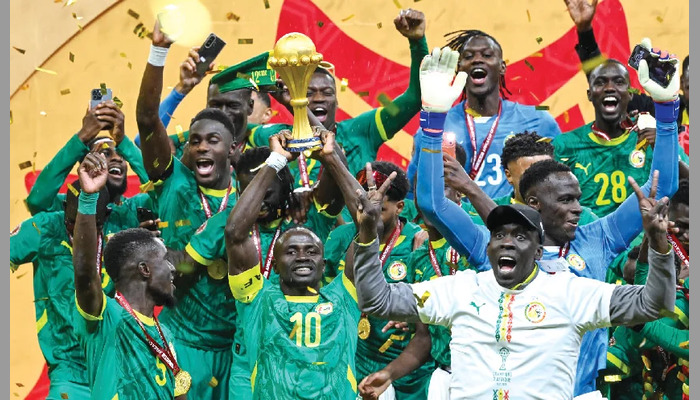
The Africa Cup of Nations (AFCON), which concluded on Sunday with Senegal lifting the trophy after a tense 1–0 extra-time win over hosts Morocco, has become the most commercially successful tournament in the competition’s history, according to the Confederation of African Football (CAF). Commercial revenue from the tournament has risen by 90 per cent compared with previous editions, a surge CAF attributes to an expanded sponsor base and wider media distribution.
The growth underscores why CAF’s recent decision to overhaul its tournament calendar has drawn intense attention from broadcasters and investors alike. In December, CAF announced it would move AFCON from a biennial to a four-year cycle by 2028, a shift designed to increase the tournament’s scarcity and commercial value. To offset the longer gap, the governing body will introduce a new annual competition, the African Nations League (ANL), from 2029.
AFCON is the financial backbone of African football. The 2023 tournament in Côte d’Ivoire generated a record $72m profit, while the Morocco 2025 edition was forecast to deliver $193m in total revenue, including roughly $47m from media rights and $126m from sponsorships. CAF has said the tournament could contribute as much as $114m in net profit, making it the most lucrative AFCON on record.

Much of the commercial growth has come from sponsors. The number of official partners has increased sharply, from nine during the 2021 tournament to 17 in 2023 and 23 for the most recent edition. CAF says the expansion reflects both the entry of new global brands and the retention of existing partners, many of whom see AFCON as offering strong returns despite Africa’s fragmented media markets.
The commercial momentum has helped CAF return to profitability. The organisation reported a net profit of $9.48m for the 2023–24 financial year, its first surplus in several years, following a period marked by governance turmoil and the collapse of a $1bn, 12-year broadcast agreement with France’s Lagardère that was annulled by an Egyptian court in 2019.
The shift to a four-year AFCON cycle is widely seen as an attempt to strengthen CAF’s hand in future broadcast negotiations once its current deal with US-based IMG expires after the Morocco tournament. Analysts argue that making AFCON less frequent could lift rights values, particularly if CAF avoids calendar clashes with the European Championship.
“CAF depends on AFCON in a way UEFA does not depend on the Euros,” said Imran Otieno, managing editor of African sports publication Mozzart Sport. “Reducing frequency creates scarcity. The African Nations League is designed to fill the commercial gap in off years and provide broadcasters with regular content.”
African football’s media revenues remain modest by global standards. UEFA currently earns about $3.9bn a year from broadcast rights for its club competitions and is targeting as much as $5.8bn annually in its next cycle. CAF’s total media income is a fraction of that figure, constrained by lower advertising yields and uneven infrastructure across the continent.

Consumption patterns are also shifting. Research by African sports analytics firm Africa Scores shows that 41 per cent of African football fans primarily consume content on mobile devices, slightly more than the 40 per cent who watch on television. That trend is pushing CAF to rethink how rights packages are structured, with greater emphasis on digital, highlights and short-form content.
Streaming platforms are already testing the waters. Netflix, which has expanded into live sports in the US and Europe, launched a daily highlights show for AFCON 2025, signalling the potential entry of global streamers into future CAF rights deals.
On the pitch, the Morocco final illustrated both AFCON’s emotional pull and its growing global visibility. Senegal’s victory came after a controversial temporary walkout over a disputed penalty decision, before former Liverpool forward Sadio Mané urged his teammates to return and complete the match. The incident briefly overshadowed the final but also highlighted the intensity that continues to make AFCON a valuable broadcast property.
CAF president Patrice Motsepe, elected in 2021 on a promise to commercialise African football, has defended the reforms as necessary for long-term sustainability. Critics, including several national team coaches, argue the changes favour European clubs at the expense of African football culture.
For CAF, the challenge is to convert record commercial momentum into durable media value, without diluting the identity of a tournament that remains the continent’s most powerful sporting asset.